Understanding Genetic Mutations: Causes, Types, and Effects
Fundamentals of Genetic Mutations
What Are Genetic Mutations?
Genetic mutations refer to alterations in the sequence of DNA base pairs within an organism's genome. These changes can occur spontaneously during DNA replication or be induced by environmental influences such as ultraviolet radiation. Mutations may affect the proteins synthesized by the DNA, potentially altering an organism's traits. While many mutations are corrected by cellular repair mechanisms, some become permanent and heritable.
In biological terms, a mutation is a sudden, inheritable change in an organism's characteristics. Individuals exhibiting such changes are often called mutants. Most mutations tend to be recessive, meaning their effects may not be immediately visible unless inherited from both parents.
Example Problem
A certain organism has a DNA sequence segment: ATCGGTA. During replication, a mutation changes the third base from C to T. What is the new sequence, and how might this affect the protein produced?
Solution:
The original sequence: ATCGGTA
After mutation: ATTGGTA
This single base substitution may alter the codon and potentially change the amino acid during protein synthesis, possibly affecting the protein's function. The exact impact depends on the codon affected and the resulting amino acid change.
Varieties and Classification of Mutations
Types of Genetic Mutations
Mutations can be broadly categorized based on their nature and location. They include gene mutations, which involve changes in the nucleotide sequence of a single gene, and chromosomal mutations, which affect larger segments or entire chromosomes. Gene mutations can be substitutions, insertions, or deletions of base pairs.
Additionally, mutations are classified as somatic or germline. Somatic mutations occur in body cells and are not passed to offspring, whereas germline mutations occur in reproductive cells and can be inherited by future generations.
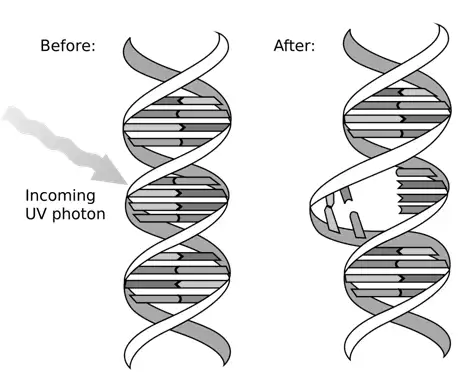
Diagram showing the process of DNA mutation
Example Problem
A gene sequence originally reads GGA TCC AAG. A deletion mutation removes the second base in the second codon. Write the new sequence and explain the possible consequence.
Solution:
Original codons: GGA | TCC | AAG
Deletion of second base in second codon (TCC): removes 'C', new sequence: GGA | CC AAG
This causes a frameshift mutation, altering the reading frame and potentially changing all subsequent amino acids, which can severely affect protein function.
Origins and Triggers of Mutations
Internal and External Causes
Mutations arise from both internal cellular processes and external environmental factors. Internally, errors during DNA replication can introduce changes in the genetic code. These replication mistakes, although rare, contribute to genetic diversity and evolution.
Externally, exposure to mutagens such as ultraviolet light, certain chemicals, and radiation can damage DNA. For example, UV radiation can cause thymine bases to form dimers, disrupting normal base pairing and leading to mutations.
Example Problem
During DNA replication, a base is incorrectly paired due to UV exposure, causing a thymine dimer. Explain how this mutation might affect the DNA and the organism.
Solution:
Thymine dimers cause adjacent thymine bases to bond abnormally, distorting the DNA helix. This can block replication or transcription, potentially leading to cell malfunction or death. If unrepaired, it may result in permanent mutations affecting the organism's traits.
Consequences and Significance of Mutations
Impact on Organisms and Evolution
Mutations can have a range of effects, from neutral to harmful or beneficial. Somatic mutations affect only the individual and are not inherited, while germline mutations can be passed to offspring, influencing evolution.
Beneficial mutations may produce new protein variants that help organisms adapt to environmental changes, driving evolutionary processes. For instance, some bacterial mutations confer antibiotic resistance, enhancing survival.
Conversely, mutations can cause genetic disorders or diseases such as cancer, when mutations disrupt genes controlling cell division.
Example Problem
A mutation in the gene coding for hemoglobin causes red blood cells to become sickle-shaped. Explain how this mutation can be both harmful and beneficial.
Solution:
The sickle shape impairs oxygen transport, causing sickle cell anemia, a harmful genetic disorder.
However, individuals with this mutation have increased resistance to malaria, providing a survival advantage in malaria-endemic regions.
Quick Reference: Summary of Genetic Mutations
Aspect | Description | Example |
|---|---|---|
Definition | Permanent change in DNA sequence | Base substitution, insertion, deletion |
Types | Gene mutations, chromosomal mutations, somatic, germline | Frameshift, point mutation |
Causes | Replication errors, UV radiation, chemicals | Thymine dimer formation |
Effects | Neutral, beneficial (evolution), harmful (disease) | Sickle cell anemia, cancer |
Inheritance | Germline mutations passed to offspring | Inherited genetic disorders |
Glossary of Key Terms
Term | Meaning |
|---|---|
Mutation | A change in the DNA sequence of an organism |
Gene Mutation | Alteration in the nucleotide sequence of a single gene |
Chromosomal Mutation | Changes affecting large segments or entire chromosomes |
Somatic Mutation | Mutation occurring in body cells, not inherited |
Germline Mutation | Mutation in reproductive cells, heritable |
Mutagen | Agent that causes mutations (e.g., UV light, chemicals) |
Thymine Dimer | Abnormal bonding between adjacent thymine bases caused by UV |
Frameshift Mutation | Insertion or deletion altering the reading frame of DNA |
Allele | Different versions of a gene |
Phenotype | Observable traits of an organism |
Frequently Asked Questions
What is the definition of mutation in biology?
Mutation is a permanent alteration in the DNA sequence of a cell, which may or may not affect the organism's traits.
Can you explain gene mutation with examples?
Gene mutations are changes in the DNA sequence of a gene. Examples include sickle cell disease caused by a single base substitution and cystic fibrosis resulting from deletions in a gene.
What causes DNA mutations?
Mutations can result from errors during DNA replication or exposure to mutagens like UV radiation and chemicals.
How do mutations contribute to genetic diversity?
Mutations introduce new alleles into a population, increasing genetic variation and enabling adaptation through natural selection.
Are all mutations harmful?
No, some mutations are neutral or beneficial, aiding in evolution and adaptation, while others can cause diseases.