Comprehensive Overview of Enzymes: Structure, Function, and Activity
Fundamentals of Enzymes and Their Biological Significance
Understanding Enzymes and Their Role in Life Processes
Enzymes are specialized biological molecules, primarily proteins, that accelerate chemical reactions essential for life. They act as catalysts, enabling metabolic pathways such as respiration, digestion, and excretion to proceed efficiently. Each enzyme interacts with specific molecules called substrates, transforming them into products vital for cellular functions.
While most enzymes are protein-based, some RNA molecules known as ribozymes also exhibit catalytic properties. Enzymes are ubiquitous, present in all tissues and bodily fluids, orchestrating reactions that maintain homeostasis and respond to cellular signals.
Example: Consider the enzyme lactase, which catalyzes the breakdown of lactose into glucose and galactose. Without lactase, lactose digestion is impaired, leading to intolerance symptoms.
Structural Characteristics and Classification of Enzymes
Architecture and Functional Grouping of Enzymes
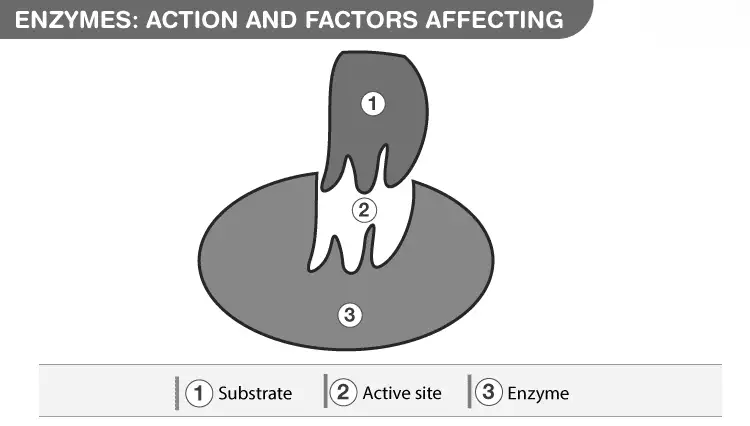
Enzymes are composed of amino acid chains folded into intricate three-dimensional shapes. This conformation determines their catalytic activity and substrate specificity. The active site, a specialized region formed by the enzyme's folding, binds substrates and facilitates the reaction.
Enzymes vary greatly in size, from small proteins with a few dozen amino acids to large complexes with thousands. The active site typically involves only a small portion of the enzyme's structure.
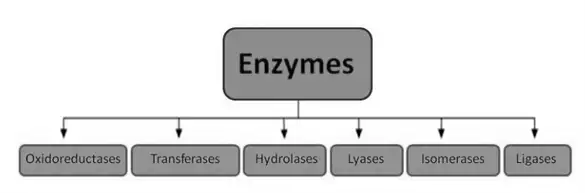
Functional Classes of Enzymes
According to the International Union of Biochemistry, enzymes are categorized into six main classes based on the reactions they catalyze:
Oxidoreductases: Facilitate oxidation-reduction reactions, e.g., pyruvate dehydrogenase.
Transferases: Transfer functional groups between molecules, e.g., transaminases.
Hydrolases: Catalyze bond cleavage via hydrolysis, e.g., pepsin.
Lyases: Break bonds without hydrolysis or oxidation, e.g., aldolase.
Isomerases: Rearrange molecular structures within a molecule, e.g., phosphoglucomutase.
Ligases: Join two molecules together, e.g., DNA ligase.
Many enzymes require non-protein helpers called cofactors, which include prosthetic groups tightly bound to enzymes, coenzymes that transiently associate during catalysis, and metal ions essential for activity.
Example: NAD (nicotinamide adenine dinucleotide) acts as a coenzyme in redox reactions, temporarily accepting electrons during metabolic processes.
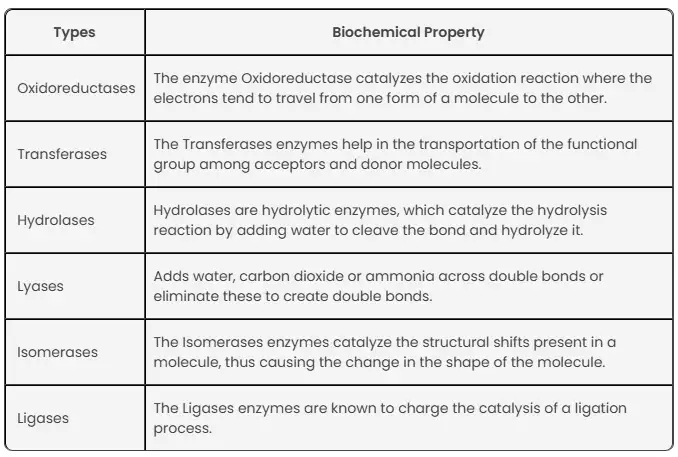
Table listing six types of enzymes with their biochemical properties explained.
Mechanisms of Enzyme Action and Substrate Interaction
How Enzymes Facilitate Chemical Transformations
For a chemical reaction to proceed, reactant molecules must collide with sufficient energy and proper orientation to overcome the activation energy barrier. Enzymes lower this barrier by binding substrates at their active sites, forming enzyme-substrate complexes that stabilize transition states.
The interaction between enzyme and substrate is often explained by the induced-fit model, where substrate binding induces conformational changes in the enzyme, enhancing catalytic efficiency.
Enzymes employ various catalytic strategies, including bond strain, covalent catalysis, acid-base catalysis, and proximity effects, to accelerate reactions.
\[ \begin{array}{l} \text{Reactant}_1 + \text{Reactant}_2 \rightarrow \text{Product} \\ \text{Reactant}_1 + \text{Enzyme} \rightarrow \text{Intermediate} \\ \text{Intermediate} + \text{Reactant}_2 \rightarrow \text{Product} + \text{Enzyme} \end{array} \]
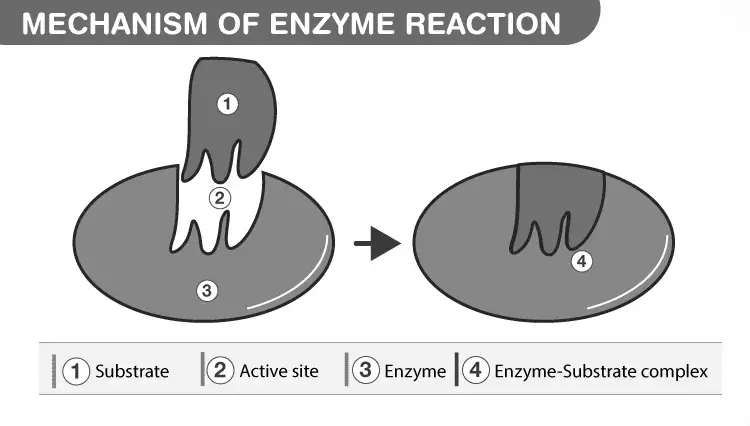
Schematic of Enzyme Catalysis
Example: In the hydrolysis of a peptide bond by a serine protease, the enzyme forms a covalent intermediate with the substrate, facilitating bond cleavage.
Enzyme Activity: Dynamics, Influencing Factors, and Biological Roles
Understanding Enzyme Function and Conditions Affecting Their Efficiency
Enzymes operate by forming transient complexes with substrates, converting them into products while remaining unchanged themselves. The catalytic cycle involves substrate binding, transition state formation, product release, and enzyme regeneration.
\[ E + S \rightarrow [ES] \rightarrow [EP] \rightarrow E + P \]
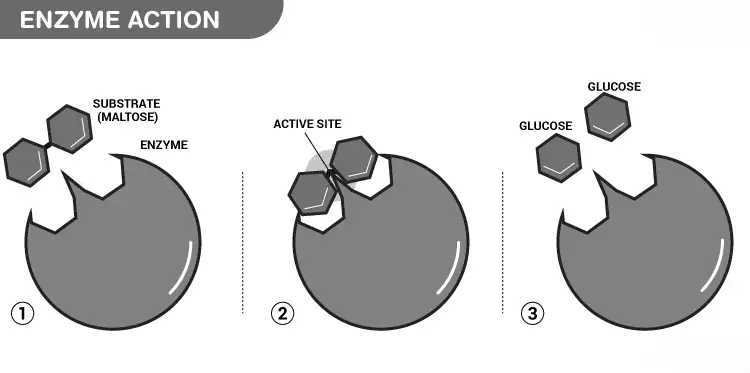
Enzyme-Substrate Interaction and Product Formation
Several factors influence enzyme activity:
Temperature: Activity increases with temperature up to an optimum (usually around 35–40°C for human enzymes), beyond which denaturation reduces function.
pH: Each enzyme has an optimal pH range (commonly near neutral); deviations alter ionic states of amino acids, affecting catalysis.
Substrate Concentration: Enzyme activity rises with substrate concentration until saturation, where all active sites are occupied.
Inhibitors: Molecules that bind active sites or allosteric sites can reduce enzyme activity; competitive inhibitors resemble substrates.
Salt Concentration: Changes in ionic strength can disrupt enzyme structure and function by affecting electrostatic interactions.
Effect of Temperature and pH on Enzyme Activity
Example: An enzyme with an optimum pH of 7 shows reduced activity at pH 4 due to protonation changes in its active site residues.
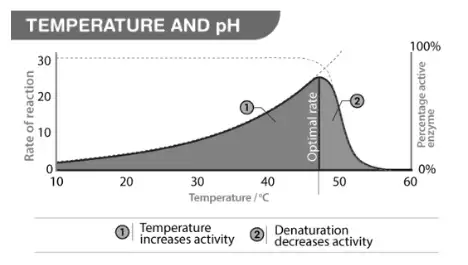
Illustration shows a graph illustrating how temperature affects enzyme activity and rate of reaction.
Practical Applications and Examples of Enzymes in Daily Life
Enzymes in Food, Medicine, and Industry
Enzymes play crucial roles beyond cellular metabolism, impacting food production, pharmaceuticals, and biotechnology.
In food processing, yeast enzymes ferment sugars to produce bread and alcoholic beverages. For instance, yeast fermentation releases carbon dioxide, causing bread to rise and develop texture.
In medicine, enzyme inhibitors serve as drugs to regulate enzyme activity, treating diseases by targeting specific enzymes.
Example: Aspirin inhibits cyclooxygenase enzymes, reducing inflammation and pain by blocking prostaglandin synthesis.
Summary Table: Key Points on Enzymes
Aspect | Details |
|---|---|
Definition | Biological catalysts, mostly proteins, accelerating biochemical reactions |
Structure | Polypeptide chains folded into 3D shapes with active sites |
Classification | Six classes: Oxidoreductases, Transferases, Hydrolases, Lyases, Isomerases, Ligases |
Cofactors | Non-protein helpers: prosthetic groups, coenzymes, metal ions |
Mechanism | Substrate binding, transition state stabilization, product formation |
Factors Affecting Activity | Temperature, pH, substrate concentration, inhibitors, salt concentration |
Biological Roles | Metabolism, signal transduction, energy production, molecular transport |
Glossary of Essential Enzyme Terms
Term | Meaning |
|---|---|
Active Site | Region on enzyme where substrate binds and reaction occurs |
Substrate | The molecule upon which an enzyme acts |
Cofactor | Non-protein molecule required for enzyme activity |
Coenzyme | A type of cofactor that binds temporarily during catalysis |
Denaturation | Loss of enzyme's 3D structure and function due to external factors |
Enzyme-Substrate Complex | Temporary complex formed when substrate binds enzyme |
Induced Fit Model | Model describing enzyme conformational change upon substrate binding |
Inhibitor | Substance that decreases enzyme activity by binding to enzyme |
Oxidoreductase | Enzyme class catalyzing oxidation-reduction reactions |
Ligase | Enzyme class that joins two molecules together |
Frequently Asked Questions About Enzymes
Which enzyme is not a protein?
Ribozymes are RNA molecules that act as enzymes and are not proteins.
How are enzymes defined?
Enzymes are biological catalysts that speed up chemical reactions without being consumed.
What does the induced fit theory explain?
It describes how enzyme shape changes upon substrate binding to enhance catalysis.
Can you name some enzymes found in plants?
Examples include amylase, catalase, and peroxidase, which aid in digestion and protection.
Are enzymes considered polymers?
Yes, most enzymes are proteins, which are polymers of amino acids.