Comprehensive Overview of Share Capital and Its Classifications
Understanding the Concept and Varieties of Share Capital
Essence and Purpose of Share Capital
Share capital represents the funds a company raises by issuing shares to investors. This capital forms the financial backbone that supports the company’s operations and growth initiatives. When a company issues new shares, its share capital correspondingly increases, reflecting the infusion of fresh resources.
There are two primary categories of share capital: equity share capital and preference share capital. Equity share capital is generated by selling ordinary shares to investors, granting them ownership rights and voting privileges. Preference share capital, on the other hand, arises from issuing preference shares, which typically provide fixed dividends and priority over equity shares in asset distribution.
Example Problem
A startup company issues 15,000 equity shares at a face value of ₹10 each and 5,000 preference shares at ₹100 each. Calculate the total share capital raised by the company.
Solution:
Equity share capital = Number of equity shares × Face value per share
\[ 15,000 \times 10 = 150,000 \text{ ₹} \]
Preference share capital = Number of preference shares × Face value per share
\[ 5,000 \times 100 = 500,000 \text{ ₹} \]
Total share capital = Equity share capital + Preference share capital
\[ 150,000 + 500,000 = 650,000 \text{ ₹} \]
Thus, the company has raised ₹650,000 through share capital.
Visualizing the Categories of Share Capital
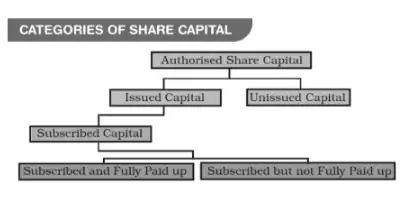
The image is a flowchart showing different categories of share capital. Step-by-step explanation: 1. Share capital starts with "Authorised Share Capital," the total amount a company can issue. 2. It splits into "Issued Capital" (shares actually given out) and "Unissued Capital" (shares not yet given). 3. "Issued Capital" breaks down into "Subscribed Capital," which are shares investors agreed to buy. 4. "Subscribed Capital" divides into two types: "Subscribed and Fully Paid up" (investors paid all money) and "Subscribed but not Fully Paid up" (investors have not paid all yet).
Detailed Classification of Share Capital from an Accounting Perspective
Authorised Capital: The Legal Limit
Authorised capital, also known as registered or nominal capital, is the maximum amount of share capital a company is legally permitted to issue as specified in its Memorandum of Association. The company cannot exceed this limit without following the prescribed legal procedures to alter it. Importantly, the entire authorised capital need not be issued immediately; the company may issue shares in stages based on its financial requirements.
Example Problem
A company has an authorised capital of ₹2,000,000 divided into shares of ₹10 each. If the company has issued shares worth ₹1,200,000, calculate the unissued capital.
Solution:
Total authorised shares = \(\frac{2,000,000}{10} = 200,000\) shares
Issued shares = \(\frac{1,200,000}{10} = 120,000\) shares
Unissued shares = Total authorised shares - Issued shares
\[ 200,000 - 120,000 = 80,000 \text{ shares} \]
Unissued capital = Unissued shares × Face value per share
\[ 80,000 \times 10 = 800,000 \text{ ₹} \]
Therefore, the unissued capital amounts to ₹800,000.
Issued Capital: Shares Offered to Investors
Issued capital refers to the portion of authorised capital that the company has actually offered to the public or investors for subscription. This includes shares allotted to promoters and other stakeholders. The remaining authorised capital that has not been offered is termed unissued capital.
Example Problem
A company’s authorised capital is ₹5,000,000, but it has issued shares worth ₹3,500,000. What is the value of unissued capital?
Solution:
Unissued capital = Authorised capital - Issued capital
\[ 5,000,000 - 3,500,000 = 1,500,000 \text{ ₹} \]
Hence, the unissued capital is ₹1,500,000.
Subscribed Capital: Shares Accepted by Investors
Subscribed capital is the portion of issued capital that investors have agreed to purchase. It represents the actual commitment from shareholders to invest in the company. Sometimes, the subscribed capital may be less than the issued capital if some shares remain unsubscribed.
Example Problem
A company issues shares worth ₹4,000,000, but investors subscribe to shares worth ₹3,600,000. Calculate the unsubscribed capital.
Solution:
Unsubscribed capital = Issued capital - Subscribed capital
\[ 4,000,000 - 3,600,000 = 400,000 \text{ ₹} \]
Therefore, ₹400,000 worth of shares remain unsubscribed.
Called-up Capital: Amount Requested from Shareholders
Called-up capital is the portion of subscribed capital that the company has requested shareholders to pay. It may be less than or equal to the subscribed capital, depending on the payment schedule. Shareholders are obligated to pay the called-up amount within the stipulated time.
Example Problem
A company has a subscribed capital of ₹2,500,000 but has called up ₹2,000,000 from shareholders. How much capital is yet to be called up?
Solution:
Uncalled capital = Subscribed capital - Called-up capital
\[ 2,500,000 - 2,000,000 = 500,000 \text{ ₹} \]
Thus, ₹500,000 is yet to be called up from shareholders.
Paid-up Capital: Actual Funds Received
Paid-up capital is the amount of called-up capital that shareholders have actually paid to the company. It reflects the real inflow of funds and is recorded in the company’s financial statements.
Example Problem
If a company has called up ₹1,800,000 from shareholders but has received ₹1,700,000, calculate the unpaid amount.
Solution:
Unpaid capital = Called-up capital - Paid-up capital
\[ 1,800,000 - 1,700,000 = 100,000 \text{ ₹} \]
Therefore, ₹100,000 is still unpaid by shareholders.
Summary Table for Quick Revision
Term | Definition | Key Feature |
|---|---|---|
Authorised Capital | Maximum capital a company can issue as per its Memorandum | Legal limit; can be increased or decreased by law |
Issued Capital | Portion of authorised capital offered to investors | Shares circulated for subscription |
Subscribed Capital | Part of issued capital accepted by investors | Actual commitment from shareholders |
Called-up Capital | Amount requested by company from shareholders | Payment demanded on subscribed shares |
Paid-up Capital | Amount actually received from shareholders | Reflects real inflow of funds |
Equity Share Capital | Capital raised by issuing ordinary shares | Ownership rights and voting power |
Preference Share Capital | Capital raised by issuing preference shares | Fixed dividends and priority in assets |
Glossary of Key Terms Related to Share Capital
Term | Meaning |
|---|---|
Authorised Capital | The maximum share capital a company can legally issue |
Issued Capital | Shares offered to the public from authorised capital |
Subscribed Capital | Shares that investors have agreed to buy |
Called-up Capital | Amount requested by the company from shareholders |
Paid-up Capital | Amount actually received from shareholders |
Equity Shares | Ordinary shares conferring ownership and voting rights |
Preference Shares | Shares with fixed dividends and priority in payments |
Unissued Capital | Portion of authorised capital not yet issued |
Face Value | Nominal value of a share as stated on the certificate |
Memorandum of Association | Legal document defining company’s objectives and capital |
Frequently Asked Questions on Share Capital
What is the difference between authorised and issued capital?
Authorised capital is the maximum capital a company can issue legally, while issued capital is the portion of authorised capital actually offered to investors.
Can a company issue shares beyond its authorised capital?
No, a company cannot issue shares exceeding its authorised capital unless it amends its Memorandum of Association following legal procedures.
What does paid-up capital signify in a company’s finances?
Paid-up capital represents the actual amount of money received from shareholders for shares issued and called up.
How does preference share capital differ from equity share capital?
Preference shares provide fixed dividends and priority in asset distribution, whereas equity shares offer ownership rights and voting privileges.
Is it necessary for a company to issue its entire authorised capital at once?
No, a company may issue shares in stages based on its funding needs and market conditions.