Understanding Young’s Modulus and Elasticity
Fundamentals of Elasticity and Material Stiffness
Defining Young’s Modulus and Its Significance
Young’s modulus, often called the modulus of elasticity, quantifies a material's ability to resist deformation when subjected to tensile or compressive forces. It represents the ratio of stress (force per unit area) to strain (relative change in length) within the elastic limit of the material. This property is crucial for predicting how materials like metals, plastics, and wood will behave under mechanical loads.
Named after Thomas Young, this modulus applies primarily to linear elastic solids such as rods and wires, providing insight into their tensile elasticity. While other elastic constants like bulk modulus and shear modulus exist, Young’s modulus is the most commonly used to assess tensile deformation.
Example: A copper wire is stretched by a force causing a small elongation. Young’s modulus helps determine how much the wire will stretch under this load, ensuring it remains within safe limits.
Mathematical Expression of Young’s Modulus
The relationship between stress and strain for a material within its elastic range is expressed as:
\[ E = \frac{\sigma}{\varepsilon} \]
Where:
\(E\) is Young’s modulus in pascals (Pa)
\(\sigma\) is the applied uniaxial stress in pascals (Pa)
\(\varepsilon\) is the resulting strain (dimensionless)
Stress is calculated as the force applied divided by the cross-sectional area, and strain is the ratio of change in length to the original length.
Example: If a force of 1500 N is applied to a steel wire with a cross-sectional area of 0.005 m², and the wire elongates by 0.002 m from an original length of 2 m, calculate the Young’s modulus of steel.
Solution:
Given:
Force, \(F = 1500 \text{ N}\)
Area, \(A = 0.005 \text{ m}^2\)
Original length, \(L_0 = 2 \text{ m}\)
Change in length, \(\Delta L = 0.002 \text{ m}\)
Calculate stress:
\[ \sigma = \frac{F}{A} = \frac{1500}{0.005} = 300000 \text{ Pa} \]
Calculate strain:
\[ \varepsilon = \frac{\Delta L}{L_0} = \frac{0.002}{2} = 0.001 \]
Calculate Young’s modulus:
\[ E = \frac{\sigma}{\varepsilon} = \frac{300000}{0.001} = 3 \times 10^{8} \text{ Pa} \]
Visualizing Young’s Modulus
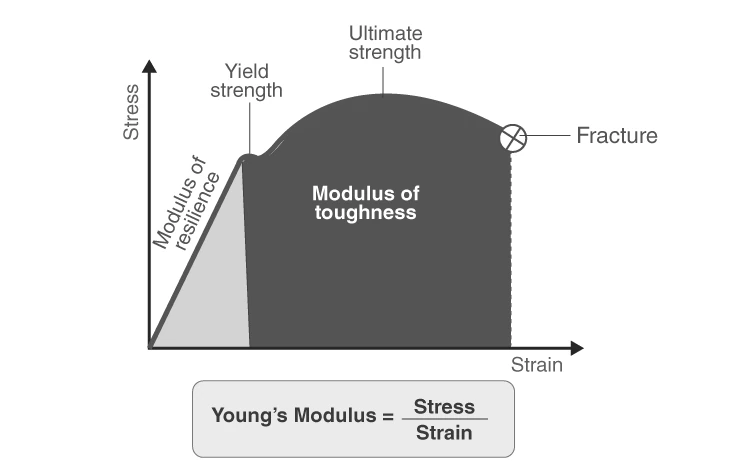
Illustration of Young’s Modulus showing stress-strain relationship
Factors Influencing Elastic Behavior and Material Rigidity
How Material Properties Affect Young’s Modulus
The magnitude of Young’s modulus varies significantly among materials, reflecting their stiffness and resistance to deformation. For instance, steel exhibits a high modulus, indicating strong resistance to stretching, whereas materials like plastic or wood have lower values, meaning they deform more easily under the same load.
Understanding these differences is essential for selecting appropriate materials in engineering and construction, ensuring safety and performance.
Example: Compare the rigidity of steel and wood by their Young’s modulus values. Steel’s modulus is approximately \(2 \times 10^{11} \text{ Pa}\), while wood’s is about \(1.3 \times 10^{10} \text{ Pa}\). This shows steel is roughly 15 times stiffer than wood.
Typical Young’s Modulus Values for Common Materials
Material | Young’s Modulus (×1010 Pa) |
|---|---|
Steel | 20 |
Glass | 6.5 |
Wood | 1.3 |
Plastic (Polystyrene) | 0.3 |
Practical Application: Calculating Deformation in Steel
Consider a steel beam initially 250 m long subjected to a tensile stress of \(2.0 \text{ N/m}^2\). Using the known Young’s modulus for steel, estimate the elongation.
Solution:
Given:
Initial length, \(L_0 = 250 \text{ m}\)
Stress, \(\sigma = 2.0 \text{ N/m}^2\)
Young’s modulus for steel, \(E = 2.0 \times 10^{11} \text{ Pa}\)
Calculate strain:
\[ \varepsilon = \frac{\sigma}{E} = \frac{2.0}{2.0 \times 10^{11}} = 1.0 \times 10^{-11} \]
Calculate change in length:
\[ \Delta L = \varepsilon \times L_0 = 1.0 \times 10^{-11} \times 250 = 2.5 \times 10^{-9} \text{ m} \]
The elongation is extremely small, demonstrating steel’s high rigidity.
Calculations and Practical Examples of Young’s Modulus
Determining Young’s Modulus from Stress and Strain
Young’s modulus can be directly calculated by dividing the applied stress by the resulting strain. This simple ratio is fundamental in material science and engineering to assess material behavior under load.
Example 1: A material experiences a stress of \(3 \text{ N/m}^2\) producing a strain of 0.6. Find its Young’s modulus.
Solution:
\[ E = \frac{\sigma}{\varepsilon} = \frac{3}{0.6} = 5 \text{ N/m}^2 \]
Example 2: Calculate the Young’s modulus of a substance if it undergoes a strain of 0.2 under an applied stress of \(5 \text{ N/m}^2\).
Solution:
\[ E = \frac{5}{0.2} = 25 \text{ N/m}^2 \]
Quick Reference: Summary of Key Elasticity Concepts
Concept | Definition / Formula | Units |
|---|---|---|
Young’s Modulus (E) | \(E = \frac{\sigma}{\varepsilon}\) | Pascal (Pa) or N/m² |
Stress (\(\sigma\)) | \(\sigma = \frac{F}{A}\) | Pascal (Pa) |
Strain (\(\varepsilon\)) | \(\varepsilon = \frac{\Delta L}{L_0}\) | Dimensionless |
Force (F) | Applied load causing deformation | Newton (N) |
Cross-sectional Area (A) | Area perpendicular to force | m² |
Change in Length (\(\Delta L\)) | Elongation or compression amount | m |
Original Length (\(L_0\)) | Initial length before deformation | m |
Bulk Modulus (K) | Resistance to uniform compression | Pa |
Shear Modulus (G) | Resistance to shear stress | Pa |
Poisson’s Ratio (\(\mu\)) | Ratio of lateral to axial strain | Dimensionless |
Glossary of Essential Terms
Term | Meaning |
|---|---|
Young’s Modulus | Ratio of stress to strain in elastic region |
Stress | Force applied per unit area |
Strain | Relative deformation or change in length |
Elastic Limit | Maximum stress before permanent deformation |
Bulk Modulus | Measure of volumetric elasticity |
Shear Modulus | Measure of resistance to shear deformation |
Poisson’s Ratio | Ratio of lateral contraction to axial extension |
Ductility | Ability to deform plastically under tensile stress |
Elastic Deformation | Temporary shape change reversible on load removal |
Plastic Deformation | Permanent shape change after stress removal |
Frequently Asked Questions
What are some examples of dimensionless quantities in elasticity?
Poisson’s ratio and strain are common dimensionless quantities used to describe material deformation without units.
Which material is known for having the highest elasticity?
Steel is widely recognized for its high elasticity, exhibiting a large Young’s modulus and strong resistance to deformation.
How is ductility defined in materials?
Ductility refers to a material’s ability to undergo significant plastic deformation, such as being stretched into a wire, without breaking.
What is the dimensional formula of Young’s modulus?
The dimensional formula for Young’s modulus is \([ML^{-1}T^{-2}]\), representing force per unit area.
What is the SI unit of Young’s modulus?
The SI unit for Young’s modulus is the pascal (Pa), equivalent to newtons per square meter (N/m²).