Understanding Fluid Viscosity and Its Measurement
Fundamentals of Fluid Viscosity
Defining Viscosity and Its Physical Significance
Viscosity quantifies how much a fluid opposes motion when subjected to an external force. It represents the internal friction between fluid layers that slide past one another. This resistance is measured by the tangential force per unit area divided by the velocity gradient in the fluid under steady, laminar flow conditions.
In simpler terms, viscosity explains why some liquids like water or alcohol flow quickly, while others such as honey or glycerin move sluggishly. The difference arises from the fluid's molecular interactions and structure, which determine its flow resistance.
Example: Consider two liquids: one flows rapidly like petrol, and another flows slowly like oil. The faster flowing liquid has a lower viscosity, indicating less internal resistance to flow compared to the slower one.
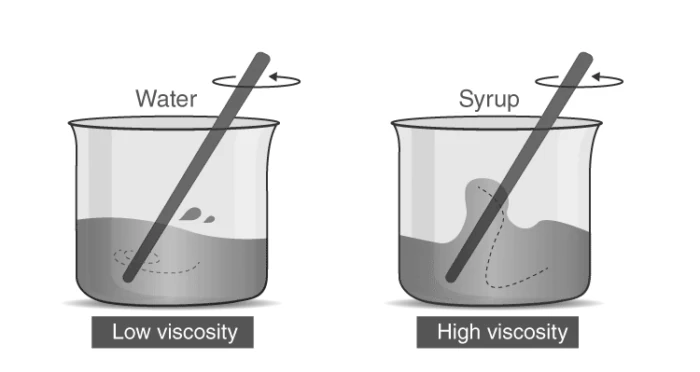
Diagram showing the coefficient of viscosity concept
Quantifying Viscosity: Coefficient and Measurement Techniques
Understanding the Coefficient of Viscosity and Its Calculation
The coefficient of viscosity, denoted by \( \eta \), is a constant for a given liquid at a specific temperature and characterizes its resistance to flow. It is determined by measuring the force required to move one layer of fluid relative to another at a certain velocity gradient.
Mathematically, the frictional force \( f \) between two fluid layers of area \( A \) separated by distance \( dx \) with velocity difference \( dV \) is expressed as:
\[ f = \eta \times A \times \frac{dV}{dx} \]
This formula highlights that the force needed to maintain a velocity difference depends directly on the coefficient of viscosity and the velocity gradient.
Example: Suppose two fluid layers are 2 cm apart, each having an area of 3 cm\(^2\), and the velocity difference between them is 4 cm/s. If the coefficient of viscosity is \(0.5 \text{ poise}\), calculate the frictional force between the layers.
Solution:
\[ f = \eta \times A \times \frac{dV}{dx} = 0.5 \times 3 \times \frac{4}{2} = 0.5 \times 3 \times 2 = 3 \text{ dyne} \]
Thus, the frictional force is 3 dyne.
Temperature Effects and Industrial Applications of Viscosity
How Temperature Influences Viscosity in Liquids and Gases
The coefficient of viscosity for liquids generally decreases as temperature rises because increased thermal energy weakens intermolecular bonds, allowing molecules to move more freely. Conversely, in gases, viscosity increases with temperature due to enhanced molecular collisions.
This contrasting behavior is crucial for industries that rely on precise fluid flow characteristics under varying thermal conditions.
Example: A liquid has a viscosity of 1.2 mPa·s at 25°C. If the temperature increases to 50°C, the viscosity drops to 0.8 mPa·s. Calculate the percentage decrease in viscosity.
Solution:
\[ \text{Percentage decrease} = \frac{1.2 - 0.8}{1.2} \times 100 = \frac{0.4}{1.2} \times 100 = 33.33\% \]
Therefore, the viscosity decreases by 33.33% when temperature rises from 25°C to 50°C.
Significance of Viscosity Measurements in Various Industries
Viscosity data is vital for manufacturers to predict how fluids behave during processing and end-use. It plays a key role in sectors such as food production, adhesives, petroleum refining, concrete mixing, and cosmetics formulation, where flow properties impact quality and efficiency.
Viscosity's role across different manufacturing industries
Quick Reference: Key Points on Viscosity
Aspect | Details |
|---|---|
Definition | Resistance of fluid to flow due to internal friction |
Coefficient of Viscosity (\( \eta \)) | Force per unit area divided by velocity gradient |
Formula | \( f = \eta A \frac{dV}{dx} \) |
Units | Poise (P), Centipoise (cP), or Pascal-second (Pa·s) |
Effect of Temperature (Liquids) | Viscosity decreases with increasing temperature |
Effect of Temperature (Gases) | Viscosity increases with increasing temperature |
Measurement Method | Poiseuille’s method and other viscometers |
Applications | Food, adhesives, petroleum, concrete, cosmetics industries |
Glossary of Important Terms
Term | Meaning |
|---|---|
Viscosity | Measure of a fluid's resistance to flow |
Coefficient of Viscosity (\( \eta \)) | Constant representing fluid's internal friction |
Velocity Gradient | Rate of change of velocity between fluid layers |
Shear Stress | Force per unit area acting parallel to fluid layers |
Poiseuille’s Method | Technique to measure viscosity by fluid flow through a tube |
Laminar Flow | Fluid flow in parallel layers without disruption |
Poise | Unit of viscosity in CGS system |
Centipoise (cP) | One hundredth of a poise, commonly used unit |
Intermolecular Forces | Attractive forces between molecules affecting viscosity |
Frictional Force | Force resisting relative motion between fluid layers |
Frequently Asked Questions
What causes a fluid to have high viscosity?
High viscosity results from strong intermolecular forces that resist the movement of fluid layers, making the fluid flow slowly.
How does temperature affect the viscosity of gases?
In gases, viscosity increases with temperature because molecules move faster and collide more frequently, increasing internal friction.
Why is viscosity important in industrial processes?
Viscosity data helps manufacturers control fluid flow, ensuring product quality and efficient processing in industries like food, cosmetics, and petroleum.
What units are commonly used to express viscosity?
Viscosity is often measured in poise (P), centipoise (cP), or Pascal-seconds (Pa·s), depending on the measurement system.
How is the coefficient of viscosity experimentally determined?
It is commonly measured using methods like Poiseuille’s technique, where fluid flow through a narrow tube under pressure is analyzed.