Understanding Fluid Viscosity: Measurement and Applications
Fundamentals of Fluid Viscosity
Concept and Significance of Viscosity
Viscosity represents the internal resistance a fluid exhibits when its layers move relative to each other. This resistance stems from frictional forces between adjacent fluid layers as they slide past one another during flow. Essentially, viscosity quantifies how "thick" or "sticky" a fluid is, influencing how easily it allows objects to move through it or how readily it flows.
Fluids with high viscosity, such as honey, resist motion strongly due to intense intermolecular attractions causing significant internal friction. Conversely, fluids like water have low viscosity, enabling them to flow smoothly with minimal resistance. Although gases also possess viscosity, it is generally less perceptible under normal conditions.
Example Problem
A sphere of radius \(0.002 \text{ m}\) is dropped into a fluid, and it attains a terminal velocity of \(0.01 \text{ m/s}\). The density difference between the sphere and the fluid is \(1500 \text{ kg/m}^3\), and acceleration due to gravity is \(9.8 \text{ m/s}^2\). Calculate the viscosity of the fluid using the formula:
\[ \eta = \frac{2}{9} \frac{\Delta \rho \, g \, a^2}{v} \]
Solution:
Given: \(a = 0.002 \text{ m}\), \(\Delta \rho = 1500 \text{ kg/m}^3\), \(g = 9.8 \text{ m/s}^2\), \(v = 0.01 \text{ m/s}\)
Substitute values:
\[ \eta = \frac{2}{9} \times \frac{1500 \times 9.8 \times (0.002)^2}{0.01} = \frac{2}{9} \times \frac{1500 \times 9.8 \times 4 \times 10^{-6}}{0.01} \]
\[ = \frac{2}{9} \times \frac{0.0588}{0.01} = \frac{2}{9} \times 5.88 = 1.3067 \text{ Pa·s} \]
Therefore, the fluid's viscosity is approximately \(1.31 \text{ Pa·s}\).
Defining Viscosity and Its Units
Viscosity is formally defined as the measure of a fluid's resistance to deformation or flow. It is an intrinsic property that does not depend on the quantity of fluid present. The standard SI unit for viscosity is the pascal-second (Pa·s), also known as the poiseuille (Pl). Other units include newton-second per square meter (N·s/m²). Its dimensional formula is expressed as \([M L^{-1} T^{-1}]\).
Temperature influences viscosity differently for liquids and gases: liquids become less viscous as temperature rises, allowing them to flow more freely, whereas gases tend to increase in viscosity with temperature.
Exam Tip: Remember that viscosity is an intensive property, meaning it remains constant regardless of the fluid's volume.
Classification and Measurement of Viscosity
Types of Viscosity: Dynamic and Kinematic
Viscosity can be categorized into two main types based on how it is measured:
- Dynamic (Absolute) Viscosity: This measures the fluid's resistance to flow when an external force is applied, reflecting the internal friction between fluid layers.
- Kinematic Viscosity: This quantifies the fluid's resistance to flow under the influence of gravity, calculated as the ratio of dynamic viscosity to fluid density.
While these two are related, they serve different practical purposes. Kinematic viscosity is often more relevant in applications involving gravitational flow, such as in pipelines or open channels.
Example Problem
A fluid has a dynamic viscosity of \(0.002 \text{ Pa·s}\) and a density of \(800 \text{ kg/m}^3\). Calculate its kinematic viscosity.
Solution:
Kinematic viscosity \( \nu \) is given by:
\[ \nu = \frac{\eta}{\rho} \]
Substituting the values:
\[ \nu = \frac{0.002}{800} = 2.5 \times 10^{-6} \text{ m}^2/\text{s} \]
Thus, the kinematic viscosity is \(2.5 \times 10^{-6} \text{ m}^2/\text{s}\).
Newtonian vs Non-Newtonian Fluids
Fluids are further classified based on how their viscosity responds to changes in stress or temperature:
- Newtonian Fluids: Their viscosity remains constant regardless of the applied stress or shear rate. Water is a classic example.
- Non-Newtonian Fluids: Their viscosity varies with applied stress or temperature changes. Toothpaste is a common example, exhibiting shear-thinning behavior.
Understanding this distinction is crucial for applications in industries like food processing, cosmetics, and lubrication.
Note: Pressure can also affect viscosity; increasing pressure generally raises the viscosity of liquids by restricting molecular movement.
Techniques for Measuring Viscosity
Using a Falling Sphere and Viscometers
A straightforward method to estimate viscosity involves timing a sphere as it falls through a fluid. The slower the descent, the higher the fluid's viscosity. However, for precise measurements, specialized instruments called viscometers are employed.
One common type is the U-tube or Ostwald viscometer, which consists of two bulbs connected by a narrow capillary tube. The fluid is drawn into the upper bulb and allowed to flow through the capillary to the lower bulb. The time taken for the fluid to pass between two marked points correlates directly with its kinematic viscosity.
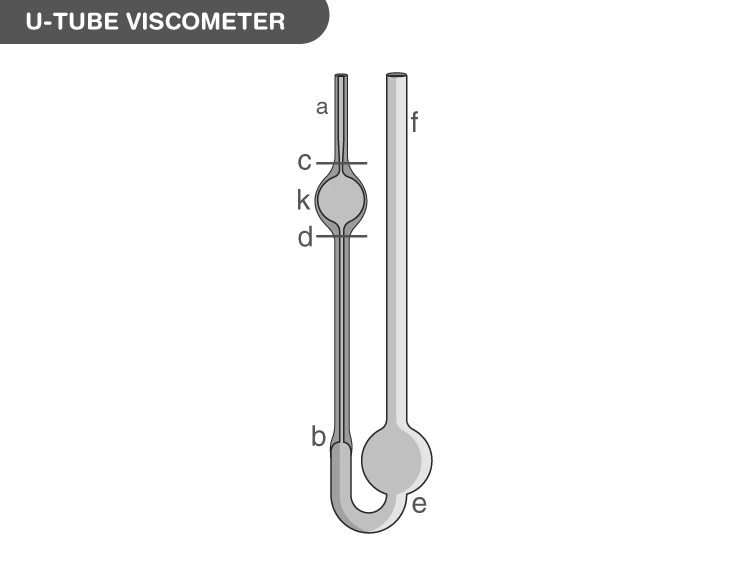
Commercial viscometers often provide a calibration factor, allowing the kinematic viscosity to be calculated by multiplying the measured flow time by this factor.
Example Problem
A liquid takes 120 seconds to flow between two marks in a U-tube viscometer. The viscometer's calibration constant is \(1.5 \times 10^{-6} \text{ m}^2/\text{s}^2\). Determine the kinematic viscosity of the liquid.
Solution:
Kinematic viscosity \( \nu \) is:
\[ \nu = \text{calibration constant} \times \text{time} = 1.5 \times 10^{-6} \times 120 = 1.8 \times 10^{-4} \text{ m}^2/\text{s} \]
The liquid's kinematic viscosity is \(1.8 \times 10^{-4} \text{ m}^2/\text{s}\).
Summary and Key Concepts
| Term | Definition | Unit |
|---|---|---|
| Viscosity | Resistance of fluid layers to flow | Pascal-second (Pa·s) |
| Dynamic Viscosity | Measure of fluid's internal friction under applied force | Pa·s |
| Kinematic Viscosity | Ratio of dynamic viscosity to fluid density | m²/s |
| Newtonian Fluid | Fluid with constant viscosity regardless of stress | — |
| Non-Newtonian Fluid | Fluid whose viscosity changes with stress or temperature | — |
| Poiseuille (Pl) | SI unit of viscosity equivalent to Pa·s | Pa·s |
| Viscometer | Instrument to measure fluid viscosity | — |
| Shearing Stress | Force per unit area causing fluid layers to slide | Pa |
| Velocity Gradient | Rate of change of velocity between fluid layers | 1/s |
| Terminal Velocity | Constant speed attained by a falling object in fluid | m/s |
Glossary of Important Terms
| Term | Meaning |
|---|---|
| Viscosity | Internal friction resisting fluid flow |
| Dynamic Viscosity | Viscosity measured under applied force |
| Kinematic Viscosity | Viscosity relative to fluid density |
| Newtonian Fluid | Fluid with constant viscosity regardless of shear |
| Non-Newtonian Fluid | Fluid whose viscosity varies with stress or temperature |
| Shearing Stress | Force per unit area causing fluid layers to move |
| Velocity Gradient | Change in velocity between adjacent fluid layers |
| Viscometer | Device used to measure viscosity |
| Terminal Velocity | Steady speed of an object falling through fluid |
| Poiseuille | Unit of viscosity equal to Pascal-second |
Frequently Asked Questions
What exactly is viscosity?
Viscosity is the measure of how much a fluid resists flowing, caused by internal friction between its layers.
Why is viscosity considered an intensive property?
Because viscosity does not depend on the amount of fluid present, it remains constant regardless of volume.
How does temperature affect the viscosity of liquids and gases?
Increasing temperature decreases the viscosity of liquids, making them flow easier, while it increases the viscosity of gases.
What is the relationship between viscosity and flow rate?
Flow rate is inversely proportional to viscosity; higher viscosity means slower flow.
How is kinematic viscosity different from dynamic viscosity?
Kinematic viscosity is dynamic viscosity divided by fluid density, representing flow resistance under gravity.