Understanding Angular Momentum: Concepts and Applications
Fundamentals of Angular Momentum
Defining Angular Momentum and Its Physical Significance
Angular momentum is a fundamental property of objects in rotational motion, analogous to linear momentum for moving bodies. It quantifies the rotational inertia and velocity of a spinning or revolving object, combining both magnitude and direction as a vector quantity. This property explains why spinning wheels, such as those on a bicycle, help maintain balance by resisting changes in their rotational state.
Mathematically, angular momentum (\( \vec{L} \)) is expressed as the product of the moment of inertia (\( I \)) and the angular velocity (\( \vec{\omega} \)) of the object:
\[ \vec{L} = I \vec{\omega} \]
Here, the moment of inertia represents how mass is distributed relative to the axis of rotation, and angular velocity indicates how fast the object spins.
Example: Calculating Angular Momentum of a Rotating Disk
A solid disk with a mass of 3 kg and radius 0.2 m spins at an angular velocity of 5 rad/s. Find its angular momentum.
Solution:
The moment of inertia for a solid disk about its central axis is given by:
\[ I = \frac{1}{2} m r^2 = \frac{1}{2} \times 3 \times (0.2)^2 = 0.06 \text{ kg·m}^2 \]
Using the formula for angular momentum:
\[ L = I \omega = 0.06 \times 5 = 0.3 \text{ kg·m}^2/\text{s} \]
Therefore, the disk's angular momentum is \(0.3 \text{ kg·m}^2/\text{s}\).
Mathematical Expressions and Quantum Aspects of Angular Momentum
Formulas for Angular Momentum in Different Contexts
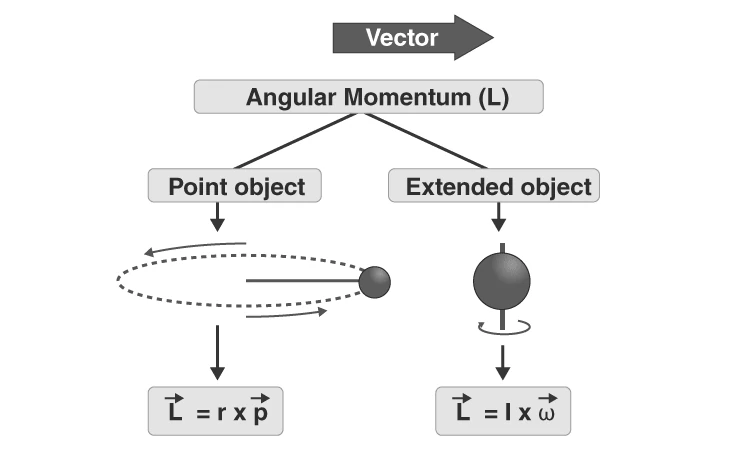
Angular momentum can be described in two primary scenarios:
- For a point mass revolving around a fixed point: The angular momentum is the cross product of the position vector (\( \vec{r} \)) and the linear momentum (\( \vec{p} \)):
\[ \vec{L} = \vec{r} \times \vec{p} \]
- For an extended rigid body rotating about a fixed axis: It is the product of the moment of inertia and angular velocity:
\[ \vec{L} = I \vec{\omega} \]
In quantum mechanics, the angular momentum quantum number, also known as the azimuthal quantum number, characterizes the angular momentum of electrons in atomic orbitals. It determines the shape and size of the orbital and takes integer values from 0 up to \(n-1\), where \(n\) is the principal quantum number.
Example: Angular Momentum of a Revolving Particle
A particle of mass 0.5 kg moves in a circle of radius 0.3 m with a linear speed of 4 m/s. Calculate its angular momentum about the center of the circle.
Solution:
First, calculate the linear momentum:
\[ p = m v = 0.5 \times 4 = 2 \text{ kg·m/s} \]
Then, angular momentum is:
\[ L = r \times p = 0.3 \times 2 = 0.6 \text{ kg·m}^2/\text{s} \]
The particle's angular momentum is \(0.6 \text{ kg·m}^2/\text{s}\).
Directionality and Practical Examples of Angular Momentum
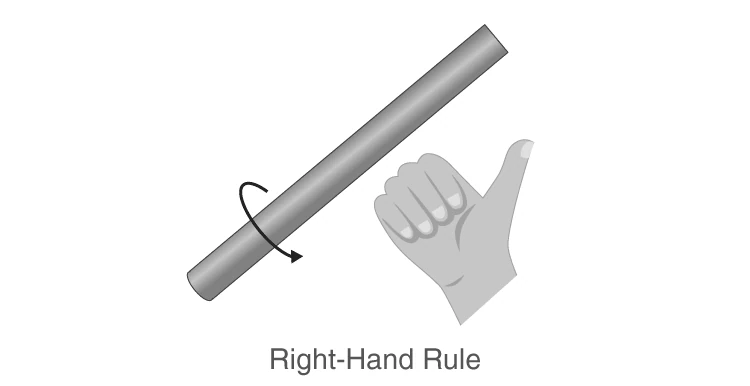
Determining Angular Momentum Direction Using the Right-Hand Rule
The orientation of angular momentum vectors is established by the right-hand rule. To apply this rule, point the fingers of your right hand in the direction of the position vector (\( \vec{r} \)), then curl them toward the direction of the linear momentum (\( \vec{p} \)). Your extended thumb will then indicate the direction of the angular momentum vector (\( \vec{L} \)). This convention ensures consistent representation of rotational directions in physics.
Real-World Illustrations of Angular Momentum
Angular momentum is observable in many everyday phenomena. Two notable examples include:
- Ice Skater's Spin: When an ice skater pulls their arms closer to their body, they reduce their moment of inertia. Due to conservation of angular momentum, their angular velocity increases, causing them to spin faster.
- Gyroscope Stability: A gyroscope maintains its orientation because its spinning wheel possesses angular momentum. This property is exploited in navigation systems and spacecraft attitude control.

Example: Angular Momentum Conservation in a Spinning Skater
An ice skater with a moment of inertia of 4 kg·m² spins at 3 rad/s with arms extended. When she pulls her arms in, her moment of inertia decreases to 1.5 kg·m². Find her new angular velocity.
Solution:
Using conservation of angular momentum:
\[ I_1 \omega_1 = I_2 \omega_2 \]
Substitute the known values:
\[ 4 \times 3 = 1.5 \times \omega_2 \implies \omega_2 = \frac{12}{1.5} = 8 \text{ rad/s} \]
The skater's angular velocity increases to \(8 \text{ rad/s}\) after pulling her arms in.
Summary Table for Quick Review
| Concept | Definition/Formula | Units |
|---|---|---|
| Angular Momentum (\( \vec{L} \)) | \( \vec{L} = I \vec{\omega} \) or \( \vec{L} = \vec{r} \times \vec{p} \) | kg·m²/s |
| Moment of Inertia (\( I \)) | Depends on mass distribution; e.g., \( I = \frac{1}{2} m r^2 \) for a solid disk | kg·m² |
| Angular Velocity (\( \vec{\omega} \)) | Rate of rotation | rad/s |
| Angular Momentum Quantum Number | Determines orbital shape; values from 0 to \( n-1 \) | Dimensionless |
| Right-Hand Rule | Determines direction of \( \vec{L} \) | Vector direction |
Glossary of Key Terms
| Term | Meaning |
|---|---|
| Angular Momentum | Rotational equivalent of linear momentum; product of moment of inertia and angular velocity |
| Moment of Inertia | Measure of an object's resistance to changes in its rotation |
| Angular Velocity | Rate at which an object rotates or spins |
| Linear Momentum | Product of mass and linear velocity of an object |
| Right-Hand Rule | Method to determine the direction of angular momentum vector |
| Quantum Number | Number describing quantized properties of particles, such as angular momentum |
| Torque | Rotational force causing change in angular momentum |
| Rotational Inertia | Another term for moment of inertia |
| Gyroscope | Device that uses angular momentum to maintain orientation |
| Conservation of Angular Momentum | Principle stating angular momentum remains constant if no external torque acts |
Frequently Asked Questions
How is angular momentum calculated for a rotating object?
Angular momentum is found by multiplying the moment of inertia by the angular velocity: \( \vec{L} = I \vec{\omega} \).
What does the right-hand rule indicate in angular momentum?
It determines the direction of the angular momentum vector by curling the fingers from the position vector to linear momentum, with the thumb pointing in the direction of \( \vec{L} \).
How does an ice skater increase their spinning speed?
By pulling their arms closer to the body, the skater reduces their moment of inertia, causing an increase in angular velocity due to conservation of angular momentum.
What is the relationship between angular velocity and radius in an isolated system?
Angular velocity is inversely proportional to the radius when angular momentum is conserved.
What is the dimensional formula of angular momentum?
The dimensional formula is \( M L^2 T^{-1} \), representing mass, length squared, and inverse time.