Comprehensive Overview of Thermodynamic Processes
Understanding Quasi-Static and Isothermal Transformations
Defining Quasi-Static Processes in Thermodynamics
A quasi-static process is one where the system remains infinitesimally close to thermodynamic equilibrium with its surroundings at every instant. This ensures that state variables such as pressure, volume, and temperature are well-defined throughout the transformation. Such processes are idealized and serve as a foundation for analyzing real thermodynamic changes.
Characteristics of Isothermal Changes
An isothermal process occurs when the temperature of the system remains constant during the transformation. Since internal energy depends solely on temperature for ideal gases, it remains unchanged in this process. According to the ideal gas law, pressure and volume are inversely related at constant temperature, expressed as \( PV = \text{constant} \).
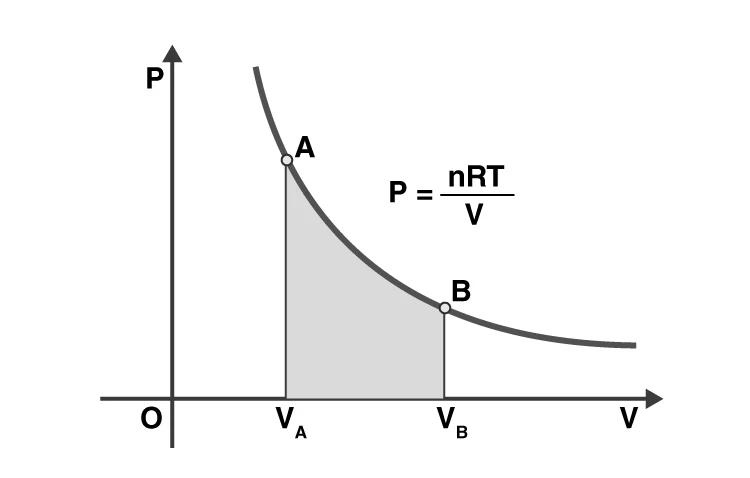
Illustration of a thermodynamic system undergoing transformation
The work done by the gas during an isothermal expansion or compression can be calculated by integrating pressure with respect to volume:
\[ W = nRT \ln \frac{V_B}{V_A} \]
Here, \(V_A\) and \(V_B\) are the initial and final volumes respectively, \(n\) is the number of moles, \(R\) is the gas constant, and \(T\) is the constant temperature.
Key points to remember:
Work done \(W\) is positive if the volume increases (\(V_B > V_A\)) and negative if volume decreases.
Change in internal energy \(\Delta U = 0\) since temperature is constant.
Heat exchanged \(Q = W\) as per the first law of thermodynamics \(Q = W + \Delta U\).
Example: Calculating Work in an Isothermal Expansion
A gas expands isothermally at \(300 \text{ K}\) from a volume of \(2.0 \text{ L}\) to \(5.0 \text{ L}\). Calculate the work done by the gas if it contains \(0.5\) moles.
Solution:
Given: \(T = 300 \text{ K}\), \(V_A = 2.0 \text{ L} = 2.0 \times 10^{-3} \text{ m}^3\), \(V_B = 5.0 \text{ L} = 5.0 \times 10^{-3} \text{ m}^3\), \(n = 0.5\) moles, \(R = 8.314 \text{ J/mol·K}\).
Work done is:
\[ W = nRT \ln \frac{V_B}{V_A} = 0.5 \times 8.314 \times 300 \times \ln \frac{5.0 \times 10^{-3}}{2.0 \times 10^{-3}} \]
Calculate the logarithm:
\[ \ln \frac{5.0 \times 10^{-3}}{2.0 \times 10^{-3}} = \ln 2.5 \approx 0.9163 \]
Therefore,
\[ W = 0.5 \times 8.314 \times 300 \times 0.9163 \approx 1142.5 \text{ J} \]
The gas does approximately \(1142.5 \text{ J}\) of work during the expansion.
Exploring Adiabatic and Isochoric Transformations
Fundamentals of Adiabatic Processes
An adiabatic process is characterized by the absence of heat exchange between the system and its environment, meaning \(Q = 0\). In such a process, any work done by or on the system results in a change in its internal energy. The pressure and volume of an ideal gas during an adiabatic change follow the relation \(PV^\gamma = \text{constant}\), where \(\gamma\) is the heat capacity ratio.
From the first law of thermodynamics:
\[ Q = W + \Delta U \]
Since \(Q=0\), it follows that:
\[ \Delta U = -W \]
This implies that if the system does work on the surroundings (work done positive), its internal energy decreases, and vice versa.
Characteristics of Isochoric Processes
In an isochoric process, the volume remains fixed, so there is no work done by or on the system because work depends on volume change. Hence, \(W = 0\). The first law simplifies to:
\[ Q = \Delta U \]
Any heat added to the system changes its internal energy directly without performing work.
Example: Internal Energy Change in an Adiabatic Compression
A gas is compressed adiabatically from a volume of \(4.0 \text{ L}\) to \(1.0 \text{ L}\). If the work done on the gas is \(500 \text{ J}\), determine the change in internal energy.
Solution:
Since the process is adiabatic, \(Q=0\), and from the first law:
\[ \Delta U = -W \]
Work done on the gas is positive \(W = +500 \text{ J}\), so:
\[ \Delta U = -500 \text{ J} \]
This means the internal energy decreases by \(500 \text{ J}\) during compression.
Visual representation of adiabatic and isochoric processes
Insights into Isobaric and Cyclic Thermodynamic Changes
Understanding Isobaric Processes
Isobaric transformations occur at constant pressure. The work done by the system during such a process depends on the change in volume and is given by:
\[ W = P \Delta V \]
If the volume increases, the work done by the system is positive; if it decreases, the work is negative. The first law of thermodynamics for this process is:
\[ Q = W + \Delta U = P \Delta V + \Delta U \]
Defining Cyclic Processes
A cyclic process is one where the system returns to its initial state after undergoing a series of transformations. Since internal energy is a state function, the net change in internal energy over a complete cycle is zero:
\[ \Delta U_{\text{cycle}} = 0 \]
The net work done by the system in a cycle equals the net heat absorbed.
Example: Work Done in an Isobaric Expansion
A gas expands isobarically at a pressure of \(2.0 \times 10^5 \text{ Pa}\) from \(1.0 \text{ m}^3\) to \(3.0 \text{ m}^3\). Calculate the work done by the gas.
Solution:
Given: \(P = 2.0 \times 10^5 \text{ Pa}\), \(V_A = 1.0 \text{ m}^3\), \(V_B = 3.0 \text{ m}^3\).
Work done is:
\[ W = P (V_B - V_A) = 2.0 \times 10^5 \times (3.0 - 1.0) = 2.0 \times 10^5 \times 2.0 = 4.0 \times 10^5 \text{ J} \]
The gas performs \(400,000 \text{ J}\) of work during the expansion.
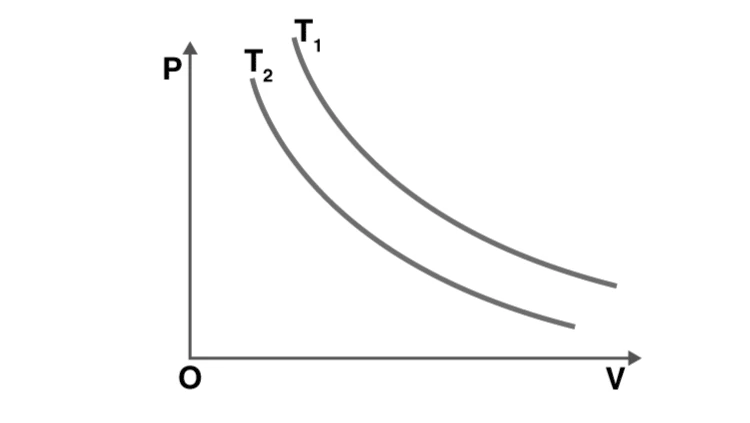
Pressure-Volume diagram illustrating isothermal processes at different temperatures
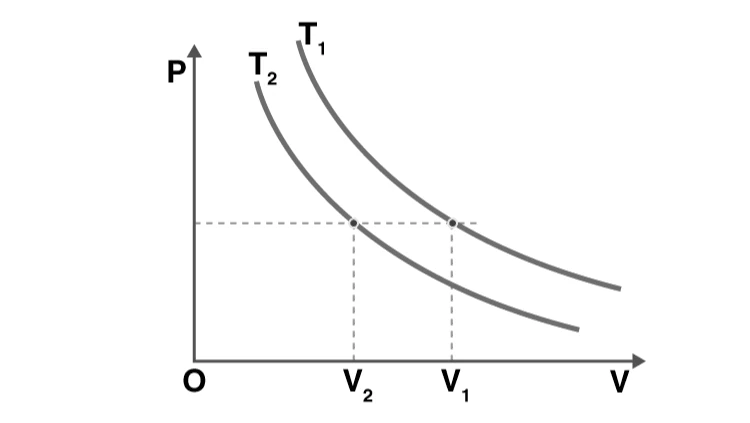
Volume-Temperature graph depicting behavior at constant pressure
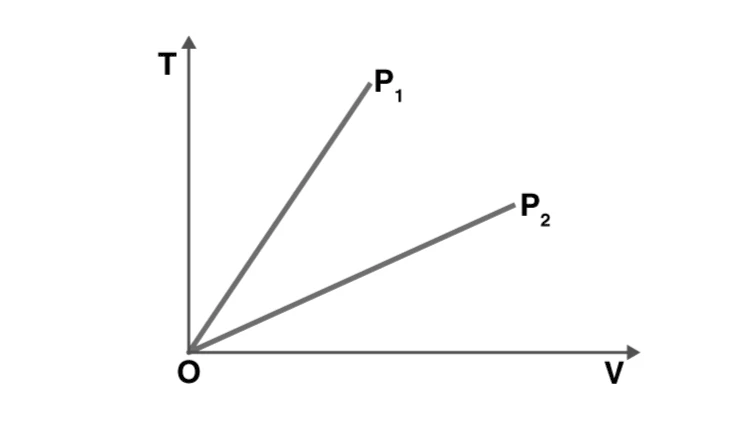
Graph showing isobaric processes at different pressures
Example: Comparing Temperatures from PV Curves
Two isothermal processes are shown on a PV diagram. One curve lies closer to the origin than the other. Which process corresponds to the higher temperature?
Solution:
At constant pressure, volume and temperature are directly proportional.
The curve farther from the origin corresponds to a larger volume at the same pressure, indicating a higher temperature.
Therefore, the isothermal curve farther from the origin represents the higher temperature.
Example: Determining Pressure from Volume-Temperature Graphs
Two volume-temperature graphs at constant pressure have slopes \(m_1\) and \(m_2\) with \(m_1 > m_2\). Which graph corresponds to the higher pressure?
Solution:
From the ideal gas law, the slope of the \(V-T\) graph at constant pressure is \(\frac{nR}{P}\).
A larger slope means lower pressure since slope is inversely proportional to pressure.
Thus, the graph with slope \(m_2\) (smaller slope) corresponds to the higher pressure.
Summary Table of Thermodynamic Processes
Process | Constant Parameter | Work Done \(W\) | Heat Exchange \(Q\) | Change in Internal Energy \(\Delta U\) |
|---|---|---|---|---|
Isothermal | Temperature (T) | \(W = nRT \ln \frac{V_B}{V_A}\) | \(Q = W\) | \(0\) |
Adiabatic | No heat exchange (\(Q=0\)) | Depends on \(\Delta V\) and \(\gamma\) | 0 | \(\Delta U = -W\) |
Isochoric | Volume (V) | 0 | \(Q = \Delta U\) | Depends on heat added |
Isobaric | Pressure (P) | \(W = P \Delta V\) | \(Q = P \Delta V + \Delta U\) | Varies with heat and work |
Cyclic | System returns to initial state | Net work done over cycle | Net heat absorbed equals work done | 0 |
Glossary of Key Thermodynamics Terms
Term | Definition |
|---|---|
Adiabatic Process | A process with no heat exchange between system and surroundings. |
Isothermal Process | A transformation occurring at constant temperature. |
Isochoric Process | A process where volume remains constant. |
Isobaric Process | A process occurring at constant pressure. |
Quasi-Static Process | A process that proceeds infinitely slowly, maintaining equilibrium at every step. |
Internal Energy (\(U\)) | The total energy contained within a thermodynamic system. |
Work (\(W\)) | Energy transferred by the system due to volume change against external pressure. |
Heat (\(Q\)) | Energy transferred due to temperature difference between system and surroundings. |
Cyclic Process | A process where the system returns to its initial state after a series of changes. |
Heat Capacity Ratio (\(\gamma\)) | The ratio of specific heats \(C_p/C_v\) for a gas. |
Frequently Asked Questions
When do gases and vapors behave like ideal gases?
Gases and vapors approximate ideal gas behavior at low pressures and low densities where intermolecular forces are negligible.
What is the triple point of water?
The triple point of water is the unique temperature and pressure where solid, liquid, and vapor phases coexist in equilibrium, occurring at 0.01°C and 0.006 atm.
Does the enthalpy of an ideal gas depend only on temperature?
Yes, for an ideal gas, enthalpy depends solely on temperature because internal energy is a function of temperature alone.
Is enthalpy an intensive or extensive property?
Enthalpy is an extensive property, meaning it depends on the amount of substance present in the system.
What happens to a substance below its triple point pressure?
Below the triple point pressure, a substance cannot exist as a liquid; it transitions directly between solid and vapor phases upon heating.