Understanding the Parallel Axis Theorem and Its Applications
Fundamentals of the Parallel Axis Theorem
Concept and Mathematical Expression
The parallel axis theorem provides a method to calculate the moment of inertia of a rigid body about any axis parallel to one passing through its center of mass. It states that the moment of inertia about the new axis equals the moment of inertia about the centroidal axis plus the product of the body's mass and the square of the distance between the two axes.
Mathematically, this is expressed as:
\[ I = I_c + M h^2 \]
where:
- \(I\) is the moment of inertia about the axis parallel to the centroidal axis.
- \(I_c\) is the moment of inertia about the axis through the center of mass.
- \(M\) is the total mass of the body.
- \(h\) is the perpendicular distance between the two axes.
Example: Calculating Moment of Inertia Using the Parallel Axis Theorem
A uniform disc has a mass of 4 kg and a moment of inertia about its center of mass axis as \(0.5 \text{ kg·m}^2\). Find the moment of inertia about an axis parallel to this axis but 0.3 m away.
Solution:
Given:
- \(M = 4 \text{ kg}\)
- \(I_c = 0.5 \text{ kg·m}^2\)
- \(h = 0.3 \text{ m}\)
Using the parallel axis theorem:
\[ I = I_c + M h^2 = 0.5 + 4 \times (0.3)^2 = 0.5 + 4 \times 0.09 = 0.5 + 0.36 = 0.86 \text{ kg·m}^2 \]
Therefore, the moment of inertia about the new axis is \(0.86 \text{ kg·m}^2\).
Deriving the Parallel Axis Theorem
Step-by-Step Explanation of the Derivation
Consider a rigid body with a known moment of inertia \(I_c\) about an axis passing through its center of mass. We want to find the moment of inertia \(I\) about a parallel axis located a distance \(h\) away.
Take a particle of mass \(m\) at a distance \(r\) from the center of mass axis. The distance from the new axis is \(r + h\). The moment of inertia about the new axis is:
\[ I = \sum m (r + h)^2 = \sum m (r^2 + 2 r h + h^2) \]
Expanding the summation:
\[ I = \sum m r^2 + 2 h \sum m r + h^2 \sum m \]
Since the axis passes through the center of mass, \(\sum m r = 0\). Also, \(\sum m = M\), the total mass. Therefore:
\[ I = I_c + M h^2 \]
This completes the derivation of the parallel axis theorem.
Example: Deriving Moment of Inertia for a Shifted Axis
A particle system has a moment of inertia of \(2 \text{ kg·m}^2\) about its centroidal axis. If the total mass is \(5 \text{ kg}\) and the axis is shifted by \(0.4 \text{ m}\), find the new moment of inertia.
Solution:
Given:
- \(I_c = 2 \text{ kg·m}^2\)
- \(M = 5 \text{ kg}\)
- \(h = 0.4 \text{ m}\)
Applying the formula:
\[ I = I_c + M h^2 = 2 + 5 \times (0.4)^2 = 2 + 5 \times 0.16 = 2 + 0.8 = 2.8 \text{ kg·m}^2 \]
The moment of inertia about the shifted axis is \(2.8 \text{ kg·m}^2\).
Applying the Parallel Axis Theorem to a Rod
Moment of Inertia Calculation for a Rod About an End
The moment of inertia of a uniform rod of length \(L\) and mass \(M\) about an axis through its center perpendicular to its length is:
\[ I_c = \frac{1}{12} M L^2 \]
The distance from the center to the end of the rod is:
\[ h = \frac{L}{2} \]
Using the parallel axis theorem, the moment of inertia about an axis through one end of the rod is:
\[ I = I_c + M h^2 = \frac{1}{12} M L^2 + M \left(\frac{L}{2}\right)^2 = \frac{1}{12} M L^2 + \frac{1}{4} M L^2 = \frac{1}{3} M L^2 \]
Example: Moment of Inertia of a Rod About Its End
A rod of length \(2 \text{ m}\) and mass \(3 \text{ kg}\) has its moment of inertia calculated about its center as \(I_c = \frac{1}{12} M L^2\). Find the moment of inertia about an axis through one end.
Solution:
Given:
- \(L = 2 \text{ m}\)
- \(M = 3 \text{ kg}\)
Calculate \(I_c\):
\[ I_c = \frac{1}{12} \times 3 \times (2)^2 = \frac{1}{12} \times 3 \times 4 = 1 \text{ kg·m}^2 \]
Distance \(h = \frac{L}{2} = 1 \text{ m}\)
Using the parallel axis theorem:
\[ I = I_c + M h^2 = 1 + 3 \times (1)^2 = 1 + 3 = 4 \text{ kg·m}^2 \]
The moment of inertia about the rod's end is \(4 \text{ kg·m}^2\).
Exploring the Perpendicular Axis Theorem
Principle and Formula for Plane Bodies
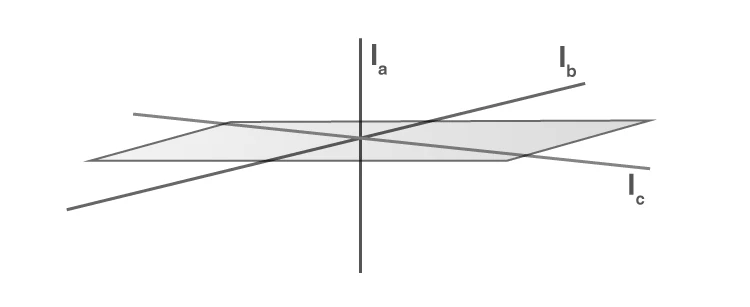
The perpendicular axis theorem applies to flat, planar objects. It states that the moment of inertia about an axis perpendicular to the plane of the body equals the sum of the moments of inertia about two mutually perpendicular axes lying in the plane and intersecting at the point where the perpendicular axis passes through.
The formula is:
\[ I_z = I_x + I_y \]
where \(I_z\) is the moment of inertia about the axis perpendicular to the plane, and \(I_x\) and \(I_y\) are moments of inertia about the two perpendicular axes in the plane.
Example: Using the Perpendicular Axis Theorem
A flat rectangular plate has moments of inertia \(I_x = 20 \text{ kg·m}^2\) and \(I_y = 30 \text{ kg·m}^2\) about two perpendicular axes in its plane. Find the moment of inertia about the axis perpendicular to the plate.
Solution:
Using the perpendicular axis theorem:
\[ I_z = I_x + I_y = 20 + 30 = 50 \text{ kg·m}^2 \]
The moment of inertia about the perpendicular axis is \(50 \text{ kg·m}^2\).
Practical Applications and Problem Solving
Applying the Parallel Axis Theorem in Engineering
In engineering, the parallel axis theorem is essential for calculating moments of inertia of bodies with irregular shapes or when the axis of rotation does not pass through the center of mass. This theorem is particularly useful in aerospace engineering for determining the rotational characteristics of spacecraft and satellites.
Similarly, the perpendicular axis theorem helps when moments of inertia about two axes in a plane are known, allowing calculation about the third perpendicular axis, which is crucial in structural analysis and mechanical design.
Example: Moment of Inertia Calculation for a Body Using Parallel Axis Theorem
A body has a moment of inertia of \(50 \text{ kg·m}^2\) about an axis through its center of gravity. The mass of the body is \(30 \text{ kg}\). Find the moment of inertia about a parallel axis located \(0.5 \text{ m}\) away.
Solution:
Given:
- \(I_c = 50 \text{ kg·m}^2\)
- \(M = 30 \text{ kg}\)
- \(h = 0.5 \text{ m}\)
Using the parallel axis theorem:
\[ I = I_c + M h^2 = 50 + 30 \times (0.5)^2 = 50 + 30 \times 0.25 = 50 + 7.5 = 57.5 \text{ kg·m}^2 \]
The moment of inertia about the shifted axis is \(57.5 \text{ kg·m}^2\).
Summary Table for Quick Review
| Theorem | Formula | Application |
|---|---|---|
| Parallel Axis Theorem | \(I = I_c + M h^2\) | Calculating moment of inertia about an axis parallel to centroidal axis |
| Perpendicular Axis Theorem | \(I_z = I_x + I_y\) | Finding moment of inertia about axis perpendicular to plane of a flat body |
| Rod Moment of Inertia | \(I = \frac{1}{3} M L^2\) (about end) | Moment of inertia of rod about an axis through one end |
Glossary of Key Terms
| Term | Definition |
|---|---|
| Moment of Inertia | Measure of an object's resistance to rotational motion about an axis. |
| Center of Mass | The point representing the average position of the mass distribution of a body. |
| Parallel Axis Theorem | A theorem to find moment of inertia about any axis parallel to one through the center of mass. |
| Perpendicular Axis Theorem | Relates moments of inertia about three mutually perpendicular axes for planar bodies. |
| Radius of Gyration | Distance from the axis at which the entire mass can be assumed to be concentrated. |
| Rigid Body | An object with a fixed shape that does not deform under applied forces. |
| Axis of Rotation | The line about which an object rotates. |
| Mass Distribution | How mass is spread out in an object relative to an axis. |
| Centroidal Axis | Axis passing through the center of mass of a body. |
| Moment Arm | Perpendicular distance from the axis of rotation to the line of action of force or mass element. |
Frequently Asked Questions
When is the parallel axis theorem most useful?
It is used to find the moment of inertia about any axis parallel to one passing through the center of mass, especially when the latter is known.
What are typical uses of the perpendicular axis theorem?
This theorem helps calculate the moment of inertia about an axis perpendicular to a plane when moments about two perpendicular in-plane axes are known.
How does the distance between axes affect the moment of inertia?
The moment of inertia increases by the product of the mass and the square of the distance between the axes, as per the parallel axis theorem.
What is the radius of gyration and why is it important?
It is the distance from the axis where the entire mass can be assumed to be concentrated to produce the same moment of inertia, simplifying calculations.
Can the parallel axis theorem be applied to any shape?
Yes, as long as the moment of inertia about the centroidal axis and the mass are known, it can be applied to any rigid body.