Understanding Standing Waves: Nodes, Antinodes, and Normal Modes
Mathematical Description of Standing Waves
Deriving the Standing Wave Equation
Imagine two waves traveling along the same line but in opposite directions. One wave moves forward along the positive x-axis, while the other moves backward along the negative x-axis. The forward-moving wave can be expressed as:
\[ y_1(u,t) = a \sin(ku - \omega t) \]
Similarly, the backward-moving wave is given by:
\[ y_2(u,t) = a \sin(ku + \omega t) \]
By applying the principle of superposition, the resultant displacement at position \( u \) and time \( t \) is the sum of these two waves:
\[ y(u,t) = y_1(u,t) + y_2(u,t) = a \sin(ku - \omega t) + a \sin(ku + \omega t) \]
Using the trigonometric identity for the sum of sines, this simplifies to:
\[ y(u,t) = 2a \sin(ku) \cos(\omega t) \]
This expression represents a standing wave, where the amplitude at each point \( u \) is modulated by \( 2a \sin(ku) \), and the oscillation varies in time as \( \cos(\omega t) \). Unlike traveling waves, the nodes and antinodes of a standing wave remain fixed in space.
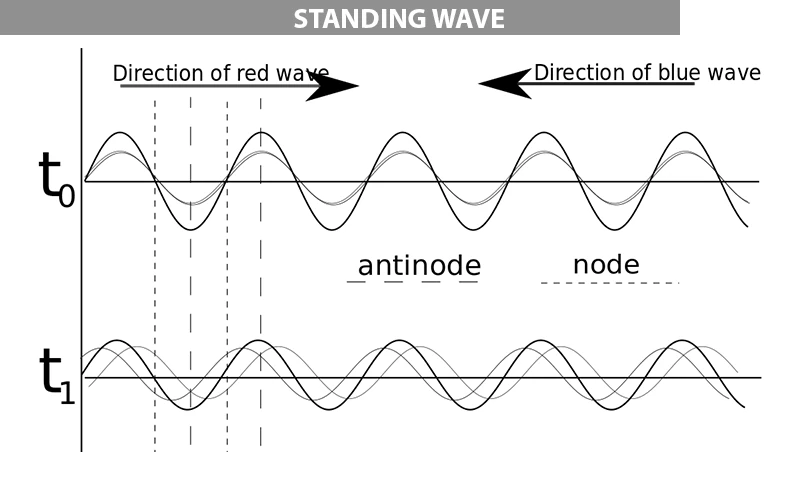
Visual representation of a standing wave
The amplitude becomes zero at points where \( \sin(ku) = 0 \), which occurs when:
\[ ku = n\pi, \quad n = 0, 1, 2, 3, \ldots \]
Substituting the wave number \( k = \frac{2\pi}{\lambda} \), the positions of zero amplitude, called nodes, are located at:
\[ u = \frac{n \lambda}{2} \]
Nodes are spaced half a wavelength apart. Conversely, the points of maximum amplitude, or antinodes, occur where \( |\sin(ku)| = 1 \), i.e.,
\[ ku = \left(n + \frac{1}{2}\right) \pi, \quad n = 0, 1, 2, 3, \ldots \]
Thus, antinodes are positioned at:
\[ u = \frac{(n + \frac{1}{2}) \lambda}{2} \]
These antinodes lie midway between nodes and are separated by \( \frac{\lambda}{2} \).
Example Problem
A string fixed at both ends has a wavelength of \( 0.8 \text{ m} \). Calculate the positions of the first three nodes and antinodes along the string.
Solution:
Given \( \lambda = 0.8 \text{ m} \).
Positions of nodes:
\[ u_n = \frac{n \lambda}{2} = \frac{n \times 0.8}{2} = 0.4n \text{ m}, \quad n=0,1,2 \]
Thus, the first three nodes are at:
\( u_0 = 0 \text{ m} \)
\( u_1 = 0.4 \text{ m} \)
\( u_2 = 0.8 \text{ m} \)
Positions of antinodes:
\[ u_a = \frac{(n + \frac{1}{2}) \lambda}{2} = 0.4 \left(n + \frac{1}{2}\right) \text{ m}, \quad n=0,1,2 \]
Therefore, the first three antinodes are located at:
\( u_0 = 0.2 \text{ m} \)
\( u_1 = 0.6 \text{ m} \)
\( u_2 = 1.0 \text{ m} \)
Characteristics of Nodes and Antinodes in Standing Waves
Understanding Fixed Points of Oscillation
Within a standing wave, certain points remain stationary, exhibiting no displacement. These points are known as nodes. At nodes, the wave's amplitude is always zero, meaning the medium does not move at these locations.
In contrast, points where the wave oscillates with the greatest amplitude are called antinodes. These points lie exactly halfway between two nodes and represent the maximum energy oscillation in the wave.
For example, in a string fixed at both ends, the endpoints are always nodes because they cannot move. The antinodes appear between these fixed points, where the string vibrates most intensely.
Example Problem
A string fixed at both ends vibrates in a standing wave pattern with nodes at \( 0 \text{ m} \), \( 0.5 \text{ m} \), and \( 1.0 \text{ m} \). Identify the positions of the antinodes.
Solution:
Nodes are at \( 0 \text{ m} \), \( 0.5 \text{ m} \), and \( 1.0 \text{ m} \).
Antinodes lie midway between nodes.
Between \( 0 \text{ m} \) and \( 0.5 \text{ m} \), antinode is at \( 0.25 \text{ m} \).
Between \( 0.5 \text{ m} \) and \( 1.0 \text{ m} \), antinode is at \( 0.75 \text{ m} \).
Therefore, antinodes are located at \( 0.25 \text{ m} \) and \( 0.75 \text{ m} \).
Normal Modes: The Natural Patterns of Vibration
Exploring the Fundamental Frequencies of Oscillating Systems
Every oscillating system has specific frequencies at which it naturally vibrates without external forcing. For instance, a mass attached to a spring oscillates at a single natural frequency. However, a stretched string fixed at both ends can vibrate in multiple distinct patterns, each with its own frequency. These patterns are called normal modes or standing waves.
Each normal mode corresponds to a standing wave with a particular number of nodes and antinodes. The fundamental mode has the fewest nodes (only at the ends), while higher modes have additional nodes along the string. These modes determine the harmonic frequencies produced by the string.
Example Problem
A string of length \( 1.2 \text{ m} \) fixed at both ends vibrates in its third normal mode. Calculate the wavelength of the standing wave and the distance between adjacent nodes.
Solution:
In the third normal mode, the string supports three antinodes and four nodes (including the ends).
The wavelength \( \lambda \) is related to the string length \( L \) by:
\[ L = \frac{3 \lambda}{2} \implies \lambda = \frac{2L}{3} = \frac{2 \times 1.2}{3} = 0.8 \text{ m} \]
The distance between adjacent nodes is half the wavelength:
\[ \frac{\lambda}{2} = \frac{0.8}{2} = 0.4 \text{ m} \]
Thus, the wavelength is \( 0.8 \text{ m} \) and nodes are spaced \( 0.4 \text{ m} \) apart.
Quick Reference: Key Points on Standing Waves
Concept | Description | Formula / Relation |
|---|---|---|
Standing Wave Equation | Resultant wave from two opposite traveling waves | \( y(u,t) = 2a \sin(ku) \cos(\omega t) \) |
Node | Point of zero amplitude | \( u = \frac{n \lambda}{2}, \quad n=0,1,2,\ldots \) |
Antinode | Point of maximum amplitude | \( u = \frac{(n + \frac{1}{2}) \lambda}{2}, \quad n=0,1,2,\ldots \) |
Distance between nodes | Half wavelength | \( \frac{\lambda}{2} \) |
Normal Mode | Natural vibration pattern of a string | \( L = \frac{n \lambda}{2}, \quad n=1,2,3,\ldots \) |
Glossary of Important Terms
Term | Definition |
|---|---|
Amplitude | Maximum displacement of a wave from its rest position |
Antinode | Point in a standing wave with maximum oscillation |
Frequency | Number of oscillations per second |
Node | Point in a standing wave with zero displacement |
Normal Mode | Specific pattern of vibration with a characteristic frequency |
Standing Wave | Wave pattern formed by the interference of two waves traveling in opposite directions |
Superposition Principle | The net displacement caused by two or more waves is the sum of their individual displacements |
Wavelength (\( \lambda \)) | Distance between two consecutive points in phase on a wave |
Wave Number (\( k \)) | Number of wavelengths per unit distance, \( k = \frac{2\pi}{\lambda} \) |
Angular Frequency (\( \omega \)) | Rate of change of phase of the wave, related to frequency by \( \omega = 2\pi f \) |
Frequently Asked Questions (FAQs)
What defines a standing wave?
A standing wave is formed when two waves of the same frequency and amplitude travel in opposite directions and interfere, creating fixed points called nodes and antinodes.
How are nodes different from antinodes?
Nodes are points where the wave displacement is always zero, while antinodes are points where the displacement reaches its maximum value.
What determines the positions of nodes on a string?
Nodes occur at positions where \( u = \frac{n \lambda}{2} \), with \( n \) being an integer, meaning they are spaced half a wavelength apart.
What is meant by normal modes of vibration?
Normal modes are the distinct standing wave patterns a system can support, each with a specific frequency and number of nodes and antinodes.
Why do standing waves not appear to travel?
Because the interference of two waves traveling in opposite directions causes fixed points of zero and maximum displacement, the wave pattern appears stationary.