Comprehensive Guide to Spring-Mass Oscillations
Fundamentals of the Spring-Mass Oscillator
Understanding the Spring-Mass Setup
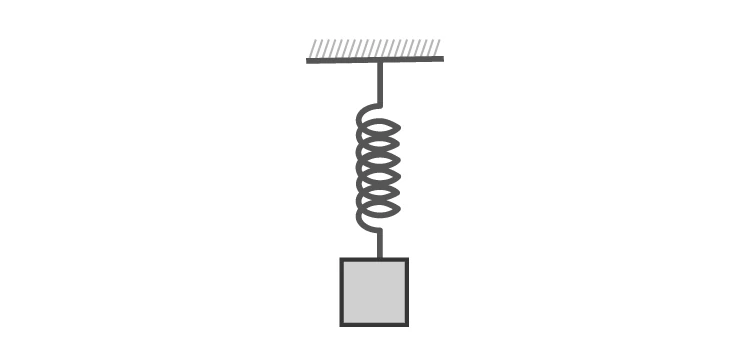
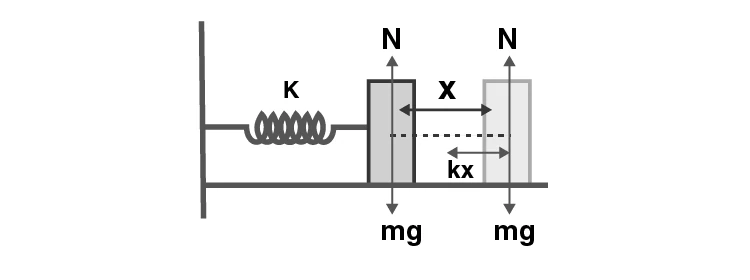
A spring-mass oscillator consists of a mass attached to the free end of a spring. This system is a classic example used to study simple harmonic motion (SHM), where the mass oscillates back and forth when displaced from its equilibrium position. Such systems are not only theoretical models but also find practical applications, such as simulating biomechanical movements like tendon dynamics or skin deformation in computer graphics.
Example: Calculating the Oscillation Period
Consider a mass of 0.5 kg attached to a spring with a spring constant of 200 N/m. Determine the time period of oscillation.
Solution:
The time period \( T \) of a mass-spring system is given by:
\[ T = 2\pi \sqrt{\frac{m}{k}} \]
Substituting the values:
\[ T = 2\pi \sqrt{\frac{0.5}{200}} = 2\pi \sqrt{0.0025} = 2\pi \times 0.05 = 0.314 \text{ s} \]
Therefore, the mass completes one oscillation in approximately 0.314 seconds.
Influence of Mass on Oscillation Period
How Mass Modifies the Oscillation Duration
In a spring-mass system, the oscillation period depends on the mass attached and the spring's stiffness. The relationship is expressed as:
\[ T = 2\pi \sqrt{\frac{m}{k}} \]
This formula reveals that the period is independent of gravitational acceleration and the amplitude of oscillation. A heavier mass results in a longer period, meaning the oscillations slow down as mass increases. This is because the inertia of the mass resists acceleration, causing slower motion.
Example: Effect of Increasing Mass
A spring with a constant \( k = 150 \text{ N/m} \) has a mass of 0.3 kg attached, oscillating with a certain period. If the mass is increased to 0.6 kg, what happens to the period?
Solution:
Initial period:
\[ T_1 = 2\pi \sqrt{\frac{0.3}{150}} = 2\pi \sqrt{0.002} = 2\pi \times 0.0447 = 0.281 \text{ s} \]
New period:
\[ T_2 = 2\pi \sqrt{\frac{0.6}{150}} = 2\pi \sqrt{0.004} = 2\pi \times 0.0632 = 0.397 \text{ s} \]
The period increases, confirming that doubling the mass increases the oscillation time.
Configurations of Spring Systems
Parallel Arrangement of Springs
When multiple springs are connected side-by-side (parallel), the displacement experienced by each spring is identical, but the restoring forces add up. The equivalent spring constant \( K_{eq} \) for springs in parallel is the sum of individual constants:
\[ K_{eq} = K_1 + K_2 + \cdots + K_n \]
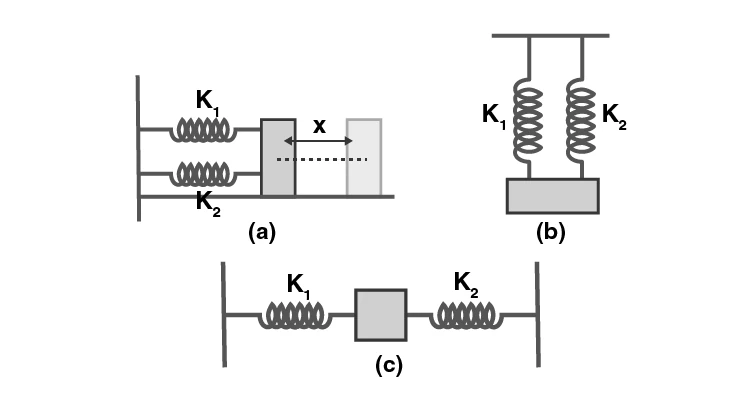
Example: Calculating Equivalent Spring Constant in Parallel
Two springs with constants 100 N/m and 150 N/m are connected in parallel. Find the equivalent spring constant.
Solution:
\[ K_{eq} = 100 + 150 = 250 \text{ N/m} \]
The combined system behaves like a single spring with a stiffness of 250 N/m.
Series Arrangement of Springs
In a series configuration, springs are connected end-to-end. The force on each spring is the same, but the total displacement is the sum of individual displacements. The equivalent spring constant is given by:
\[ \frac{1}{K_{eq}} = \frac{1}{K_1} + \frac{1}{K_2} + \cdots + \frac{1}{K_n} \]
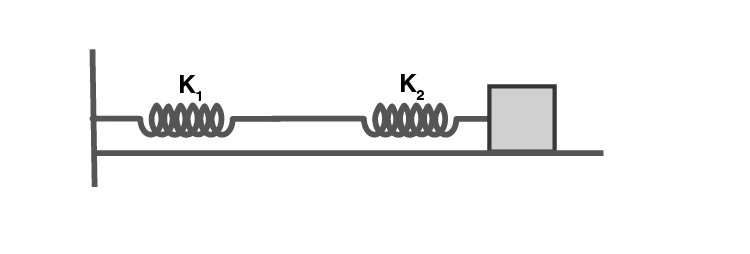
Example: Equivalent Spring Constant in Series
Two springs with constants 120 N/m and 180 N/m are connected in series. Calculate the equivalent spring constant.
Solution:
\[ \frac{1}{K_{eq}} = \frac{1}{120} + \frac{1}{180} = \frac{3}{360} + \frac{2}{360} = \frac{5}{360} \]
\[ K_{eq} = \frac{360}{5} = 72 \text{ N/m} \]
The system acts like a spring with a stiffness of 72 N/m.
Determining the Spring Constant and Its Variations
Relation Between Spring Constant and Physical Properties
Hooke's law states that the restoring force \( F \) exerted by a spring is proportional to the displacement \( x \):
\[ F = -kx \]
The spring constant \( k \) depends on the material's Young's modulus \( Y \), cross-sectional area \( A \), and length \( L \) as:
\[ k = \frac{YA}{L} \]
If a spring is cut into two equal parts, each part's spring constant doubles because the length is halved:
\[ k_{new} = 2k \]
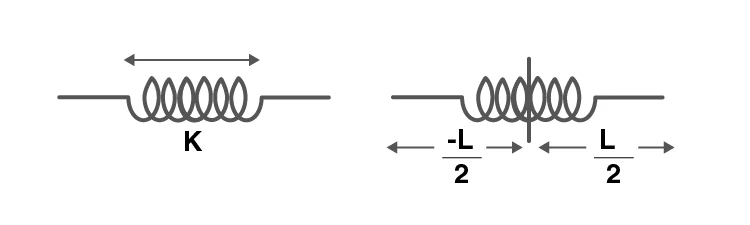
Example: Effect of Cutting a Spring
A spring with a constant of 100 N/m is cut into two equal halves. What is the spring constant of each half?
Solution:
Since \( k \propto \frac{1}{L} \), halving the length doubles the spring constant:
\[ k_{half} = 2 \times 100 = 200 \text{ N/m} \]
Each half is stiffer than the original spring.
Calculating the Oscillation Period of a Spring-Mass System
Stepwise Approach to Find the Time Period
To determine the oscillation period of a mass attached to a spring, follow these steps:
- Identify the equilibrium position where the net force is zero. This corresponds to the spring's natural length.
- Displace the mass slightly by a distance \( x \) from equilibrium. The restoring force is given by:
\[ F = -kx \]
The acceleration \( a \) of the mass is:
\[ a = \frac{F}{m} = -\frac{k}{m} x \]
Since acceleration in SHM is also expressed as:
\[ a = -\omega^2 x \]
Equating the two expressions yields:
\[ \omega = \sqrt{\frac{k}{m}} \]
The time period \( T \) is then:
\[ T = \frac{2\pi}{\omega} = 2\pi \sqrt{\frac{m}{k}} \]
Example: Finding the Period of Oscillation
A 0.4 kg mass is attached to a spring with a spring constant of 80 N/m. Calculate the oscillation period.
Solution:
\[ T = 2\pi \sqrt{\frac{0.4}{80}} = 2\pi \sqrt{0.005} = 2\pi \times 0.0707 = 0.444 \text{ s} \]
The mass completes one oscillation in approximately 0.444 seconds.
Practice Problems on Spring-Mass Oscillations
Problem 1: Velocity and Displacement at Half Maximum Acceleration
A particle undergoing linear SHM has its acceleration at half the maximum value. Determine its velocity and displacement at this instant.
Solution:
Maximum acceleration is \( a_{max} = A \omega^2 \). Given acceleration is half, so:
\[ a = \frac{a_{max}}{2} = A \omega^2 \sin \theta = \frac{A \omega^2}{2} \]
Therefore, phase angle \( \theta = \frac{\pi}{6} \) (since \( \sin \frac{\pi}{6} = \frac{1}{2} \)).
Velocity:
\[ v = A \omega \cos \theta = A \omega \cos \frac{\pi}{6} = A \omega \frac{\sqrt{3}}{2} \]
Displacement:
\[ x = A \sin \theta = A \sin \frac{\pi}{6} = \frac{A}{2} \]
Problem 2: Frequency from Speeds at Different Positions
A particle in SHM has speeds \( v_1 \) and \( v_2 \) at distances \( y_1 \) and \( y_2 \) from equilibrium. Find the oscillation frequency.
Solution:
Velocity in SHM is:
\[ v = \omega \sqrt{A^2 - y^2} \]
Squaring and rearranging:
\[ \frac{v^2}{\omega^2} + y^2 = A^2 \]
Using two points:
\[ \frac{v_1^2}{\omega^2} + y_1^2 = \frac{v_2^2}{\omega^2} + y_2^2 \]
Solving for \( \omega^2 \):
\[ \omega^2 = \frac{v_1^2 - v_2^2}{y_2^2 - y_1^2} \]
Frequency:
\[ f = \frac{\omega}{2\pi} = \frac{1}{2\pi} \sqrt{\frac{v_1^2 - v_2^2}{y_2^2 - y_1^2}} \]
Problem 3: Energy Distribution in SHM
For a particle oscillating with amplitude \( A \):
- Find the kinetic energy fraction when displacement is \( \frac{A}{4} \).
- Determine the displacement where kinetic and potential energies are equal.
Solution:
Kinetic energy:
\[ KE = \frac{1}{2} m \omega^2 (A^2 - y^2) \]
Potential energy:
\[ PE = \frac{1}{2} m \omega^2 y^2 \]
Total energy:
\[ E = \frac{1}{2} m \omega^2 A^2 \]
(a) At \( y = \frac{A}{4} \):
\[ KE = \frac{1}{2} m \omega^2 \left(A^2 - \left(\frac{A}{4}\right)^2\right) = \frac{1}{2} m \omega^2 \frac{15A^2}{16} = \frac{15}{16} E \]
So, kinetic energy is 93.75% of total energy.
(b) For \( KE = PE \):
\[ \frac{1}{2} m \omega^2 (A^2 - y^2) = \frac{1}{2} m \omega^2 y^2 \Rightarrow y = \frac{A}{\sqrt{2}} \]
Problem 4: Oscillation Period with Multiple Springs at Angles
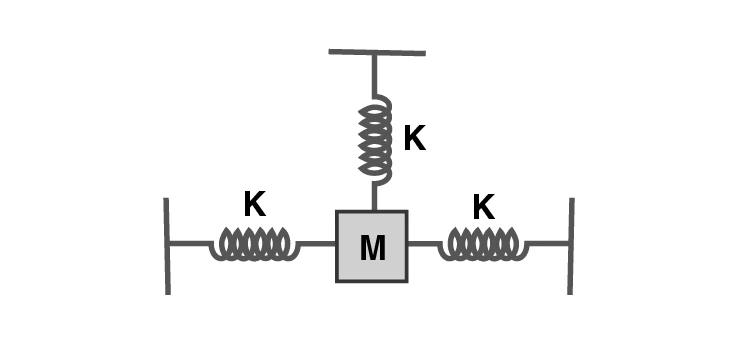
Three identical springs with spring constant \( k \) are connected at equal 120° angles to a mass. Find the oscillation period when the mass is pulled along one spring's direction.
Solution:
Each spring contributes a restoring force component. Using geometry, the net restoring force constant is:
\[ K_{eq} = \frac{3k}{2} \]
Therefore, the time period is:
\[ T = 2\pi \sqrt{\frac{M}{K_{eq}}} = 2\pi \sqrt{\frac{2M}{3k}} \]
Problem 5: Equation of Motion from Mechanical Energy
A 0.25 kg particle oscillates with amplitude 0.3 m. Its mechanical energy at mean position is \( 5 \times 10^{-3} \text{ J} \). Find the equation of motion if the initial phase is 45°.
Solution:
Mechanical energy:
\[ E = \frac{1}{2} m \omega^2 A^2 = 5 \times 10^{-3} \]
Solving for \( \omega^2 \):
\[ \omega^2 = \frac{2E}{m A^2} = \frac{2 \times 5 \times 10^{-3}}{0.25 \times 0.09} = \frac{0.01}{0.0225} = 0.444 \text{ rad}^2/\text{s}^2 \]
\[ \omega = \sqrt{0.444} = 0.666 \text{ rad/s} \]
Equation of motion:
\[ y = 0.3 \sin(0.666 t + \frac{\pi}{4}) \]
Problem 6: Oscillation Period on an Inclined Plane
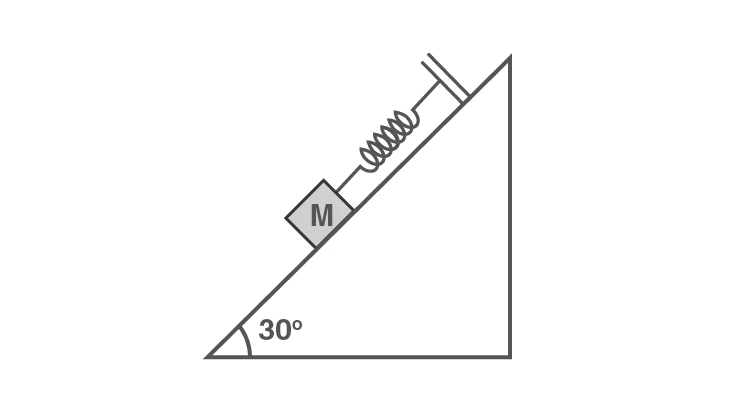
A 0.15 kg block slides without friction on a 25° incline, attached to a spring with force constant 50 N/m. Find the oscillation period if the block is displaced slightly.
Solution:
Effective spring constant along incline remains \( k = 50 \text{ N/m} \).
Mass \( m = 0.15 \text{ kg} \).
Time period:
\[ T = 2\pi \sqrt{\frac{m}{k}} = 2\pi \sqrt{\frac{0.15}{50}} = 2\pi \sqrt{0.003} = 2\pi \times 0.0548 = 0.344 \text{ s} \]
Summary Table for Quick Revision
| Concept | Formula/Relation | Notes |
|---|---|---|
| Time Period of Spring-Mass System | \( T = 2\pi \sqrt{\frac{m}{k}} \) | Depends on mass and spring constant only |
| Equivalent Spring Constant (Parallel) | \( K_{eq} = \sum K_i \) | Displacement same, forces add |
| Equivalent Spring Constant (Series) | \( \frac{1}{K_{eq}} = \sum \frac{1}{K_i} \) | Force same, displacements add |
| Spring Constant Relation | \( k = \frac{YA}{L} \) | Inversely proportional to length |
| Acceleration in SHM | \( a = -\omega^2 x \) | Proportional to displacement |
| Velocity in SHM | \( v = \omega \sqrt{A^2 - x^2} \) | Depends on amplitude and displacement |
| Mechanical Energy in SHM | \( E = \frac{1}{2} m \omega^2 A^2 \) | Constant throughout oscillation |
| Energy Distribution | \( KE = \frac{1}{2} m \omega^2 (A^2 - x^2), \quad PE = \frac{1}{2} m \omega^2 x^2 \) | KE + PE = Total Energy |
| Effect of Mass on Period | Period increases with mass | Heavier mass oscillates slower |
| Effect of Amplitude on Period | Period independent of amplitude | Amplitude affects energy, not period |
Glossary of Key Terms
| Term | Definition |
|---|---|
| Amplitude (A) | Maximum displacement from equilibrium in SHM |
| Equilibrium Position | Position where net force on mass is zero |
| Hooke's Law | Force exerted by spring proportional to displacement |
| Inertia | Resistance of mass to change in motion |
| Oscillation Period (T) | Time taken for one complete cycle of motion |
| Restoring Force | Force that brings the system back to equilibrium |
| Simple Harmonic Motion (SHM) | Periodic motion where acceleration is proportional to displacement |
| Spring Constant (k) | Measure of spring stiffness |
| Young's Modulus (Y) | Material property indicating stiffness |
| Angular Frequency (\( \omega \)) | Rate of change of phase in SHM, related to period by \( \omega = \frac{2\pi}{T} \) |
Frequently Asked Questions
Why does the mass of a pendulum not affect its period, but it does in a spring-mass system?
The pendulum's period depends on gravitational acceleration and length, not mass, because gravitational force and inertia both scale with mass and cancel out. In contrast, a spring-mass system's period depends on mass because the restoring force is provided by the spring, independent of mass, so mass affects inertia and thus the period.
How can the period of oscillation be independent of amplitude?
Although a larger amplitude means the mass travels a greater distance, it also moves faster on average. These effects balance out, keeping the period constant for small oscillations.
What factors influence the period of a mass on a spring?
The period depends on the mass attached and the spring constant. Specifically, \( T = 2\pi \sqrt{\frac{m}{k}} \), so increasing mass increases the period, while a stiffer spring (larger \( k \)) decreases it.
How does connecting springs in series or parallel affect the system's stiffness?
Springs in parallel add their stiffnesses, making the system stiffer. Springs in series reduce overall stiffness, as the equivalent spring constant is less than any individual spring's constant.
What happens to the spring constant if a spring is cut into smaller parts?
Cutting a spring into smaller lengths increases its spring constant inversely proportional to the length. For example, halving the length doubles the spring constant.