Understanding Wave Propagation in Stretched Strings
Fundamentals of Wave Motion in Strings
Nature and Energy of Waves on a String
When a taut string is plucked between two fixed supports, a wave disturbance travels along its length. This disturbance carries energy and momentum without transporting matter. The wave on the string is transverse, meaning the displacement of the string is perpendicular to the direction of wave travel. As the wave moves, each segment of the string gains both kinetic energy, due to motion, and elastic potential energy, due to deformation.
This phenomenon illustrates how mechanical waves transmit energy through a medium by oscillations of particles about their equilibrium positions.
Example: A guitar string is stretched tightly between two poles. When plucked, the wave travels along the string, transferring energy from the point of plucking to the ends. Explain why the wave is transverse and how energy is carried along the string.
Solution:
The string’s particles move up and down (perpendicular) while the wave travels horizontally, confirming the transverse nature.
Energy is transferred as particles oscillate, storing elastic potential energy when displaced and kinetic energy when moving.
The wave transports energy along the string without net movement of the string’s particles.
Factors Influencing Wave Speed in a String
Role of Linear Mass Density and Tension
The speed at which a wave travels along a stretched string depends primarily on two factors: the string’s linear mass density and the tension applied to it. Linear mass density, denoted by \( \mu \), is the mass per unit length of the string, calculated as \( \mu = \frac{m}{l} \), where \( m \) is the mass and \( l \) is the length.
For instance, a thinner guitar string with lower linear density allows waves to move faster compared to a thicker rope. Additionally, increasing the tension \( T \) in the string, such as by tightening the tuning pegs on a guitar, also increases the wave velocity.
The relationship between wave velocity \( v \), tension \( T \), and linear mass density \( \mu \) is given by:
\[ v = \sqrt{\frac{T}{\mu}} \]
Illustration of guitar strings under different tensions affecting wave speed
Example: Two strings, A and B, have linear densities of \( 4.0 \times 10^{-4} \text{ kg/m} \) and \( 8.0 \times 10^{-4} \text{ kg/m} \) respectively. If the tension in string A is \( 50 \text{ N} \) and in string B is \( 200 \text{ N} \), which string will have a higher wave velocity? Calculate the velocities.
Solution:
For string A: \[ v_A = \sqrt{\frac{50}{4.0 \times 10^{-4}}} = \sqrt{125000} = 353.55 \text{ m/s} \]
For string B: \[ v_B = \sqrt{\frac{200}{8.0 \times 10^{-4}}} = \sqrt{250000} = 500 \text{ m/s} \]
String B has a higher wave velocity due to greater tension despite higher linear density.
Deriving the Wave Velocity Formula on a String
Step-by-Step Derivation Using a Pulse Model
To derive the formula for wave speed on a stretched string, consider a single symmetrical pulse traveling along the string. By adopting a reference frame moving with the pulse, the pulse appears stationary while the string moves beneath it.
Focus on a small segment of the string of length \( dl \), which forms an arc of a circle with radius \( R \) and subtends an angle \( 2 d\theta \) at the center. The tension \( T \) acts tangentially at both ends of this segment.
The horizontal components of tension cancel out, while the vertical components combine to provide the restoring force:
\[ F = 2 T \sin d\theta \approx 2 T d\theta = \frac{T dl}{R} \]
The mass of the segment is:
\[ dm = \mu dl \]
This segment undergoes centripetal acceleration towards the center of the circle:
\[ a = \frac{v^2}{R} \]
Applying Newton’s second law:
\[ F = dm \times a \implies \frac{T dl}{R} = \mu dl \times \frac{v^2}{R} \]
Simplifying, we find the wave velocity:
\[ v = \sqrt{\frac{T}{\mu}} \]
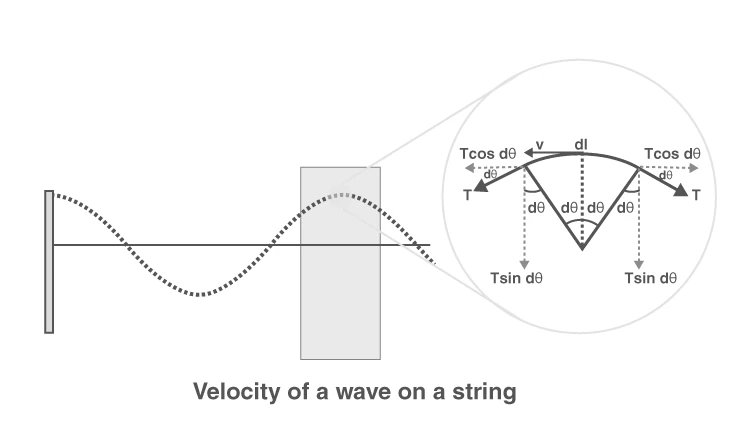
Force analysis on a small string segment during wave motion
Example: A string with linear density \( 2.5 \times 10^{-4} \text{ kg/m} \) is stretched with a tension of \( 40 \text{ N} \). Calculate the speed of a wave traveling along this string.
Solution:
Using the formula:
\[ v = \sqrt{\frac{T}{\mu}} = \sqrt{\frac{40}{2.5 \times 10^{-4}}} = \sqrt{160000} = 400 \text{ m/s} \]
Practical Application: Wave Velocity in Guitar Strings
Calculating Wave Speeds and Tensions in Different Strings
Consider a six-string guitar where the high E string has a linear mass density of \( 3.09 \times 10^{-4} \text{ kg/m} \) and the low E string has \( 5.78 \times 10^{-3} \text{ kg/m} \). The tension in the high E string is \( 56.40 \text{ N} \).
Problem:
Find the wave velocity in the high E string.
Determine whether the tension in the low E string should be higher or lower than the high E string to maintain the same wave speed.
Calculate the required tension in the low E string for equal wave velocity.
Solution:
Wave velocity in high E string:
\[ v = \sqrt{\frac{T}{\mu}} = \sqrt{\frac{56.40}{3.09 \times 10^{-4}}} = \sqrt{182491} \approx 427.23 \text{ m/s} \]
Since the low E string’s linear density is about 20 times greater, to keep the wave speed the same, the tension must also be increased by a factor of 20. Therefore, the low E string requires a higher tension.
Tension in low E string:
\[ T = \mu v^2 = (5.78 \times 10^{-3})(427.23)^2 = 5.78 \times 10^{-3} \times 182491 = 1055 \text{ N} \]
Summary Table for Wave Velocity on Strings
Parameter | Symbol | Definition | Unit |
|---|---|---|---|
Wave Velocity | \( v \) | Speed of wave propagation along the string | m/s |
Tension | \( T \) | Force stretching the string | Newton (N) |
Linear Mass Density | \( \mu \) | Mass per unit length of the string | kg/m |
Mass | \( m \) | Total mass of the string | kg |
Length | \( l \) | Length of the string | m |
Wavelength | \( \lambda \) | Distance between two consecutive wave crests | m |
Frequency | \( f \) | Number of oscillations per second | Hz |
Restoring Force | \( F \) | Force that returns the string to equilibrium | Newton (N) |
Acceleration | \( a \) | Centripetal acceleration of string element | m/s² |
Radius of Curvature | \( R \) | Radius of the arc formed by string segment | m |
Key Terms and Definitions
Term | Meaning |
|---|---|
Transverse Wave | A wave where particle displacement is perpendicular to wave direction |
Linear Mass Density (\( \mu \)) | Mass per unit length of a string |
Tension (\( T \)) | Force applied along the string to stretch it |
Wave Velocity (\( v \)) | Speed at which a wave travels through a medium |
Restoring Force | Force that acts to bring a displaced string element back to equilibrium |
Centripetal Acceleration | Acceleration directed towards the center of curvature of a moving particle |
Wavelength (\( \lambda \)) | Distance between two successive crests or troughs of a wave |
Frequency (\( f \)) | Number of wave oscillations per second |
Mass (\( m \)) | Amount of matter in the string |
Length (\( l \)) | Distance between the two fixed ends of the string |
Frequently Asked Questions
What is the formula to calculate wave velocity on a stretched string?
The wave velocity \( v \) is given by \( v = \sqrt{\frac{T}{\mu}} \), where \( T \) is the tension and \( \mu \) is the linear mass density of the string.
Which factors influence the speed of a wave on a string?
The wave speed depends on the tension applied to the string and its linear mass density. Higher tension increases speed, while greater mass per unit length decreases it.
Does the frequency of vibration affect the wave speed on a string?
No, the frequency does not influence the wave speed. The speed depends only on the string’s tension and linear mass density.
Why are waves on a string called transverse waves?
Because the particles of the string move perpendicular to the direction in which the wave travels.
How can the tension in a guitar string be adjusted?
The tension is changed by turning the tuning pegs, which tightens or loosens the string, thereby altering the wave speed and pitch.