Understanding Longitudinal Waves and Their Properties
Fundamentals of Longitudinal Wave Motion
Defining Longitudinal Waves and Their Behavior
Longitudinal waves are a category of mechanical waves where the particles of the medium oscillate parallel to the direction in which the wave travels. This means the displacement of particles aligns with the wave's propagation path, creating alternating regions of compression and rarefaction. Compression refers to areas where particles are densely packed, while rarefaction indicates regions where particles are spread apart.
The wavelength, denoted by \( \lambda \), is the distance between two successive compressions or rarefactions. When two waves overlap such that their compressions and rarefactions align, constructive interference occurs, amplifying the wave. Conversely, if compressions coincide with rarefactions, destructive interference results, reducing the wave's amplitude.
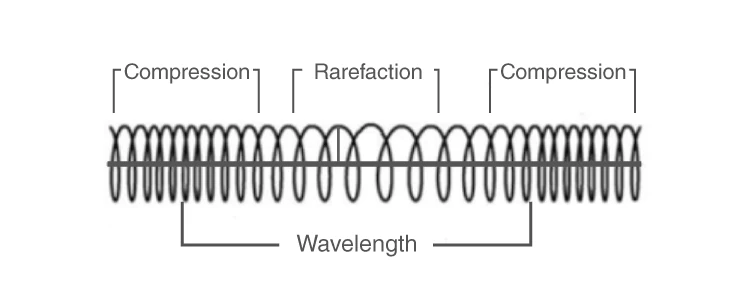
Illustration of compression and rarefaction regions in a longitudinal wave
Example Problem
A longitudinal wave travels through a medium with a wavelength of 0.5 meters. If the wave speed is \( 340 \text{ m/s} \), calculate the frequency of the wave.
Solution:
The frequency \( f \) is related to wave speed \( v \) and wavelength \( \lambda \) by the formula:
\[ f = \frac{v}{\lambda} \]
Substituting the given values:
\[ f = \frac{340 \text{ m/s}}{0.5 \text{ m}} = 680 \text{ Hz} \]
Therefore, the wave frequency is \( 680 \text{ Hz} \).
Mathematical Description and Wave Formula
Wave Equation and Parameters Explained
The displacement \( y \) of a point on a longitudinal wave traveling along the \( x \)-axis can be expressed as:
\[ y(x,t) = y_0 \cos \left[ \omega \left( t - \frac{x}{c} \right) \right] \]
Here, \( y_0 \) represents the amplitude of oscillation, \( \omega \) is the angular frequency, \( c \) is the wave speed, \( x \) is the distance from the source, and \( t \) is the time elapsed. The term \( \frac{x}{c} \) corresponds to the time taken by the wave to reach the point at distance \( x \).
The frequency \( f \) of the wave is related to angular frequency by:
\[ f = \frac{\omega}{2\pi} \]
Example Problem
A longitudinal wave has an angular frequency of \( 400 \text{ rad/s} \) and travels at a speed of \( 320 \text{ m/s} \). Calculate the frequency and the time taken for the wave to travel 1.6 meters.
Solution:
Frequency is given by:
\[ f = \frac{\omega}{2\pi} = \frac{400}{2 \times 3.1416} \approx 63.66 \text{ Hz} \]
Time to travel distance \( x = 1.6 \text{ m} \) is:
\[ t = \frac{x}{c} = \frac{1.6 \text{ m}}{320 \text{ m/s}} = 0.005 \text{ s} \]
Thus, the wave frequency is approximately \( 63.66 \text{ Hz} \) and it takes \( 0.005 \text{ seconds} \) to cover 1.6 meters.
Applications: Sound and Pressure Waves
Sound Waves as Longitudinal Vibrations
Sound waves are classic examples of longitudinal waves generated by vibrating objects. These waves propagate through a medium such as air, water, or solids by compressing and rarefying the particles. The amplitude of a sound wave corresponds to the maximum pressure variation from the ambient atmospheric pressure.
The speed of sound depends on the medium's properties, including its composition and temperature. For instance, sound travels faster in warm air compared to cold air due to increased particle energy.
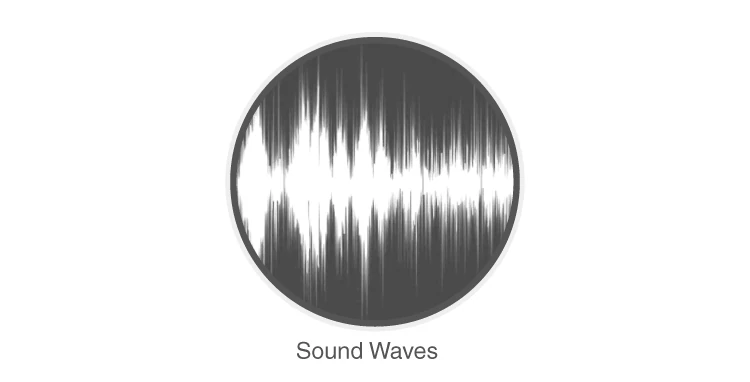
Representation of sound waves propagating as longitudinal waves
Example Problem
A tuning fork produces a sound wave with a frequency of \( 440 \text{ Hz} \). If the speed of sound in air is \( 343 \text{ m/s} \), find the wavelength of the sound wave.
Solution:
Using the relation:
\[ \lambda = \frac{v}{f} = \frac{343 \text{ m/s}}{440 \text{ Hz}} \approx 0.78 \text{ m} \]
The wavelength of the sound wave is approximately \( 0.78 \text{ meters} \).
Understanding Pressure Waves and Their Oscillations
Pressure waves involve the transmission of disturbances through variations in pressure within a medium. These waves can be described by harmonic oscillations where the displacement \( y \) varies with position and time as:
\[ y = y_0 \cos(kx - \omega t + \phi) \]
Here, \( y_0 \) is the amplitude, \( k \) is the wave number, \( \omega \) is the angular frequency, \( x \) is the position along the propagation axis, \( t \) is time, and \( \phi \) is the phase constant.
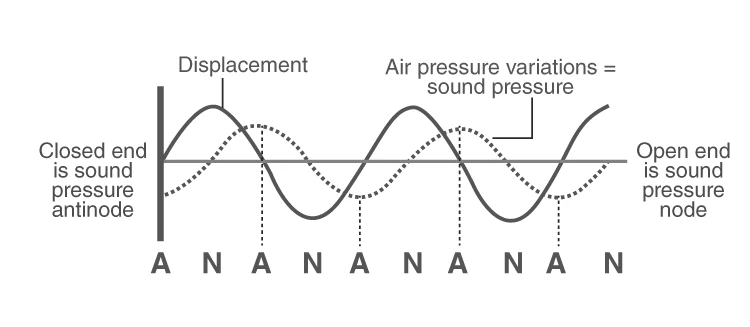
Oscillatory behavior of pressure waves in a medium
Example Problem
A pressure wave has a wave number \( k = 15 \text{ rad/m} \), angular frequency \( \omega = 300 \text{ rad/s} \), and amplitude \( y_0 = 0.02 \text{ m} \). Write the expression for displacement at position \( x = 0.1 \text{ m} \) and time \( t = 0.005 \text{ s} \) assuming phase \( \phi = 0 \).
Solution:
Substitute values into the wave equation:
\[ y = 0.02 \cos(15 \times 0.1 - 300 \times 0.005 + 0) = 0.02 \cos(1.5 - 1.5) = 0.02 \cos(0) = 0.02 \text{ m} \]
The displacement at the given position and time is \( 0.02 \text{ meters} \).
Key Features of Longitudinal Waves
Compression and Rarefaction Explained
In longitudinal waves, compression refers to the zones where particles are densely packed together, resulting in higher pressure. Conversely, rarefaction describes regions where particles are spread apart, causing lower pressure. These alternating zones travel through the medium, carrying energy without transporting matter.
Wavelength and Amplitude in Longitudinal Waves
The wavelength is the spatial distance between two successive compressions or rarefactions. It determines the wave's spatial periodicity. The amplitude is the maximum displacement of particles from their equilibrium position, measured as the distance from the rest point to either a compression or rarefaction.
Period and Frequency Relationship
The period is the time taken for one complete wave cycle to pass a point, while the frequency is the number of wave cycles passing per second. They are inversely related:
\[ f = \frac{1}{T} \]
Example Problem
A longitudinal wave has a frequency of \( 500 \text{ Hz} \). Calculate its period and wavelength if the wave speed is \( 340 \text{ m/s} \).
Solution:
Period \( T \) is:
\[ T = \frac{1}{f} = \frac{1}{500} = 0.002 \text{ s} \]
Wavelength \( \lambda \) is:
\[ \lambda = \frac{v}{f} = \frac{340}{500} = 0.68 \text{ m} \]
Thus, the period is \( 0.002 \text{ seconds} \) and the wavelength is \( 0.68 \text{ meters} \).
Contrasting Longitudinal and Transverse Waves
Differences in Particle Motion and Wave Characteristics
Longitudinal waves feature particle oscillations parallel to the wave's travel direction, producing compressions and rarefactions. In contrast, transverse waves have particle vibrations perpendicular to the wave's direction, forming crests and troughs. Examples of longitudinal waves include sound waves and seismic P-waves, while electromagnetic waves and ocean surface waves are transverse.
Example Question
Explain three fundamental differences between longitudinal and transverse waves.
Answer:
Particle displacement in longitudinal waves is parallel to wave propagation; in transverse waves, it is perpendicular.
Longitudinal waves consist of compressions and rarefactions; transverse waves have crests and troughs.
Longitudinal waves require a medium to travel; some transverse waves, like electromagnetic waves, can propagate through a vacuum.
Quick Reference Summary
Property | Longitudinal Wave | Transverse Wave |
|---|---|---|
Particle Motion | Parallel to wave direction | Perpendicular to wave direction |
Wave Components | Compressions and rarefactions | Crests and troughs |
Examples | Sound waves, seismic P-waves | Light waves, ocean waves |
Medium Requirement | Requires a medium | Some can travel in vacuum |
Wave Speed | Depends on medium elasticity and density | Depends on medium tension and density |
Glossary of Key Terms
Term | Definition |
|---|---|
Amplitude | Maximum displacement of particles from equilibrium in a wave |
Compression | Region in a longitudinal wave where particles are closest together |
Frequency | Number of wave cycles passing a point per second |
Interference | Interaction of two or more waves resulting in constructive or destructive effects |
Longitudinal Wave | Wave with particle displacement parallel to wave propagation |
Rarefaction | Region in a longitudinal wave where particles are spread apart |
Transverse Wave | Wave with particle displacement perpendicular to wave propagation |
Wavelength (\( \lambda \)) | Distance between two successive compressions or rarefactions |
Wave Number (\( k \)) | Number of wave cycles per unit distance, \( k = \frac{2\pi}{\lambda} \) |
Angular Frequency (\( \omega \)) | Rate of change of phase of the wave, related to frequency by \( \omega = 2\pi f \) |
Frequently Asked Questions
What is the formula for a longitudinal wave?
The displacement of a point on a longitudinal wave is given by \( y(x,t) = y_0 \cos \left[ \omega \left( t - \frac{x}{c} \right) \right] \), where \( y_0 \) is amplitude, \( \omega \) is angular frequency, \( c \) is wave speed, \( x \) is position, and \( t \) is time.
What are the main characteristics of sound waves?
Sound waves are characterized by loudness (amplitude), pitch (frequency), and quality (timbre), which depend on the wave's amplitude, frequency, and waveform respectively.
How do ripples form when a pebble is dropped into still water?
Dropping a pebble creates circular ripples due to kinetic energy transferring through oscillating water particles, forming alternating crests and troughs that spread outward.
Are mechanical waves also called elastic waves?
Yes, mechanical waves are often termed elastic waves because they rely on the elastic properties of the medium to propagate disturbances.
Under what condition can sound waves travel through gases?
Sound waves travel through gases under adiabatic conditions, where temperature remains constant during compressions and rarefactions, allowing wave propagation without heat exchange.