Understanding Snell’s Law and Light Refraction
Fundamentals of Light Refraction and Snell’s Principle
Basics of Refraction and Its Governing Law
When light travels from one transparent medium to another, it changes direction at the interface; this phenomenon is called refraction. The extent to which light bends depends on the optical properties of the two media involved. Snell’s Law provides a mathematical relationship to predict the angle of refraction based on the refractive indices of the media and the angle of incidence.
At the point where the light ray strikes the boundary, a perpendicular line called the normal is drawn. The angles of incidence and refraction are measured with respect to this normal. The refractive index quantifies how much a medium slows down light compared to vacuum, influencing the bending of the ray.
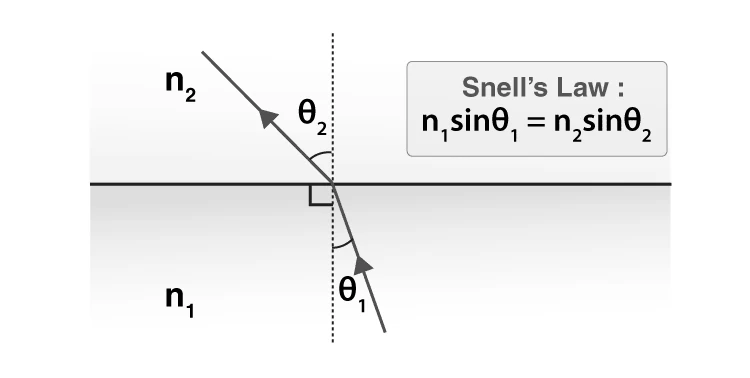
Illustration of Snell’s Law showing incident and refracted rays with normal
Mathematically, Snell’s Law is expressed as:
\[ n_1 \sin \theta_1 = n_2 \sin \theta_2 \]
where \( n_1 \) and \( n_2 \) are the refractive indices of the first and second media, and \( \theta_1 \) and \( \theta_2 \) are the angles of incidence and refraction respectively.
Example: Calculating Refraction Angle from Water to Air
Consider a light ray with wavelength 550 nm traveling from water (refractive index \( n_1 = 1.33 \)) into air (refractive index \( n_2 = 1.0003 \)). If the angle of incidence in water is \( 25^\circ \), find the angle of refraction in air.
Solution:
Using Snell’s Law:
\[ n_1 \sin \theta_1 = n_2 \sin \theta_2 \]
Substitute the known values:
\[ 1.33 \times \sin 25^\circ = 1.0003 \times \sin \theta_2 \]
Calculate \( \sin 25^\circ \):
\[ \sin 25^\circ \approx 0.4226 \]
So,
\[ 1.33 \times 0.4226 = 1.0003 \times \sin \theta_2 \]
\[ 0.562 = 1.0003 \times \sin \theta_2 \]
Therefore,
\[ \sin \theta_2 = \frac{0.562}{1.0003} \approx 0.5618 \]
Find \( \theta_2 \):
\[ \theta_2 = \sin^{-1}(0.5618) \approx 34.2^\circ \]
Answer: The refracted ray makes an angle of approximately \( 34.2^\circ \) with the normal in air.
Analyzing Complex Refraction Through Multiple Media
Light Behavior Across Several Interfaces
When light passes through multiple transparent layers, such as air, glass, and water, it undergoes successive refractions at each boundary. The overall bending depends on the refractive indices of each medium and the angles at which light strikes the interfaces. Despite multiple refractions, the emergent ray can be parallel to the incident ray under certain conditions.
Consider a ray entering a glass slab from air, then passing into water. The refractive indices are \( n_{\text{air}} = 1.0003 \), \( n_{\text{glass}} = 1.5 \), and \( n_{\text{water}} = 1.33 \). Snell’s Law applies at each interface:
\[ n_1 \sin \theta_1 = n_2 \sin \theta_2 \]
Rearranged, it can be expressed as:
\[ \sin \theta_2 = \frac{n_1}{n_2} \sin \theta_1 \]
When light moves from a medium with a higher refractive index to a lower one, it bends away from the normal; conversely, it bends towards the normal when moving from lower to higher refractive index.
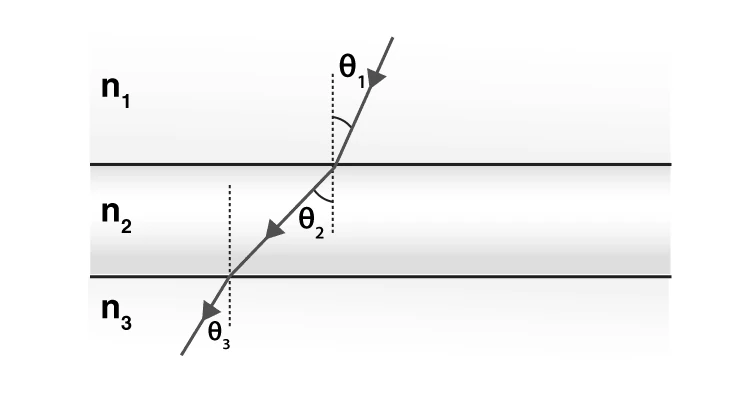
Light refraction through multiple media layers
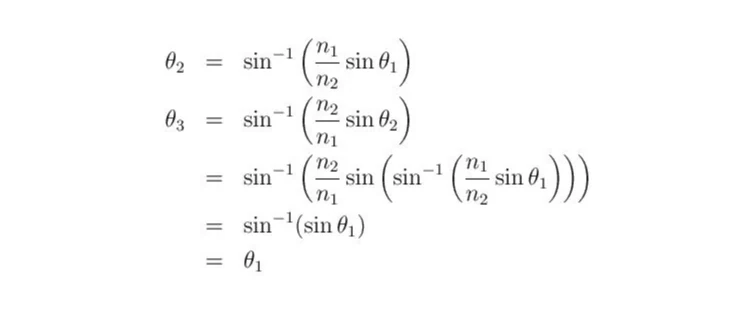
Detailed illustration of Snell’s Law with multiple refractions
Example: Refraction Through a Glass Slab
A light ray strikes a glass slab (refractive index 1.5) from air at an angle of \( 40^\circ \). Calculate the angle of refraction inside the glass.
Solution:
Apply Snell’s Law:
\[ n_{\text{air}} \sin \theta_{\text{air}} = n_{\text{glass}} \sin \theta_{\text{glass}} \]
Substitute values:
\[ 1.0003 \times \sin 40^\circ = 1.5 \times \sin \theta_{\text{glass}} \]
Calculate \( \sin 40^\circ \):
\[ \sin 40^\circ \approx 0.6428 \]
So,
\[ 1.0003 \times 0.6428 = 1.5 \times \sin \theta_{\text{glass}} \]
\[ 0.643 = 1.5 \times \sin \theta_{\text{glass}} \]
Therefore,
\[ \sin \theta_{\text{glass}} = \frac{0.643}{1.5} \approx 0.4287 \]
Find \( \theta_{\text{glass}} \):
\[ \theta_{\text{glass}} = \sin^{-1}(0.4287) \approx 25.4^\circ \]
Answer: The refracted ray inside the glass slab makes an angle of approximately \( 25.4^\circ \) with the normal.
Practical Implications and Everyday Examples of Refraction
Understanding Refraction in Daily Life and Optical Devices
Refraction explains many common phenomena, such as why objects under water appear shifted from their actual position. For instance, when fishing with a spear, the apparent position of the fish is different due to light bending at the water surface, making it easier to aim. In contrast, fishing with a rod requires compensating for this effect.
Refraction is also fundamental in designing lenses for glasses, cameras, and microscopes, where controlling light paths is essential. The bending of light rays allows lenses to focus or disperse light, enabling clear vision or magnification.
Visual representation of refraction effects in practical use
Example: Apparent Depth of an Object Under Water
A fish is located 1.2 m below the water surface. Calculate the apparent depth as seen by an observer above the water. The refractive index of water is 1.33.
Solution:
The apparent depth \( d_a \) is related to the real depth \( d_r \) by:
\[ d_a = \frac{d_r}{n} \]
Substitute the values:
\[ d_a = \frac{1.2 \text{ m}}{1.33} \approx 0.90 \text{ m} \]
Answer: The fish appears to be at a depth of approximately 0.90 m from the water surface.
Quick Reference: Key Points on Snell’s Law and Refraction
Concept | Details |
|---|---|
Refraction | Bending of light when it passes from one medium to another |
Snell’s Law | \( n_1 \sin \theta_1 = n_2 \sin \theta_2 \) |
Refractive Index | Ratio of speed of light in vacuum to speed in medium |
Angle of Incidence | Angle between incident ray and normal |
Angle of Refraction | Angle between refracted ray and normal |
Light from denser to rarer medium | Ray bends away from the normal |
Light from rarer to denser medium | Ray bends towards the normal |
Apparent Depth | Object appears shallower due to refraction |
Applications | Optical lenses, fishing, prisms, cameras |
Critical Angle | Angle of incidence for total internal reflection (not covered in detail here) |
Glossary of Important Terms
Term | Definition |
|---|---|
Refraction | The bending of light as it passes from one medium to another |
Snell’s Law | Mathematical relation between angles and refractive indices during refraction |
Refractive Index | Measure of how much a medium slows down light compared to vacuum |
Angle of Incidence | Angle between incoming ray and the normal at the interface |
Angle of Refraction | Angle between refracted ray and the normal |
Normal | Perpendicular line to the surface at the point of incidence |
Apparent Depth | Perceived depth of an object due to refraction |
Medium | Material through which light travels |
Total Internal Reflection | Phenomenon when light reflects completely inside a denser medium |
Critical Angle | Minimum angle of incidence for total internal reflection to occur |
Frequently Asked Questions
What is Snell’s Law in physics?
Snell’s Law describes how light bends when it passes between two media with different refractive indices, relating the angles of incidence and refraction mathematically.
Why is Snell’s Law important?
It helps predict the path of light rays in lenses, prisms, and other optical devices, enabling the design of instruments like glasses and cameras.
How is the angle of refraction defined?
The angle of refraction is the angle between the refracted ray and the normal line at the interface between two media.
What causes light to refract?
Refraction occurs because light changes speed when it moves from one medium to another, causing it to bend at the boundary.
Which factors influence the amount of refraction?
The refractive indices of the two media and the angle of incidence primarily determine the degree of bending of light.