Understanding Single Slit Diffraction of Light
Fundamentals of Light Diffraction
Concept and Nature of Diffraction
Diffraction refers to the phenomenon where light waves bend around obstacles or pass through narrow openings, causing the waves to spread out and illuminate regions that would otherwise be shadowed. This effect is closely linked with interference, as both occur simultaneously and influence the resulting light pattern. A common natural example is the silver lining seen around clouds, which arises due to diffraction of sunlight passing through water droplets.
Example: When sunlight encounters a cloud edge, the bending of light waves around the droplets creates a bright outline known as the silver lining.
Observing Diffraction with a Single Narrow Slit
When a beam of coherent light passes through a single slit whose width is comparable to the wavelength of the light, the light waves spread out and interfere with each other, producing a characteristic diffraction pattern on a distant screen. This pattern consists of a central bright band flanked by alternating dark and bright fringes, with intensity diminishing away from the center. The extent of spreading depends on the slit width relative to the wavelength.
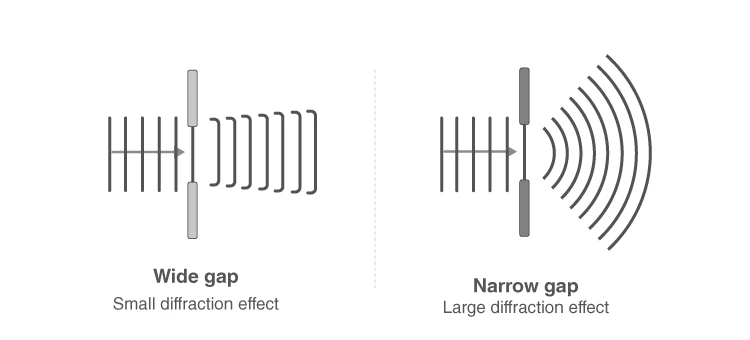
Illustration of a typical diffraction pattern formed by a single slit
Example: If a slit width is reduced to be close to the wavelength of the incident light, the diffraction pattern becomes more pronounced with wider spreading of the central maximum.
Mathematical Description of Single Slit Diffraction
Deriving the Condition for Dark Fringes
Consider a single slit of width \( a \) illuminated by monochromatic light of wavelength \( \lambda \). The screen is placed at a distance \( L \) much greater than \( a \). The angular position \( \theta \) on the screen is measured from the central axis perpendicular to the slit. To analyze the diffraction pattern, the slit is conceptually divided into equal segments, and pairs of rays separated by \( a/2 \) are considered to determine conditions for destructive interference.
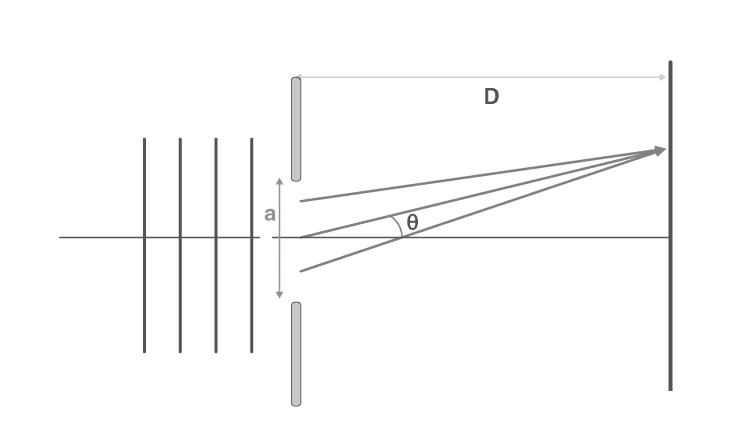
Setup illustrating single slit diffraction and angular measurement
The path difference between two rays separated by \( a/2 \) is given by:
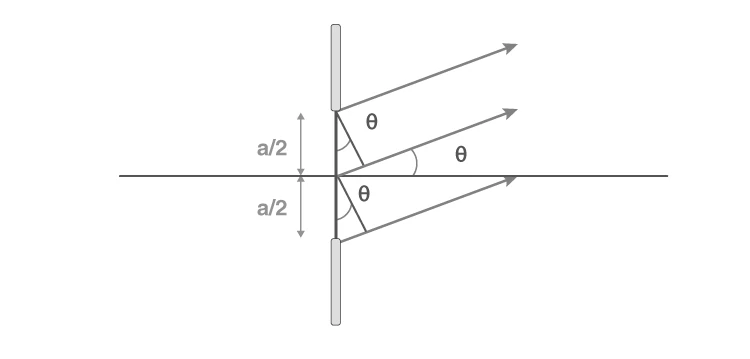
Path difference between rays separated by half the slit width
For destructive interference (dark fringes), the path difference must be an odd multiple of half the wavelength. The first minimum occurs at an angle \( \theta \) satisfying:
\[ a \sin \theta = \lambda \]
Higher order minima occur at:
\[ a \sin \theta = n \lambda, \quad n = 1, 2, 3, \ldots \]
Example: Calculate the angle for the first dark fringe if a slit of width \( 0.6 \times 10^{-4} \text{ cm} \) is illuminated by light of wavelength \( 600 \text{ nm} \).
Solution:
Given: \( a = 0.6 \times 10^{-4} \text{ cm} = 6 \times 10^{-6} \text{ m} \), \( \lambda = 600 \text{ nm} = 6 \times 10^{-7} \text{ m} \)
Using the first minimum condition:
\[ \sin \theta = \frac{\lambda}{a} = \frac{6 \times 10^{-7}}{6 \times 10^{-6}} = 0.1 \]
Therefore, \( \theta = \sin^{-1}(0.1) \approx 5.74^\circ \).
Characteristics of the Central Bright Fringe
Width and Angular Spread of the Central Maximum
The central bright fringe, or central maximum, is the most intense part of the diffraction pattern and lies between the first minima on either side. The position \( y \) of the minima on a screen placed at distance \( D \) from the slit is related to the angle \( \theta \) by:
\[ y = D \tan \theta \approx D \sin \theta \]
For small angles, \( \sin \theta \approx \theta \), so using the first minimum condition:
\[ \theta = \frac{\lambda}{a} \implies y = \frac{\lambda D}{a} \]
The width of the central maximum is twice this distance:
\[ \text{Width} = 2y = \frac{2 \lambda D}{a} \]
The angular width of the central bright fringe is:
\[ 2 \theta = \frac{2 \lambda}{a} \]
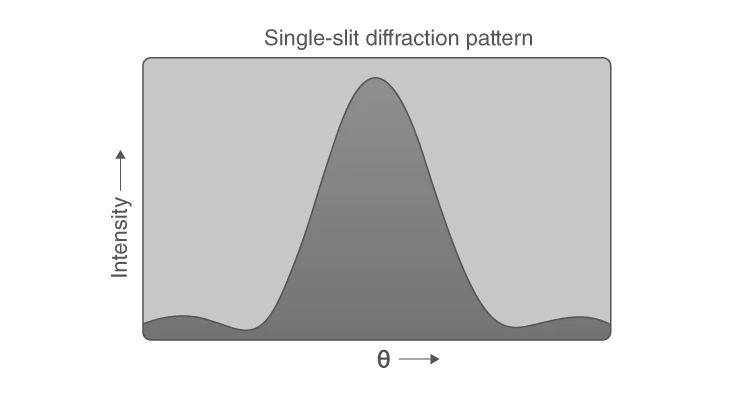
Graph showing intensity distribution and diffraction pattern for a single slit
Example: A slit of width \( 0.2 \text{ mm} \) is illuminated by light of wavelength \( 500 \text{ nm} \). If the screen is placed \( 1.5 \text{ m} \) away, find the width of the central maximum.
Solution:
Given: \( a = 0.2 \times 10^{-3} \text{ m} \), \( \lambda = 500 \times 10^{-9} \text{ m} \), \( D = 1.5 \text{ m} \)
Width of central maximum:
\[ = \frac{2 \lambda D}{a} = \frac{2 \times 500 \times 10^{-9} \times 1.5}{0.2 \times 10^{-3}} = \frac{1.5 \times 10^{-6}}{0.2 \times 10^{-3}} = 7.5 \times 10^{-3} \text{ m} = 7.5 \text{ mm} \]
The central bright fringe will be approximately 7.5 mm wide on the screen.
Summary of Key Points on Single Slit Diffraction
Concept | Explanation |
|---|---|
Diffraction | Bending and spreading of light waves around obstacles or through narrow openings. |
Single Slit Diffraction | Diffraction pattern formed when light passes through a slit comparable in size to its wavelength. |
Dark Fringe Condition | Occurs at angles where \( a \sin \theta = n \lambda \), causing destructive interference. |
Central Maximum Width | Width on screen is \( \frac{2 \lambda D}{a} \), where \( D \) is distance to screen. |
Angular Width | Angular spread of central maximum is \( \frac{2 \lambda}{a} \). |
Glossary of Important Terms
Term | Definition |
|---|---|
Diffraction | The bending and spreading of waves when they encounter an obstacle or slit. |
Wavelength (\( \lambda \)) | The distance between two consecutive peaks of a wave. |
Slit Width (\( a \)) | The physical width of the opening through which light passes. |
Interference | The phenomenon where two or more waves superpose to form a resultant wave. |
Central Maximum | The brightest and widest fringe at the center of a diffraction pattern. |
Dark Fringe | A region of destructive interference resulting in minimum light intensity. |
Angular Position (\( \theta \)) | The angle at which a fringe appears relative to the central axis. |
Path Difference | The difference in distance traveled by two waves from their sources to a point. |
Coherent Light | Light waves having constant phase difference and same frequency. |
Screen Distance (\( D \)) | The distance between the slit and the observation screen. |
Frequently Asked Questions
What causes the dark fringes in single slit diffraction?
Dark fringes occur due to destructive interference when the path difference between light waves from different parts of the slit equals an integer multiple of the wavelength, causing cancellation of light intensity.
How is the width of the central maximum related to slit width?
The width of the central maximum is inversely proportional to the slit width; narrower slits produce wider central maxima.
Why does diffraction become noticeable only when slit width is comparable to wavelength?
Diffraction effects are significant when the slit width is on the order of the wavelength because wave nature dominates and causes noticeable spreading; larger slits produce minimal diffraction.
What is the significance of the angle \( \theta \) in diffraction?
The angle \( \theta \) represents the direction from the central axis where minima and maxima appear on the screen, helping to locate the fringes in the diffraction pattern.
Can diffraction patterns be observed with other waves besides light?
Yes, diffraction occurs with all types of waves including sound, water, and electron waves, wherever wave behavior is present.