Understanding the Link Between Uniform Circular Motion and Simple Harmonic Motion
Relating Circular Motion to Oscillatory Movement
Visualizing the Projection of Circular Motion as Oscillation
Consider a stone tied to a string and swung at a steady angular velocity in a horizontal circle around a fixed point. This stone undergoes uniform circular motion. When viewed from the side, the stone's movement appears as a back-and-forth oscillation along a straight horizontal line, with the string's fixed end acting as the midpoint of this motion.
Similarly, the shadow or projection of the stone onto a plane perpendicular to the circle's plane also exhibits a to-and-fro motion. This observation was historically significant; Galileo noted that Jupiter's four main moons moved in such a manner relative to the planet, demonstrating simple harmonic motion characteristics.
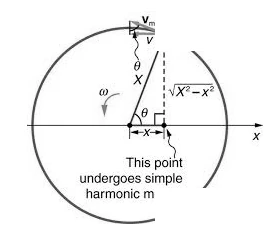
Example: Interpreting Oscillation from Circular Motion
A particle moves in a circle of radius 0.5 m at a constant angular speed of 4 rad/s. Determine the equation describing the particle's projection on the horizontal axis if its initial angular position is zero.
Solution:
The position of the particle at time \( t \) is given by the angle \( \theta = \omega t + \phi \), where \( \omega = 4 \text{ rad/s} \) and \( \phi = 0 \).
The horizontal projection \( x(t) \) is:
\[ x(t) = A \cos(\omega t + \phi) = 0.5 \cos(4t) \text{ meters} \]
This equation represents simple harmonic motion with amplitude 0.5 m and angular frequency 4 rad/s.
Mathematical Representation of SHM from Circular Motion
Deriving the Position Function of Oscillatory Motion
For a particle moving uniformly in a circle of radius \( A \) with angular velocity \( \omega \), its angular position at time \( t \) is \( \theta = \omega t + \phi \), where \( \phi \) is the initial phase angle. The projection of this particle on the x-axis, denoted as \( x(t) \), follows the relation:
\[ x(t) = A \cos(\omega t + \phi) \]
This formula describes the position of a particle undergoing simple harmonic motion (SHM) along a line, with amplitude \( A \), angular frequency \( \omega \), and phase \( \phi \).
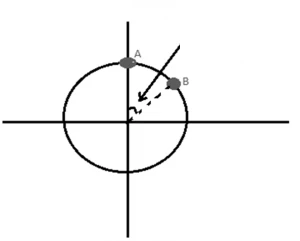
Example: Position Function of a Particle in SHM
A particle oscillates with amplitude 0.3 m and angular frequency 5 rad/s. If its initial phase is \( \frac{\pi}{4} \), write the expression for its displacement at time \( t \).
Solution:
Using the SHM formula:
\[ x(t) = A \cos(\omega t + \phi) = 0.3 \cos(5t + \frac{\pi}{4}) \text{ meters} \]
This equation gives the particle's displacement at any time \( t \).
Analyzing Meeting Times and Velocities in SHM
Calculating When Two Oscillating Particles Align
Consider two particles, A and B, oscillating with the same amplitude \( A \) and angular frequency \( \omega \), but with a phase difference of \( \frac{\pi}{3} \). Their displacements are given by:
\[ x_A = A \sin(\omega t), \quad x_B = A \sin\left(\omega t + \frac{\pi}{3}\right) \]
We want to find the first time \( t \) when both particles have the same displacement, i.e., when they meet.
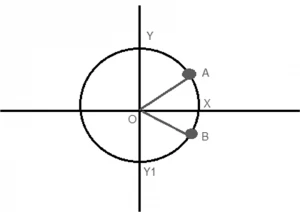
Since both particles have the same angular speed, the angle between them remains constant at \( \frac{\pi}{3} \). If particle A moves through an angle \( \theta \) before meeting B, the condition for equal projections is:
\[ \angle AOX = \angle BOX \]
Given the phase difference:
\[ \angle AOB = \frac{\pi}{3} \]
From these, it follows that:
\[ \angle AOX = \frac{\pi}{6} \]
The time taken for this is:
\[ t = \frac{\pi}{3 \omega} \]
Example: Time for Two Oscillators to Meet
Two particles oscillate with amplitude 0.4 m and angular frequency 6 rad/s, with a phase difference of \( \frac{\pi}{3} \). Calculate the first time they have the same displacement.
Solution:
Using the formula:
\[ t = \frac{\pi}{3 \omega} = \frac{\pi}{3 \times 6} = \frac{\pi}{18} \approx 0.1745 \text{ seconds} \]
Thus, the particles first meet after approximately 0.1745 seconds.
Determining When Velocities Match in Magnitude
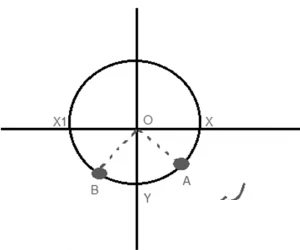
To find when the two particles have the same velocity magnitude, we analyze their velocity vectors. Although their speeds may be equal, their directions differ due to phase difference. The condition for equal magnitude of displacement leads to:
\[ \angle AOY = \angle BOY \]
With the known phase difference:
\[ \angle AOB = \frac{\pi}{3} \]
We find:
\[ \angle AOY = \frac{\pi}{6} \]
The total angle covered by particle A is:
\[ \pi - \frac{\pi}{6} = \frac{5\pi}{6} \]
Therefore, the time taken is:
\[ t = \frac{5\pi}{6 \omega} \]
Example: Time for Equal Velocity Magnitude
Using the previous example's parameters, find when the two particles first have the same velocity magnitude.
Solution:
\[ t = \frac{5\pi}{6 \times 6} = \frac{5\pi}{36} \approx 0.4363 \text{ seconds} \]
Hence, they have equal velocity magnitude after approximately 0.4363 seconds.
Summary Table: Key Points on SHM and Circular Motion
| Concept | Description |
|---|---|
| Uniform Circular Motion | Movement of a particle at constant speed along a circular path. |
| Simple Harmonic Motion (SHM) | Oscillatory motion where acceleration is proportional and opposite to displacement. |
| Projection Relation | SHM can be seen as the projection of uniform circular motion on a diameter. |
| Position Equation | \( x(t) = A \cos(\omega t + \phi) \) |
| Angular Frequency | \( \omega = 2\pi f = \frac{2\pi}{T} \) |
| Phase Difference | Difference in initial angles between two oscillators, affects meeting times. |
| Time Period | \( T = \frac{2\pi}{\omega} \) |
| Velocity in SHM | Velocity magnitude varies sinusoidally, direction changes with phase. |
| Meeting Time Formula | \( t = \frac{\text{phase difference}}{\omega} \) |
| Amplitude | Maximum displacement from mean position in SHM. |
Glossary of Important Terms
| Term | Definition |
|---|---|
| Amplitude | Maximum displacement from the equilibrium position in SHM. |
| Angular Frequency (\( \omega \)) | Rate of change of angular displacement, measured in radians per second. |
| Phase | Initial angle or position of the particle in its oscillation cycle. |
| Phase Difference | Angular difference between two oscillating particles at a given time. |
| Simple Harmonic Motion (SHM) | Oscillatory motion where acceleration is proportional to and opposite displacement. |
| Uniform Circular Motion | Motion of a particle moving at constant speed along a circular path. |
| Displacement | Distance of the particle from its mean position at any instant. |
| Time Period (T) | Time taken to complete one full oscillation or revolution. |
| Frequency (f) | Number of oscillations per second, reciprocal of time period. |
| Velocity in SHM | Rate of change of displacement, varies sinusoidally with time. |
Frequently Asked Questions
What defines uniform circular motion?
It is the motion of an object moving at a constant speed along a circular path.
How is simple harmonic motion characterized?
SHM is a type of oscillation where acceleration is directly proportional and opposite to displacement from the mean position.
Is oscillatory motion always periodic?
Yes, oscillatory motion repeats itself in equal intervals and is bounded between two extreme points.
What formulas relate time period and frequency in SHM?
The time period \( T = \frac{2\pi}{\omega} \) and frequency \( f = \frac{1}{T} \), where \( \omega \) is angular frequency.
Why is uniform circular motion considered a periodic motion?
Because the object repeats its position after every full rotation, making the motion periodic.