Fundamentals of Rotational Motion in Physics
Understanding Rotational Motion and Its Types
Basics of Rotational Movement
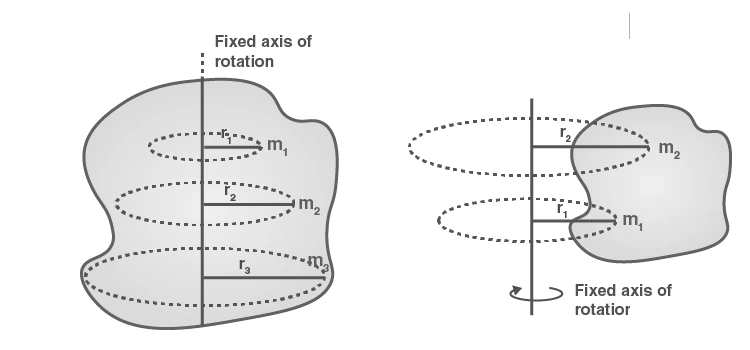
Physics explains the natural laws governing motion, including rotational motion where objects spin around an axis. Unlike linear motion where objects move along a path, rotational motion involves particles moving in circular paths about a fixed line called the axis of rotation. This motion is common in everyday life, from spinning fans to celestial bodies.
In rotational motion, different parts of a rigid body move with varying velocities depending on their distance from the axis, but all share the same angular velocity. This fundamental concept helps us analyze how bodies rotate and the forces involved.
Example: Identifying Types of Rotational Motion
Classify the following motions:
- Rotation of a ceiling fan
- Rolling of a bicycle wheel
- Earth revolving around the Sun
Solution:
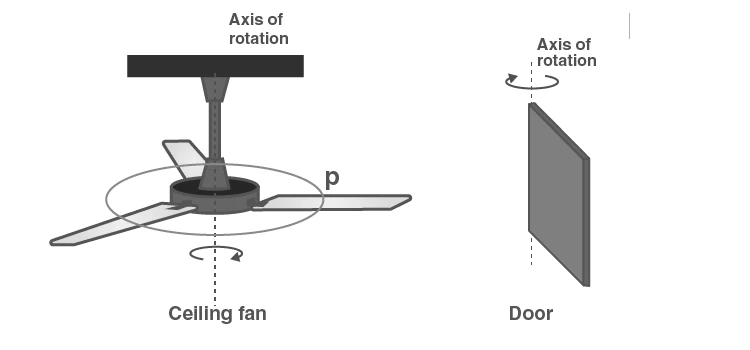
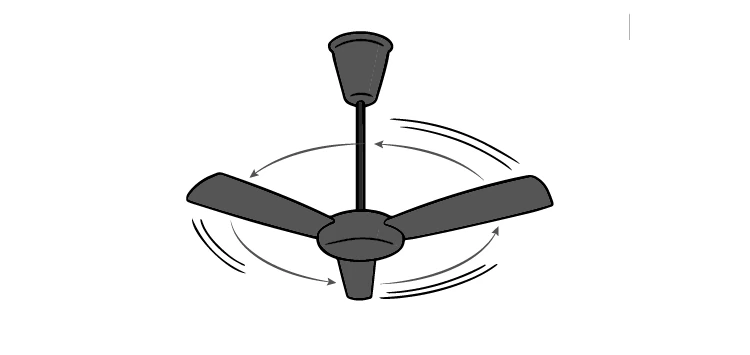
- Ceiling fan: Rotation about a fixed axis (pure rotation)
- Bicycle wheel: Combined translational and rotational motion (rolling)
- Earth around Sun: Rotation about an axis in space (orbital motion)
Categories of Rotational Motion
Rotational motion can be broadly divided into:
- Pure Rotation: The object spins around a fixed axis without translation, such as a fan blade or clock hands.
- Rolling Motion: Combines rotation about an axis and translation of the center of mass, like a rolling wheel.
- Rotation about a Moving Axis: The axis itself rotates or moves, a complex motion beyond basic scope.
Rotational Kinematics and Angular Quantities
Angular Motion Parameters and Equations
Rotational kinematics studies the relationships between angular displacement, velocity, and acceleration. These angular quantities are analogous to linear motion parameters but describe rotation about an axis.
For constant angular acceleration \( \alpha \), the angular velocity \( \omega \) and angular displacement \( \theta \) follow equations similar to linear motion:
\[ \omega = \omega_0 + \alpha t \]
\[ \theta = \omega_0 t + \frac{1}{2} \alpha t^2 \]
where \( \omega_0 \) is the initial angular velocity and \( t \) is time.
Example: Angular Velocity and Displacement from Variable Angular Acceleration
A wheel has angular acceleration \( \alpha = 5t^3 - 4t^2 \) rad/s², with initial angular velocity \( \omega_0 = 2 \text{ rad/s} \). Find expressions for:
- Angular velocity \( \omega(t) \)
- Angular displacement \( \theta(t) \)
Solution:
1. Using \( \alpha = \frac{d\omega}{dt} \), integrate:
\[ \omega = \omega_0 + \int_0^t (5t^3 - 4t^2) dt = 2 + \left( \frac{5t^4}{4} - \frac{4t^3}{3} \right) \]
2. Since \( \omega = \frac{d\theta}{dt} \), integrate again:
\[ \theta = \int_0^t \omega dt = \int_0^t \left( 2 + \frac{5t^4}{4} - \frac{4t^3}{3} \right) dt = 2t + \frac{t^5}{4} - t^4 \]
Rotational Dynamics: Torque, Moment of Inertia, and Energy
Rotational Kinetic Energy and Moment of Inertia
Objects rotating about an axis possess rotational kinetic energy, which depends on their moment of inertia \( I \) and angular velocity \( \omega \). The moment of inertia quantifies how mass is distributed relative to the axis and affects the resistance to angular acceleration.
The total rotational kinetic energy is given by:
\[ KE = \frac{1}{2} I \omega^2 \]
where \( I = \sum m_i r_i^2 \) for discrete masses or \( I = \int r^2 dm \) for continuous bodies.
Torque and Its Role in Rotation
Torque \( \vec{\tau} \) is the rotational equivalent of force, causing objects to spin about an axis. It depends on the applied force \( \vec{F} \), the distance \( r \) from the axis (lever arm), and the angle \( \theta \) between them:
\[ \vec{\tau} = \vec{r} \times \vec{F} = r F \sin \theta \]
The direction of torque is determined by the right-hand rule, indicating the axis of rotation.
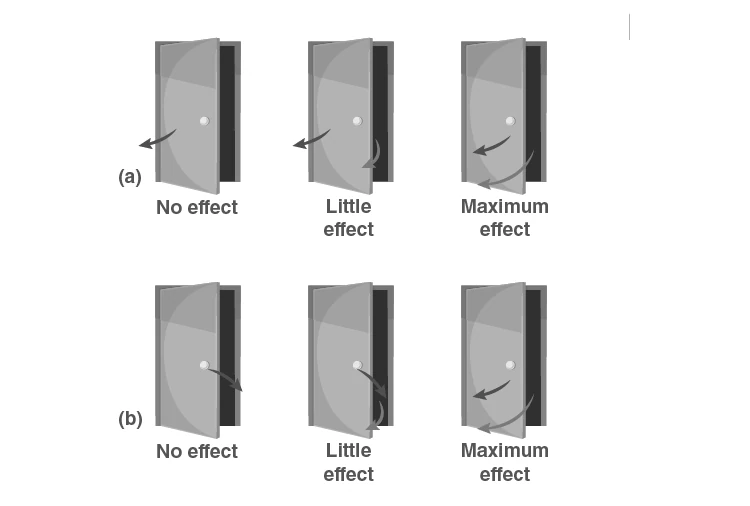
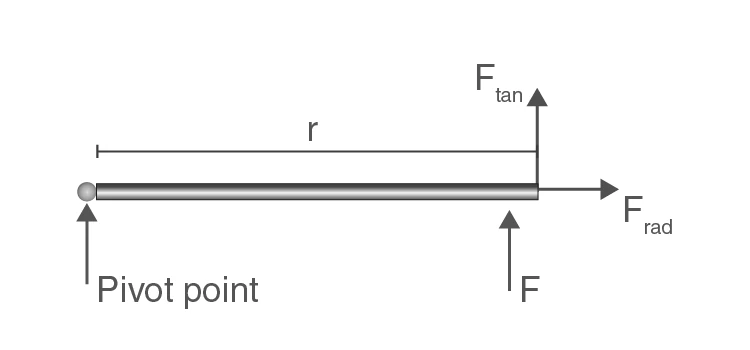
Example: Calculating Torque on a Door
A force of 15 N is applied at a distance of 0.8 m from the hinge of a door at an angle of 60° to the door plane. Find the magnitude of the torque.
Solution:
Calculate the tangential component:
\[ \tau = r F \sin \theta = 0.8 \times 15 \times \sin 60^\circ = 0.8 \times 15 \times 0.866 = 10.39 \text{ Nm} \]
Newton’s Second Law for Rotation and Stability
Newton’s second law for rotational motion relates net torque \( \tau \), moment of inertia \( I \), and angular acceleration \( \alpha \):
\[ \tau = I \alpha \]
Objects with larger moments of inertia are harder to rotate and thus more stable. Stability also depends on the torque produced by the object's weight relative to its center of mass.
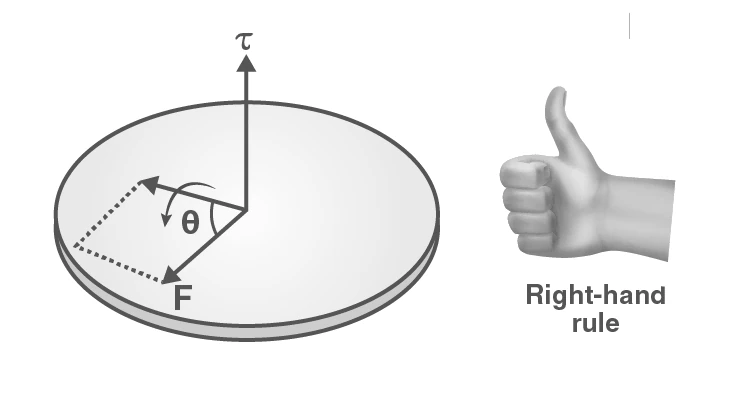
Example: Equilibrium of Forces on a Rod
Two forces of 25 N and 35 N act on a rod at points 0.3 m and 0.6 m from one end. Find the magnitude and position of a third force to keep the rod in equilibrium.
Solution:
For translational equilibrium:
\[ 25 + F = 35 \implies F = 10 \text{ N} \]
For rotational equilibrium about the end:
\[ 25 \times 0.3 = 10 \times x \implies x = \frac{7.5}{10} = 0.75 \text{ m} \]
The third force of 10 N must act at 0.75 m from the end.
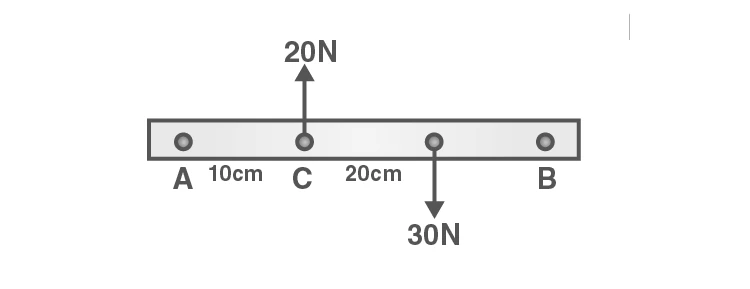
Angular Momentum and Conservation Principles
Angular Momentum of Particles and Rigid Bodies
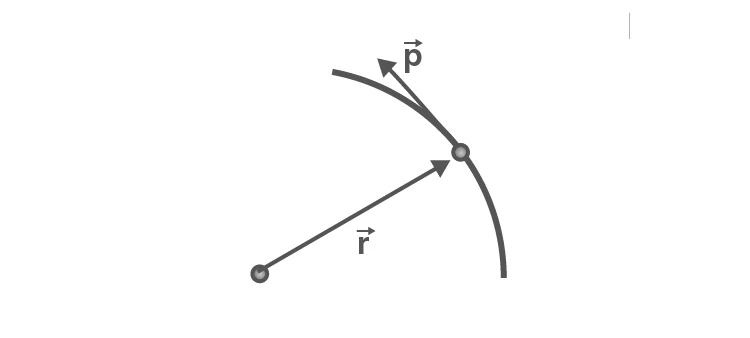
Angular momentum \( \vec{L} \) is the rotational analogue of linear momentum and is defined as:
\[ \vec{L} = \vec{r} \times \vec{p} \]
where \( \vec{r} \) is the position vector and \( \vec{p} = m \vec{v} \) is linear momentum. For a particle moving in a circle, magnitude is:
\[ L = m v r = m \omega r^2 \]
For a rigid body rotating about a fixed axis, total angular momentum is the sum of all particles’ angular momenta:
\[ L = I \omega \]
Conservation of Angular Momentum
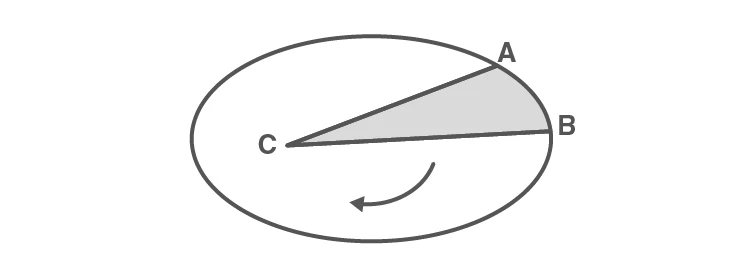
If the net external torque on a system is zero, its total angular momentum remains constant. This principle explains phenomena such as the varying speed of planets in elliptical orbits and the stability of spinning objects.
Example: Angular Velocity After Inelastic Collision
A uniform rod of length \( l \) and mass \( m \) is struck at its free end by a point mass \( m \) moving with speed \( u \) perpendicular to the rod. Find the angular velocity \( \omega \) of the rod immediately after collision.
Solution:
Using conservation of angular momentum about the pivot:
\[ m u l = \left( \frac{1}{3} m l^2 + m l^2 \right) \omega = \frac{4}{3} m l^2 \omega \]
Solving for \( \omega \):
\[ \omega = \frac{3 u}{4 l} \]
Combined Translational and Rotational Motion: Rolling
Analyzing Rolling Motion
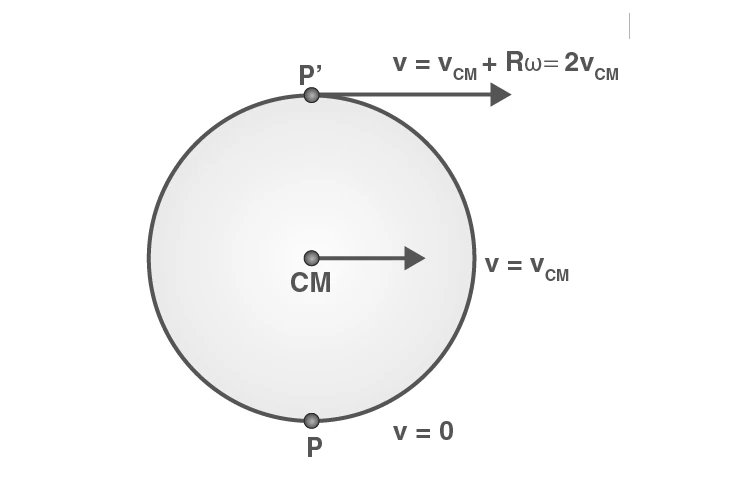
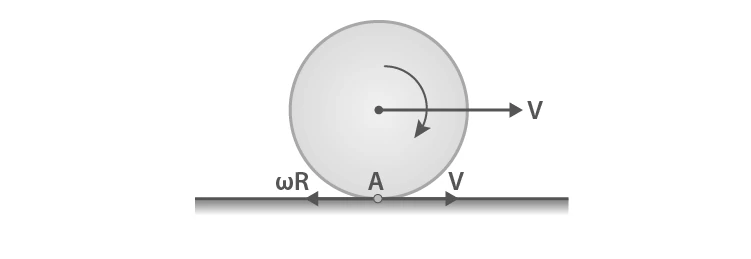
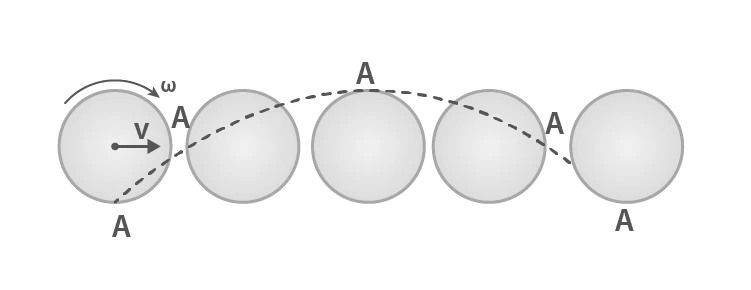
Rolling motion occurs when a round object moves such that it both rotates about its axis and translates along a surface. The velocity of any point on the rolling body is the vector sum of the translational velocity of the center of mass and the rotational velocity about the center.
For a rolling object without slipping, the linear velocity \( v \) and angular velocity \( \omega \) satisfy:
\[ v = \omega R \]
Example: Total Angular Momentum of a Rolling Disc
A disc of mass \( m \) and radius \( R \) rolls on a horizontal floor with linear speed \( v \) and angular speed \( \omega = \frac{v}{R} \). Calculate the magnitude of its total angular momentum about the point of contact with the floor.
Solution:
Moment of inertia about center: \( I = \frac{1}{2} m R^2 \)
Using the parallel axis theorem, moment of inertia about point of contact:
\[ I_0 = I + m R^2 = \frac{1}{2} m R^2 + m R^2 = \frac{3}{2} m R^2 \]
Total angular momentum:
\[ L = I_0 \omega = \frac{3}{2} m R^2 \times \frac{v}{R} = \frac{3}{2} m R v \]
Kinetic Energy in Rolling Motion
The total kinetic energy of a rolling body is the sum of translational and rotational kinetic energies:
\[ KE = \frac{1}{2} M v^2 + \frac{1}{2} I \omega^2 \]
For rolling without slipping, substituting \( v = \omega R \) gives:
\[ KE = \frac{1}{2} M \omega^2 R^2 + \frac{1}{2} I \omega^2 = \frac{1}{2} (M R^2 + I) \omega^2 \]

Applications and Advanced Concepts in Rotational Motion
Rolling on Inclined Planes and Binary Systems
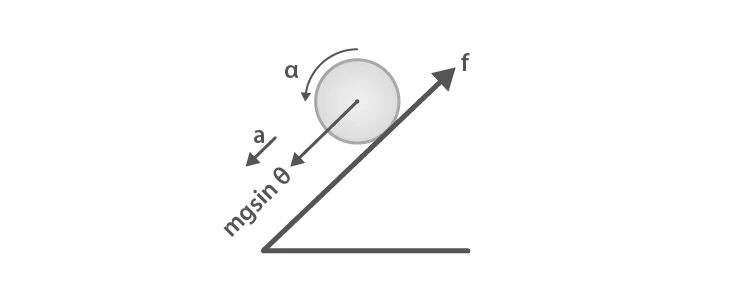
When a rigid body rolls down an incline without slipping, friction provides the torque necessary for rotation. The acceleration \( a \) of the center of mass relates to the angular acceleration \( \alpha \) by:
\[ a = R \alpha \]
For a body with moment of inertia \( I = k M R^2 \), the acceleration down an incline of angle \( \theta \) is:
\[ a = \frac{g \sin \theta}{1 + k} \]
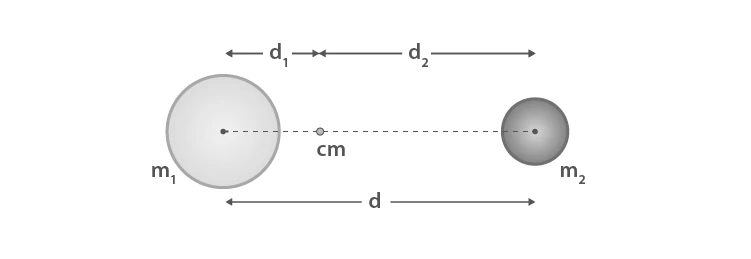
In celestial mechanics, binary systems consist of two masses orbiting their common center of mass due to mutual gravitational attraction. The orbital period \( T \), masses \( m_1, m_2 \), and separation \( d \) satisfy:
\[ \frac{4 \pi^2}{T^2} = \frac{G (m_1 + m_2)}{d^3} \]
Example: Velocity and Angular Speed of a Slipping Sphere
A solid sphere of radius \( r \) with initial angular speed \( \omega_0 \) and zero linear velocity is placed on a rough horizontal surface. Find its linear velocity \( v \) and angular velocity \( \omega \) after slipping stops.
Solution:
Using conservation of angular momentum about the point of contact:
\[ I \omega_0 = I \omega + m r v \]
Moment of inertia \( I = \frac{2}{5} m r^2 \), and \( v = r \omega \) at the end of slipping, so:
\[ \frac{2}{5} m r^2 \omega_0 = \frac{2}{5} m r^2 \omega + m r^2 \omega \]
Simplifying:
\[ \omega = \frac{2}{7} \omega_0, \quad v = r \omega = \frac{2}{7} r \omega_0 \]

Summary Table: Key Concepts in Rotational Motion
| Concept | Definition / Formula | Units |
|---|---|---|
| Angular Displacement (\( \theta \)) | Angle rotated by the body | radians (rad) |
| Angular Velocity (\( \omega \)) | \( \frac{d\theta}{dt} \) | rad/s |
| Angular Acceleration (\( \alpha \)) | \( \frac{d\omega}{dt} \) | rad/s² |
| Moment of Inertia (\( I \)) | \( \sum m_i r_i^2 \) or \( \int r^2 dm \) | kg·m² |
| Torque (\( \tau \)) | \( r F \sin \theta \) | Newton-meter (Nm) |
| Rotational Kinetic Energy | \( \frac{1}{2} I \omega^2 \) | Joules (J) |
| Angular Momentum (\( L \)) | \( I \omega \) | kg·m²/s |
| Rolling Condition | \( v = \omega R \) | m/s and rad/s |
| Newton’s Second Law (Rotation) | \( \tau = I \alpha \) | Nm = kg·m² × rad/s² |
| Acceleration on Incline (rolling) | \( a = \frac{g \sin \theta}{1 + k} \) | m/s² |
Glossary of Important Terms
| Term | Meaning |
|---|---|
| Angular Displacement | Angle through which a point or line has been rotated in a specified sense about a specified axis |
| Angular Velocity | Rate of change of angular displacement with time |
| Angular Acceleration | Rate of change of angular velocity with time |
| Moment of Inertia | Measure of an object's resistance to changes in its rotation |
| Torque | Rotational force causing an object to spin about an axis |
| Rotational Kinetic Energy | Energy due to the rotation of an object |
| Angular Momentum | Quantity of rotation of a body, product of moment of inertia and angular velocity |
| Rolling Motion | Combination of rotational and translational motion without slipping |
| Pure Rolling | Rolling motion where the point of contact has zero velocity relative to the surface |
| Rotational Equilibrium | State where net torque on a body is zero, so angular velocity is constant |
Frequently Asked Questions (FAQs)
What defines rotational motion?
Rotational motion occurs when an object spins around a fixed axis, with all points moving in circular paths around that axis.
How does torque cause rotation?
Torque is the twisting force that causes an object to rotate; it depends on the force magnitude, the distance from the axis, and the angle of application.
What is the difference between circular and rotational motion?
Circular motion involves an object moving along a circular path around an external point, while rotational motion involves spinning about an internal axis.
Why is moment of inertia important?
Moment of inertia determines how much torque is needed for a desired angular acceleration; it depends on mass distribution relative to the axis.
What conditions must be met for pure rolling?
Pure rolling requires the velocity of the point of contact with the surface to be zero relative to the surface, meaning \( v = \omega R \) and no slipping occurs.