Understanding Electrical Resistance and Resistivity
Fundamentals of Electrical Resistance
Concept and Definition of Resistance
When an electric current passes through a conductor such as a wire or bulb filament, the material opposes the flow of electrons. This opposition is termed electrical resistance and is symbolized by \( R \). Every substance exhibits some resistance, which is why conductors heat up when current flows through them.
Ohm’s law establishes a direct proportionality between the voltage \( V \) across a conductor and the current \( I \) flowing through it, expressed as:
\[ V = IR \]
Here, resistance \( R \) is the ratio of voltage to current:
\[ R = \frac{V}{I} \]
The unit of resistance is the ohm, denoted by the Greek letter omega (\( \Omega \)).
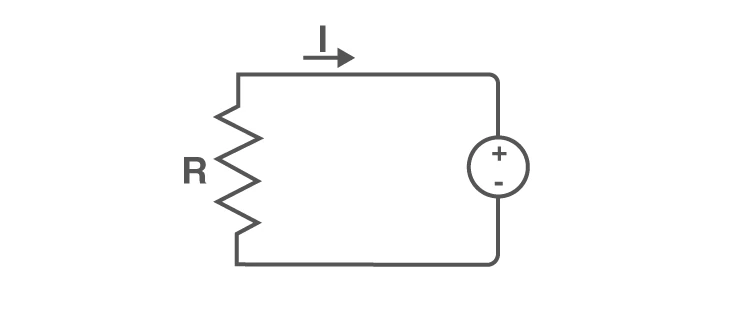
Illustration of Electrical Resistance in a Conductor
Example: Calculating Resistance from Voltage and Current
A wire carries a current of \( 3 \text{ A} \) when a voltage of \( 12 \text{ V} \) is applied across it. Find the resistance of the wire.
Solution:
Using Ohm’s law, resistance is:
\[ R = \frac{V}{I} = \frac{12 \text{ V}}{3 \text{ A}} = 4 \, \Omega \]
Therefore, the wire has a resistance of \( 4 \, \Omega \).
Factors Influencing Electrical Resistance
Dependence on Physical and Material Properties
The resistance of a conductor depends on several key factors:
Length (\( L \)): Resistance increases proportionally with the length of the conductor.
Cross-sectional Area (\( A \)): Resistance decreases as the cross-sectional area increases.
Material Type: Different materials have different intrinsic resistivities affecting resistance.
Temperature: Resistance varies with temperature changes, typically increasing for metals.
Mathematically, resistance is given by:
\[ R = \rho \frac{L}{A} \]
where \( \rho \) is the resistivity of the material, measured in ohm-meters (\( \Omega \cdot \text{m} \)).
Resistivity quantifies how strongly a material opposes electric current. Conductors have low resistivity, while insulators have very high values.
For comparison, here are resistivity values of some materials:
Material | Resistivity (\( \Omega \cdot \text{m} \)) |
|---|---|
Silver | 1.60 × 10\(^{-8}\) |
Copper | 1.70 × 10\(^{-8}\) |
Aluminium | 2.80 × 10\(^{-8}\) |
Wood | 1.00 × 10\(^{14}\) |
Air | 2.30 × 10\(^{16}\) |
Teflon | 1.00 × 10\(^{23}\) |
Graphical Representation of Resistance Influencing Factors
Example: Effect of Changing Length and Area on Resistance
A copper wire of length \( 2 \text{ m} \) and cross-sectional area \( 1 \times 10^{-6} \text{ m}^2 \) has a resistance \( R \). If the length is doubled and the area is halved, what will be the new resistance?
Solution:
Original resistance:
\[ R = \rho \frac{L}{A} \]
New length \( L' = 2L = 4 \text{ m} \), new area \( A' = \frac{A}{2} = 0.5 \times 10^{-6} \text{ m}^2 \).
New resistance \( R' \):
\[ R' = \rho \frac{L'}{A'} = \rho \frac{2L}{\frac{A}{2}} = \rho \frac{2L \times 2}{A} = 4 \rho \frac{L}{A} = 4R \]
The resistance becomes four times the original value.
Understanding Resistivity and Its Significance
Definition and Relation to Resistance
Resistivity, denoted by \( \rho \), is a fundamental property that measures how much a material resists electric current per unit length and cross-sectional area at a given temperature. It is also called specific resistance.
The relationship between resistivity, electric field \( E \), and current density \( J \) is:
\[ \rho = \frac{E}{J} \]
where:
\( E \) is the electric field in volts per meter (V/m)
\( J \) is the current density in amperes per square meter (A/m\(^2\))
Resistivity is measured in ohm-meters (\( \Omega \cdot \text{m} \)).
Example: Calculating Resistivity from Given Parameters
A wire has a current density of \( 5 \times 10^{6} \text{ A/m}^2 \) when subjected to an electric field of \( 0.1 \text{ V/m} \). Find the resistivity of the material.
Solution:
Using the formula:
\[ \rho = \frac{E}{J} = \frac{0.1 \text{ V/m}}{5 \times 10^{6} \text{ A/m}^2} = 2 \times 10^{-8} \, \Omega \cdot \text{m} \]
This resistivity value indicates a good conductor.
Distinguishing Resistance from Resistivity
While resistance depends on the size and shape of a conductor, resistivity is an intrinsic property of the material itself. Resistance changes with length and area, but resistivity remains constant for a given material at a fixed temperature.
In summary:
Resistance (\( R \)): Depends on conductor dimensions and material.
Resistivity (\( \rho \)): Material-specific constant indicating how strongly it opposes current.
Summary of Key Concepts
Term | Definition | Unit |
|---|---|---|
Resistance (\( R \)) | Opposition to current flow in a conductor | Ohm (\( \Omega \)) |
Resistivity (\( \rho \)) | Intrinsic property measuring material's resistance per unit length and area | Ohm-meter (\( \Omega \cdot \text{m} \)) |
Length (\( L \)) | Distance current travels through conductor | Meter (m) |
Cross-sectional Area (\( A \)) | Area of conductor's cross-section | Square meter (m\(^2\)) |
Current (\( I \)) | Flow of electric charge | Ampere (A) |
Voltage (\( V \)) | Electric potential difference | Volt (V) |
Electric Field (\( E \)) | Force per unit charge | Volt per meter (V/m) |
Current Density (\( J \)) | Current per unit area | Ampere per square meter (A/m\(^2\)) |
Conductivity | Reciprocal of resistivity, measures ease of current flow | Siemens per meter (S/m) |
Ohm’s Law | Relation between voltage, current, and resistance | V = IR |
Glossary of Important Terms
Term | Meaning |
|---|---|
Resistance | Measure of how much a material opposes electric current |
Resistivity | Intrinsic property indicating resistance per unit length and area |
Ohm | Unit of electrical resistance |
Conductivity | Ability of a material to conduct electric current, inverse of resistivity |
Current Density | Electric current per unit cross-sectional area |
Electric Field | Force experienced by a unit charge in a field |
Cross-sectional Area | Area of a conductor's cut surface perpendicular to current flow |
Length | Distance over which current flows in a conductor |
Ohm’s Law | Fundamental relation between voltage, current, and resistance |
Superconductor | Material with almost zero resistance at very low temperatures |
Frequently Asked Questions
What factor can reduce the resistance of an electric wire?
Increasing the wire's cross-sectional area decreases its resistance, as resistance is inversely proportional to area.
If resistance and length remain constant, what happens to resistivity when the cross-sectional area doubles?
Resistivity remains unchanged because it is a material property independent of dimensions.
How can the resistance of a wire be halved?
Doubling the cross-sectional area of the wire reduces its resistance by half.
What is the SI unit of resistivity?
The SI unit of resistivity is ohm-meter (\( \Omega \cdot \text{m} \)).
How does temperature affect the resistance of metals and insulators?
For metals, resistance increases with temperature due to reduced electron mobility. For insulators, resistance decreases as temperature rises because more electrons gain energy to conduct.