Fundamentals and Applications of Light Reflection
Principles Governing Reflection of Light
Understanding the Core Laws of Reflection
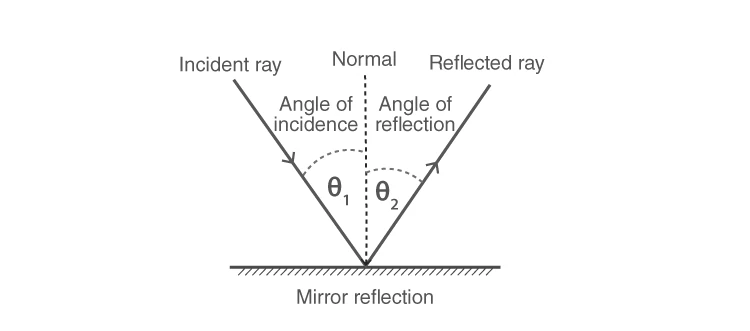
Reflection occurs when light rays strike a surface and bounce back. The fundamental rules that describe this behavior are known as the laws of reflection. The first law states that the angle at which the light ray hits the surface, called the angle of incidence, is exactly equal to the angle at which it reflects away, called the angle of reflection. Both these angles are measured relative to a line perpendicular to the surface, known as the normal.
The second law emphasizes that the incident ray, the reflected ray, and the normal all lie within the same plane. These laws are essential for understanding how images form in mirrors, whether flat or curved.
Illustrative Example: Calculating Reflection Angles
Problem: A light beam strikes a flat mirror at an angle of 40° with respect to the mirror's surface. Determine the angle of reflection.
Solution: The angle of incidence is measured from the incident ray to the normal. Since the ray makes 40° with the surface, the angle of incidence is:
\[ \theta_i = 90^\circ - 40^\circ = 50^\circ \]
According to the first law of reflection, the angle of reflection equals the angle of incidence:
\[ \theta_r = \theta_i = 50^\circ \]
Therefore, the reflected ray also makes a 50° angle with the normal.
Varieties of Reflection and Their Characteristics
Distinguishing Between Regular and Diffuse Reflection
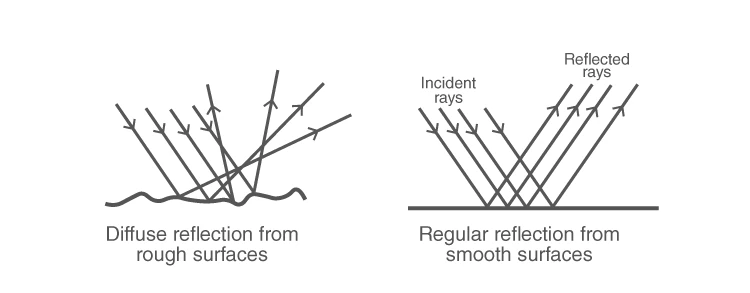
Reflection can be categorized based on the nature of the reflecting surface. Regular reflection happens on smooth surfaces like plane mirrors, where parallel light rays reflect uniformly, producing clear and sharp images. These images are virtual in plane mirrors, meaning they cannot be projected onto a screen but can be seen by the observer.
In contrast, diffuse or irregular reflection occurs on rough surfaces. Here, incoming parallel rays scatter in multiple directions due to the unevenness of the surface. This scattering allows us to see objects from various angles and is why most everyday objects are visible regardless of the observer's position.
Example Problem: Reflection Types in Practice
Problem: A smooth metallic surface and a rough wooden surface are illuminated by a parallel beam of light. Describe the nature of reflection from each surface and the type of image formed.
Solution:
- Smooth metallic surface: Exhibits regular reflection, where light rays reflect uniformly, producing a clear and well-defined image.
- Rough wooden surface: Causes diffuse reflection, scattering light in many directions, resulting in no clear image but allowing visibility from multiple viewpoints.
Reflection in Curved Mirrors and Total Internal Reflection
Behavior of Light with Concave and Convex Mirrors
Curved mirrors manipulate light differently based on their shape. Concave mirrors, which curve inward, can produce real, inverted images when the object is placed beyond the focal point. If the object is closer than the focal length, the image appears virtual, upright, and magnified. These mirrors are widely used in devices requiring focused light beams, such as flashlights and vehicle headlights.
Convex mirrors curve outward and always form virtual, upright, and reduced images regardless of the object's position. Their wide field of view makes them ideal for side mirrors on vehicles and security applications.
Example: Image Formation by a Concave Mirror
Problem: An object is placed 30 cm in front of a concave mirror with a focal length of 20 cm. Determine the nature and position of the image formed.
Solution: Using the mirror formula:
\[ \frac{1}{f} = \frac{1}{v} + \frac{1}{u} \]
Given: \( f = -20 \text{ cm} \) (concave mirror focal length is negative), \( u = -30 \text{ cm} \) (object distance is negative as per sign convention)
Calculate image distance \( v \):
\[ \frac{1}{v} = \frac{1}{f} - \frac{1}{u} = \frac{1}{-20} - \frac{1}{-30} = -\frac{1}{20} + \frac{1}{30} = -\frac{3}{60} + \frac{2}{60} = -\frac{1}{60} \]
\[ v = -60 \text{ cm} \]
The negative image distance indicates the image is real and formed on the same side as the object. The image is inverted and magnified.
Exploring Total Internal Reflection
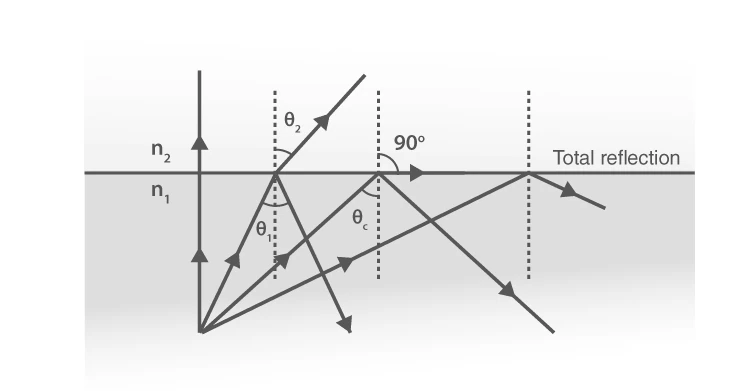
Total internal reflection occurs when light attempts to move from a denser medium to a less dense medium at an angle greater than a specific critical angle. Instead of refracting out, the light reflects entirely back into the denser medium. This phenomenon is the basis for technologies like optical fibers, which transmit light signals over long distances with minimal loss.
Example: Critical Angle and Total Internal Reflection
Problem: Light travels from water (refractive index \( n_1 = 1.33 \)) to air (\( n_2 = 1.00 \)). Calculate the critical angle for total internal reflection.
Solution: The critical angle \( \theta_c \) is given by Snell's law:
\[ \sin \theta_c = \frac{n_2}{n_1} = \frac{1.00}{1.33} \approx 0.7519 \]
\[ \theta_c = \sin^{-1}(0.7519) \approx 48.75^\circ \]
Thus, any incident angle greater than \( 48.75^\circ \) will result in total internal reflection.
Summary Table: Key Concepts of Light Reflection
| Concept | Description | Example/Application |
|---|---|---|
| First Law of Reflection | Angle of incidence equals angle of reflection. | Reflection from plane mirrors. |
| Second Law of Reflection | Incident ray, reflected ray, and normal lie in the same plane. | Image formation in mirrors. |
| Regular Reflection | Reflection from smooth surfaces producing clear images. | Plane mirrors, polished metals. |
| Diffuse Reflection | Reflection from rough surfaces scattering light. | Visibility of everyday objects. |
| Concave Mirror | Curved inward; forms real or virtual images depending on object position. | Headlights, shaving mirrors. |
| Convex Mirror | Curved outward; forms virtual, diminished images. | Vehicle side mirrors, security mirrors. |
| Total Internal Reflection | Complete reflection inside a denser medium beyond critical angle. | Optical fibers, endoscopes. |
Glossary of Important Terms
| Term | Definition |
|---|---|
| Angle of Incidence | The angle between the incident ray and the normal to the surface. |
| Angle of Reflection | The angle between the reflected ray and the normal to the surface. |
| Normal | A line perpendicular to the reflecting surface at the point of incidence. |
| Regular Reflection | Reflection from a smooth surface where rays reflect uniformly. |
| Diffuse Reflection | Reflection from a rough surface causing scattered rays. |
| Concave Mirror | A mirror with a surface curved inward like a cave. |
| Convex Mirror | A mirror with a surface curved outward. |
| Total Internal Reflection | Reflection of light entirely within a denser medium when incident angle exceeds critical angle. |
| Critical Angle | The minimum angle of incidence for which total internal reflection occurs. |
| Virtual Image | An image formed where light rays appear to diverge but do not actually converge. |
Frequently Asked Questions
What defines the angle of reflection in light reflection?
The angle of reflection is the angle between the reflected ray and the normal to the surface at the point of incidence, and it equals the angle of incidence.
How does regular reflection differ from diffuse reflection?
Regular reflection occurs on smooth surfaces producing clear images, while diffuse reflection happens on rough surfaces scattering light in many directions, preventing clear image formation.
Why do concave mirrors produce magnified images when objects are close?
When an object is within the focal length of a concave mirror, the reflected rays diverge, creating a virtual, upright, and enlarged image.
What is the significance of the critical angle in total internal reflection?
The critical angle is the minimum angle of incidence beyond which light cannot refract out of the denser medium and is instead completely reflected internally.
How are optical fibers related to the concept of reflection?
Optical fibers use total internal reflection to guide light through curved paths with minimal loss, enabling efficient transmission of data over long distances.