Understanding Pressure: Concepts and Applications
Fundamentals of Pressure and Its Measurement
Defining Pressure and Its Mathematical Expression
Pressure is a physical quantity that describes how a force is distributed over a surface area. Specifically, it is the amount of force applied perpendicular to a surface divided by the area over which this force acts. This concept explains why sharp objects like knives and nails can penetrate surfaces more easily than blunt ones.
The relationship between force and pressure is expressed by the formula:
\[ P = \frac{F}{A} \]
where \( P \) is the pressure, \( F \) is the force applied perpendicular to the surface, and \( A \) is the area of the surface.
Mathematical formula representing pressure as force per unit area
Example Problem
A force of 150 newtons is applied uniformly on a surface area of 0.5 square meters. Calculate the pressure exerted on the surface.
Solution:
Given:
Force, \( F = 150 \text{ N} \)
Area, \( A = 0.5 \text{ m}^2 \)
Using the formula for pressure:
\[ P = \frac{F}{A} = \frac{150}{0.5} = 300 \text{ Pa} \]
Therefore, the pressure exerted on the surface is \( 300 \text{ pascals} \).
Units Used to Measure Pressure
The standard unit for pressure in the International System of Units (SI) is the pascal (Pa). One pascal is defined as one newton of force applied over an area of one square meter. This unit helps quantify how concentrated a force is on a surface.
Other units such as atmospheres, bars, and millimeters of mercury are also used in different contexts, but pascal remains the fundamental SI unit.
Visual representation of pressure units and their applications
Example Problem
If a force of 200 newtons acts on a surface area of 2 square meters, what is the pressure in pascals?
Solution:
Given:
Force, \( F = 200 \text{ N} \)
Area, \( A = 2 \text{ m}^2 \)
Calculate pressure:
\[ P = \frac{F}{A} = \frac{200}{2} = 100 \text{ Pa} \]
The pressure exerted is \( 100 \text{ pascals} \).
Influence of Surface Area on Pressure
How Surface Area Modifies Pressure Without Changing Force
Pressure depends not only on the magnitude of the force but also on the area over which the force is applied. If the force remains constant, reducing the surface area increases the pressure, while increasing the surface area decreases the pressure. This principle explains why sharp objects are more effective at applying pressure.
For instance, a brick resting on its broad side exerts less pressure on the ground than when it rests on its narrow edge, even though its weight (force) remains unchanged.
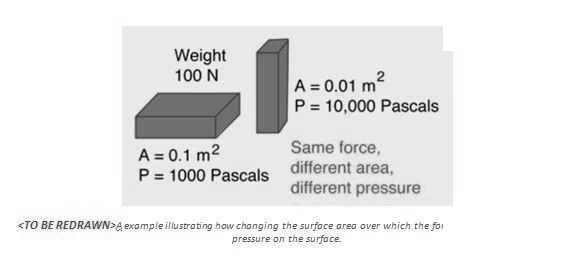
Effect of changing contact area on pressure exerted by a brick
Example Problem
A block weighing 400 newtons rests on a surface. When placed on its larger face of 0.8 square meters, calculate the pressure. Then find the pressure when it rests on its smaller face of 0.2 square meters.
Solution:
Given:
Force, \( F = 400 \text{ N} \)
Area 1, \( A_1 = 0.8 \text{ m}^2 \)
Area 2, \( A_2 = 0.2 \text{ m}^2 \)
Calculate pressure on larger face:
\[ P_1 = \frac{F}{A_1} = \frac{400}{0.8} = 500 \text{ Pa} \]
Calculate pressure on smaller face:
\[ P_2 = \frac{F}{A_2} = \frac{400}{0.2} = 2000 \text{ Pa} \]
The pressure is four times greater when the block rests on the smaller face.
Practical Examples Demonstrating Surface Area Effects
The sharpness of knives and nails is a direct application of pressure principles. A sharp knife concentrates force on a smaller edge, increasing pressure and making cutting easier. Conversely, a blunt knife spreads the force over a larger area, requiring more effort to cut.
Similarly, a karate chop is more damaging than a slap because the force is concentrated on a smaller surface area, resulting in higher pressure.
On the other hand, increasing surface area can be beneficial. For example, drawing pins have a flat end to apply force comfortably, and skis or surfboards increase the area over which weight is distributed, allowing smooth movement over snow or water.
Example Problem
Explain why a sharp knife cuts more effectively than a blunt knife, using the concept of pressure.
Answer:
A sharp knife has a smaller contact area at its edge.
Applying the same force on a smaller area increases the pressure.
Higher pressure allows the knife to cut through materials more easily.
A blunt knife has a larger contact area, reducing pressure and making cutting harder.
Summary and Key Points on Pressure
Concept | Explanation |
|---|---|
Pressure | Force applied perpendicular to a surface divided by the area over which it acts. |
Formula | \( P = \frac{F}{A} \) |
SI Unit | Pascal (Pa) = 1 Newton per square meter |
Effect of Area | Smaller area increases pressure; larger area decreases pressure for the same force. |
Applications | Sharp knives, nails, karate chops, drawing pins, skis, and surfboards. |
Glossary of Important Terms
Term | Definition |
|---|---|
Pressure | Force applied per unit area on a surface. |
Force | A push or pull that can change an object's motion. |
Pascal (Pa) | SI unit of pressure equal to one newton per square meter. |
Surface Area | The total area over which a force is distributed. |
Newton (N) | SI unit of force. |
Hydrostatic Pressure | Pressure exerted by a fluid at rest due to gravity. |
Atmospheric Pressure | Pressure exerted by the weight of the atmosphere. |
Gauge Pressure | Pressure measured relative to atmospheric pressure. |
Thrust | Force applied over an area, often used in fluid mechanics. |
Contact Force | Force applied through direct contact between objects. |
Frequently Asked Questions
What is the precise definition of pressure?
Pressure is the force applied perpendicular to a surface divided by the area over which the force acts.
How is force defined in physics?
Force is a push or pull on an object that can cause it to accelerate or change its velocity.
What does one pascal represent?
One pascal is the pressure resulting from a force of one newton applied uniformly over an area of one square meter.
Why do fluids exert pressure in all directions?
Because fluid particles move randomly and collide with surfaces from all sides, creating pressure equally in every direction.
How does temperature influence the pressure of a gas?
Increasing temperature raises the average kinetic energy of gas molecules, causing more frequent and forceful collisions, which increases pressure.