Understanding Poisson’s Ratio
Fundamentals of Poisson’s Ratio
Defining the Concept of Poisson’s Ratio
Poisson’s ratio is a fundamental property in mechanics that quantifies how a material deforms in directions perpendicular to an applied force. Specifically, it is the negative ratio of the transverse strain (contraction or expansion perpendicular to the force) to the longitudinal strain (deformation along the force direction). This dimensionless quantity is symbolized by the Greek letter \( \nu \) (nu) and named after the mathematician Siméon Poisson.
When a material is stretched or compressed, it not only changes length but also changes its width or thickness. Poisson’s ratio captures this lateral response relative to the axial deformation, providing insight into the material’s elastic behavior.
Example: A metal rod is stretched by 0.002 (longitudinal strain). If the rod’s diameter decreases by 0.0006 (transverse strain), calculate the Poisson’s ratio.
Solution:
Given longitudinal strain, \( \varepsilon_l = 0.002 \) and transverse strain, \( \varepsilon_t = -0.0006 \) (negative because diameter decreases).
Poisson’s ratio is defined as:
\[ \nu = -\frac{\varepsilon_t}{\varepsilon_l} \]
Substituting values:
\[ \nu = -\frac{-0.0006}{0.002} = 0.3 \]
Thus, the Poisson’s ratio of the rod is 0.3.
Mathematical Expression and Physical Interpretation
Formula and Explanation of Poisson’s Ratio
Consider a cuboidal object with original length \( L \) and breadth \( B \). When a tensile force is applied along the length, the object elongates by \( \Delta L \) and simultaneously contracts laterally by \( \Delta B \). The longitudinal strain \( \varepsilon_l \) and transverse strain \( \varepsilon_t \) are defined as:
\[ \varepsilon_l = \frac{\Delta L}{L}, \quad \varepsilon_t = \frac{\Delta B}{B} \]
Poisson’s ratio \( \nu \) is then given by:
\[ \nu = -\frac{\varepsilon_t}{\varepsilon_l} \]
The negative sign ensures that when the material elongates (positive \( \varepsilon_l \)), the lateral contraction (negative \( \varepsilon_t \)) results in a positive Poisson’s ratio.
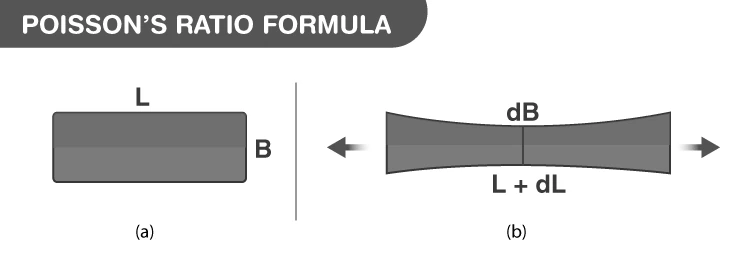
Illustration of Poisson’s ratio formula showing longitudinal and lateral strains
Example: A rubber strip with length 50 cm and width 10 cm is stretched so that its length increases by 1 cm and width decreases by 0.1 cm. Calculate the Poisson’s ratio.
Solution:
Longitudinal strain:
\[ \varepsilon_l = \frac{1}{50} = 0.02 \]
Transverse strain:
\[ \varepsilon_t = \frac{-0.1}{10} = -0.01 \]
Poisson’s ratio:
\[ \nu = -\frac{-0.01}{0.02} = 0.5 \]
The rubber’s Poisson’s ratio is 0.5, indicating significant lateral contraction.
Behavioral Insights and Material Variations
Understanding the Poisson Effect and Material Differences
The Poisson effect describes the tendency of materials to contract or expand in directions perpendicular to the applied force. When stretched, most materials become thinner laterally; when compressed, they tend to expand sideways. This behavior is quantified by Poisson’s ratio.
Typical values of Poisson’s ratio range from 0 to 0.5 for most materials. A value close to 0.5 indicates an incompressible material, such as rubber, which maintains volume during deformation. Materials like cork have near-zero Poisson’s ratio, meaning they hardly change in lateral dimensions when compressed or stretched.
Interestingly, some materials exhibit a negative Poisson’s ratio, known as auxetic materials, which expand laterally when stretched.
Comparison of Poisson’s ratio across different materials
Material deformation illustrating the Poisson effect
Example: A concrete sample has a longitudinal strain of 0.0015 under tensile stress and a lateral strain of -0.00045. Determine its Poisson’s ratio.
Solution:
Given:
\[ \varepsilon_l = 0.0015, \quad \varepsilon_t = -0.00045 \]
Calculate Poisson’s ratio:
\[ \nu = -\frac{-0.00045}{0.0015} = 0.3 \]
This value aligns with typical Poisson’s ratios for concrete.
Quick Reference: Poisson’s Ratio Summary
Material | Typical Poisson’s Ratio (\( \nu \)) | Remarks |
|---|---|---|
Rubber | ~0.5 | Nearly incompressible, large lateral contraction |
Steel | 0.27 – 0.30 | Common engineering metal |
Concrete | 0.2 – 0.3 | Typical construction material |
Cork | ~0.0 | Minimal lateral deformation |
Auxetic materials | < 0 | Expand laterally when stretched |
Glossary of Key Terms
Term | Definition |
|---|---|
Poisson’s Ratio (\( \nu \)) | Ratio of transverse strain to longitudinal strain with a negative sign |
Longitudinal Strain (\( \varepsilon_l \)) | Change in length divided by original length along the force direction |
Transverse Strain (\( \varepsilon_t \)) | Change in dimension perpendicular to the force divided by original dimension |
Elastic Limit | Maximum stress a material can withstand without permanent deformation |
Auxetic Material | Material with negative Poisson’s ratio, expands laterally when stretched |
Compressive Strain | Reduction in length or volume due to applied compressive force |
Tensile Strain | Increase in length due to applied tensile force |
Dimensionless Quantity | A quantity without any physical units |
Volume Conservation | Condition where volume remains constant during deformation |
Strain | Measure of deformation representing displacement between particles in a material body |
Frequently Asked Questions
Does temperature affect Poisson’s ratio?
Poisson’s ratio generally remains stable within the elastic limit of a material, but extreme temperature changes can slightly alter its value due to changes in material properties.
Is Poisson’s ratio always constant for a material?
Within the elastic deformation range, Poisson’s ratio is approximately constant. Beyond this range, it may vary due to plastic deformation or damage.
What does a Poisson’s ratio of 0.5 signify?
A value of 0.5 indicates an incompressible material that maintains constant volume during elastic deformation, such as rubber.
What are the units of Poisson’s ratio?
Poisson’s ratio is a dimensionless quantity and has no units.
Why is Poisson’s ratio negative for compressive deformation?
Because compressive strain is considered negative, the transverse strain sign convention leads to a negative Poisson’s ratio value in compression, reflecting lateral expansion.
Additional Visuals and Clarifications
Visualizing the gradient of Poisson’s ratio across a material

Material deformation perpendicular to applied force
Join BYJU’S for interactive physics learning resources