Understanding the Photoelectric Effect and Its Applications
Fundamentals of the Photoelectric Phenomenon
Basic Mechanism of Electron Emission by Light
The photoelectric phenomenon involves the release of electrons from a metal surface when it is illuminated by light. These emitted electrons are termed photoelectrons. Crucially, the emission and the kinetic energy of these electrons depend on the frequency of the incident light rather than its intensity. This process, where light energy causes electrons to escape from the metal, is known as photoemission.
When light strikes the metal, electrons absorb energy from the photons and use it to overcome the forces holding them within the metal lattice. This results in their ejection from the surface.
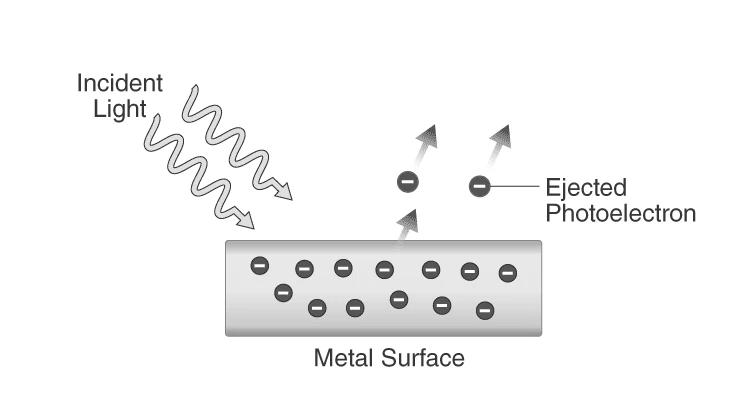
Illustration of photoelectron emission caused by incident light
Example: Calculating Energy of a Photon
Calculate the energy of a photon of light with a frequency of \(6.0 \times 10^{14} \text{ Hz}\). (Planck's constant \(h = 6.626 \times 10^{-34} \text{ J·s}\))
Solution:
The energy of a photon is given by Planck's equation:
\[ E = h \nu = (6.626 \times 10^{-34}) \times (6.0 \times 10^{14}) = 3.976 \times 10^{-19} \text{ J} \]
Thus, the photon carries an energy of approximately \(3.98 \times 10^{-19} \text{ joules}\).
Historical Insights and Early Observations
The photoelectric effect was first observed in 1887 by Wilhelm Hallwachs and experimentally confirmed by Heinrich Hertz. They noticed that when electromagnetic radiation above a certain frequency strikes a metal surface, electrons are emitted. This discovery laid the foundation for understanding the interaction between light and matter as involving discrete particles called photons.
The emitted electrons generate a current known as photoelectric current, which is a direct consequence of the photoelectric effect.
Quantum Explanation and Mathematical Framework
Photon Concept and Energy Quantization
The wave theory of light fails to explain the photoelectric effect adequately. Instead, the particle nature of light, where light consists of photons carrying quantized energy packets, provides a clear explanation. The energy of each photon is proportional to the frequency of the light, expressed by Planck's relation:
\[ E = h \nu = \frac{hc}{\lambda} \]
Here, \(E\) is the photon energy, \(h\) is Planck's constant, \(\nu\) is the frequency, \(c\) is the speed of light, and \(\lambda\) is the wavelength. Higher frequency light, such as blue light, carries photons with more energy than lower frequency light like red light.
Example: Comparing Photon Energies of Different Colors
Calculate the energy difference between photons of blue light (\(\lambda = 450 \text{ nm}\)) and red light (\(\lambda = 700 \text{ nm}\)). Use \(h = 6.626 \times 10^{-34} \text{ J·s}\) and \(c = 3.0 \times 10^{8} \text{ m/s}\).
Solution:
Energy of blue photon:
\[ E_{blue} = \frac{hc}{\lambda_{blue}} = \frac{6.626 \times 10^{-34} \times 3.0 \times 10^{8}}{450 \times 10^{-9}} = 4.42 \times 10^{-19} \text{ J} \]
Energy of red photon:
\[ E_{red} = \frac{hc}{\lambda_{red}} = \frac{6.626 \times 10^{-34} \times 3.0 \times 10^{8}}{700 \times 10^{-9}} = 2.84 \times 10^{-19} \text{ J} \]
Difference:
\[ \Delta E = E_{blue} - E_{red} = 1.58 \times 10^{-19} \text{ J} \]
Thus, blue photons have significantly higher energy than red photons.
Threshold Frequency and Work Function
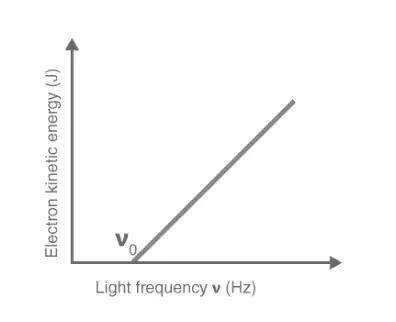
For electrons to be emitted, photons must have energy exceeding a minimum value called the work function (\(\Phi\)) of the metal. This corresponds to a threshold frequency \(\nu_{th}\) below which no photoelectrons are emitted regardless of light intensity. The work function and threshold frequency relate as:
\[ \Phi = h \nu_{th} = \frac{hc}{\lambda_{th}} \]
If the incident photon energy is less than \(\Phi\), electrons remain bound. When the photon energy equals \(\Phi\), electrons are emitted with zero kinetic energy. For photon energies greater than \(\Phi\), the excess energy converts into the kinetic energy of the emitted electrons.
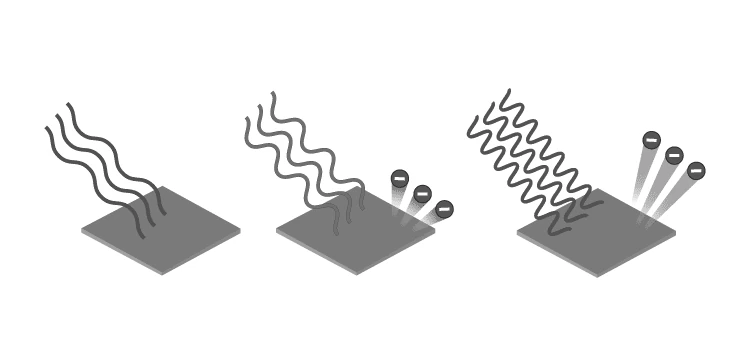
Effect of incident light frequency on photoelectron kinetic energy
Example: Calculating Maximum Kinetic Energy of Photoelectrons
A metal has a threshold wavelength of 300 nm. Calculate the maximum kinetic energy of photoelectrons when illuminated by light of wavelength 250 nm. Use \(hc = 1240 \text{ eV·nm}\).
Solution:
Work function energy:
\[ \Phi = \frac{hc}{\lambda_{th}} = \frac{1240}{300} = 4.13 \text{ eV} \]
Photon energy of incident light:
\[ E = \frac{hc}{\lambda} = \frac{1240}{250} = 4.96 \text{ eV} \]
Maximum kinetic energy:
\[ K_{max} = E - \Phi = 4.96 - 4.13 = 0.83 \text{ eV} \]
Therefore, the emitted electrons have a maximum kinetic energy of 0.83 eV.
Einstein’s Explanation and Photon Properties
Albert Einstein provided a quantum explanation for the photoelectric effect, proposing that light energy is carried in discrete packets called photons. Each photon has energy \(E = h \nu\). This theory earned him the Nobel Prize in 1921.
Photons have zero rest mass and no electric charge, travel at the speed of light, and their momentum relates to energy by:
\[ E = p c \]
where \(p\) is the photon momentum and \(c\) is the speed of light.
Experimental Insights and Governing Principles
Setup and Observations in Photoelectric Experiments
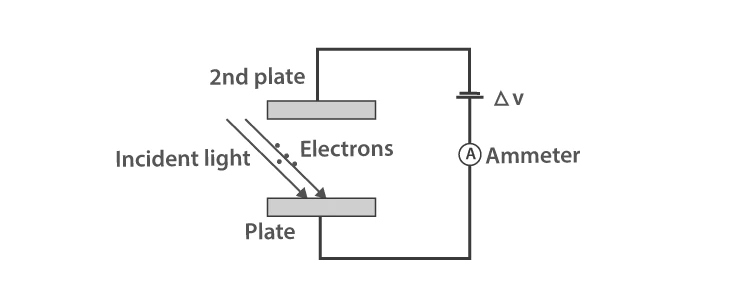
The photoelectric effect is studied using an evacuated tube containing two metal plates: a photosensitive cathode and an anode. When light strikes the cathode, electrons are emitted and collected at the anode, producing a measurable current called photocurrent. The potential difference between the plates can be varied to study the effect on electron emission.
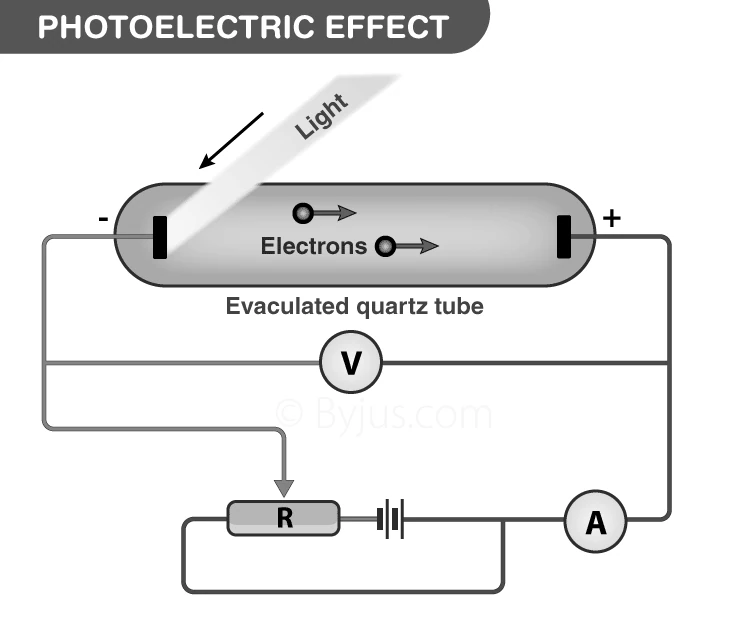
Experimental setup to investigate the photoelectric effect
Key Laws Governing the Photoelectric Effect
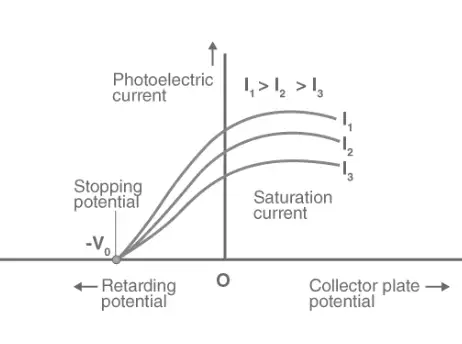
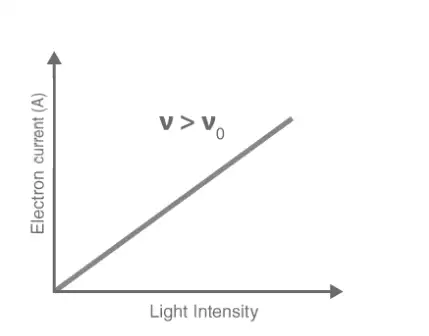
Photoelectric current is directly proportional to the intensity of incident light for frequencies above the threshold.
No electrons are emitted if the light frequency is below the threshold frequency, regardless of intensity.
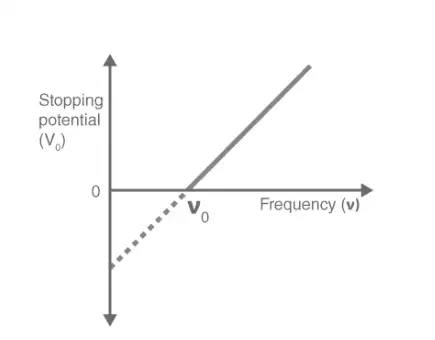
The maximum kinetic energy of emitted electrons increases linearly with the frequency of incident light above the threshold frequency.
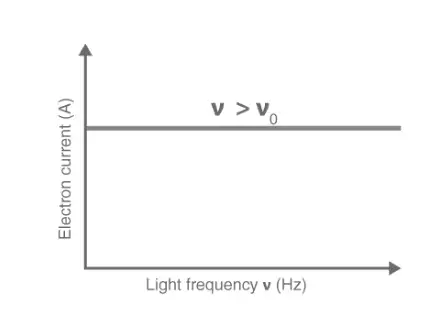
The kinetic energy of photoelectrons is independent of light intensity.
The emission of photoelectrons occurs instantaneously with light incidence.
Influence of Experimental Parameters
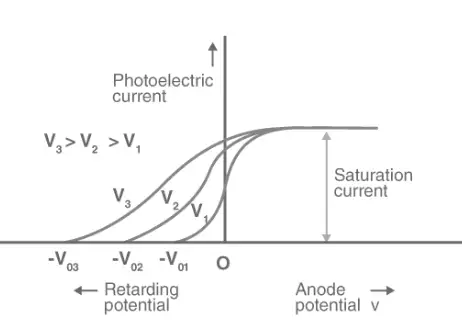
Adjusting the intensity of light changes the number of emitted electrons, affecting the photoelectric current but not their kinetic energy. Varying the potential difference between the plates influences the current until saturation is reached. Increasing the frequency of light increases the stopping potential required to halt the photoelectrons, confirming the direct relation between frequency and kinetic energy.
In a photoelectric experiment, the wavelength of incident light changes from 320 nm to 400 nm. Given \(hc/e = 1240 \text{ nm·V}\), find the decrease in stopping potential.
Solution:
Using the relation:
\[ V_1 - V_2 = \frac{hc}{e} \times \left(\frac{\lambda_2 - \lambda_1}{\lambda_1 \lambda_2}\right) \]
Substituting values:
\[ V_1 - V_2 = 1240 \times \frac{400 - 320}{320 \times 400} = 1240 \times \frac{80}{128000} = 0.775 \text{ V} \]
The stopping potential decreases by approximately 0.78 V.
Applications and Advanced Problem Solving
Practical Uses of the Photoelectric Effect
The photoelectric effect underpins many modern technologies:
Solar Panels: Convert sunlight into electricity using photoelectric materials.
Motion Detectors: Use photoelectric sensors to detect interruptions in light beams.
Automatic Lighting: Adjust screen brightness or lighting based on ambient light intensity.
Digital Cameras: Employ photoelectric sensors to capture images by detecting light.
X-Ray Photoelectron Spectroscopy (XPS): Analyzes surface chemistry by measuring emitted electron energies.
Burglar Alarms and Photomultipliers: Detect low light levels and trigger alarms.
Night Vision Devices: Amplify low light using photoelectric principles.
Numerical Problems on Photoelectric Effect
Problem 1: Maximum Kinetic Energy Calculation
The threshold wavelength of a metal is 280 nm. Calculate the maximum kinetic energy of electrons emitted when illuminated by light of wavelength 220 nm. Use \(hc = 1240 \text{ eV·nm}\).
Solution:
Work function energy:
\[ \Phi = \frac{1240}{280} = 4.43 \text{ eV} \]
Photon energy:
\[ E = \frac{1240}{220} = 5.64 \text{ eV} \]
Maximum kinetic energy:
\[ K_{max} = E - \Phi = 5.64 - 4.43 = 1.21 \text{ eV} \]
Problem 2: Change in Stopping Potential
Light wavelength changes from 350 nm to 450 nm in a photoelectric experiment. Calculate the decrease in stopping potential. Use \(hc/e = 1240 \text{ nm·V}\).
Solution:
\[ \Delta V = 1240 \times \frac{450 - 350}{350 \times 450} = 1240 \times \frac{100}{157500} \approx 0.79 \text{ V} \]
The stopping potential decreases by about 0.79 volts.
Problem 3: Photon Energy and Electron Kinetic Energy
Ultraviolet light of wavelength 240 nm causes electron emission from a metal plate. The stopping potential is 1.4 V. Calculate:
The energy of the photons in eV.
The maximum kinetic energy of the emitted electrons in eV.
Solution:
Frequency of light:
\[ \nu = \frac{c}{\lambda} = \frac{3.0 \times 10^{8}}{240 \times 10^{-9}} = 1.25 \times 10^{15} \text{ Hz} \]
Photon energy (using Planck's constant in eV·s, \(h = 4.136 \times 10^{-15} \text{ eV·s}\)):
\[ E = h \nu = (4.136 \times 10^{-15}) \times (1.25 \times 10^{15}) = 5.17 \text{ eV} \]
Maximum kinetic energy equals stopping potential energy:
\[ K_{max} = 1.4 \text{ eV} \]
Photoelectric experiment with metal plates and ammeter
Summary and Quick Reference
Concept | Definition / Formula |
|---|---|
Photon Energy | \(E = h \nu = \frac{hc}{\lambda}\) |
Work Function (Threshold Energy) | \(\Phi = h \nu_{th} = \frac{hc}{\lambda_{th}}\) |
Photoelectron Maximum Kinetic Energy | \(K_{max} = h \nu - \Phi = \frac{hc}{\lambda} - \frac{hc}{\lambda_{th}}\) |
Threshold Frequency | Minimum frequency to eject electrons: \(\nu_{th}\) |
Threshold Wavelength | Maximum wavelength to cause emission: \(\lambda_{th} = \frac{c}{\nu_{th}}\) |
Stopping Potential | Potential to stop photoelectrons: \(eV = K_{max}\) |
Photoelectric Current | Proportional to light intensity (for \(\nu > \nu_{th}\)) |
Photon Momentum | \(p = \frac{E}{c}\) |
Planck's Constant | \(h = 6.626 \times 10^{-34} \text{ J·s}\) |
Speed of Light | \(c = 3.0 \times 10^{8} \text{ m/s}\) |
Glossary of Key Terms
Term | Meaning |
|---|---|
Photoelectric Effect | Emission of electrons from a metal surface when illuminated by light. |
Photoelectron | Electron emitted due to the photoelectric effect. |
Photon | Quantum particle of light carrying energy \(E = h \nu\). |
Work Function (\(\Phi\)) | Minimum energy required to remove an electron from a metal. |
Threshold Frequency (\(\nu_{th}\)) | Minimum frequency of light needed to eject electrons. |
Threshold Wavelength (\(\lambda_{th}\)) | Maximum wavelength of light that can cause electron emission. |
Stopping Potential | Voltage needed to stop the most energetic photoelectrons. |
Photoelectric Current | Electric current produced by emitted photoelectrons. |
Planck’s Constant (h) | Fundamental constant relating energy and frequency of photons. |
Quantum | Discrete packet of energy or matter. |
Frequently Asked Questions
Why does the photoelectric effect depend on light frequency and not intensity?
The energy of each photon depends on frequency, not intensity. If the photon energy is below the work function, no electrons are emitted regardless of intensity. Intensity affects the number of photons, thus the number of emitted electrons, but not their kinetic energy.
What happens if the frequency of incident light is below the threshold frequency?
No photoelectrons are emitted because photons lack sufficient energy to overcome the work function of the metal.
How is the maximum kinetic energy of photoelectrons calculated?
It is the difference between the photon energy and the work function: \(K_{max} = h \nu - \Phi\).
What is the significance of stopping potential in photoelectric experiments?
Stopping potential is the voltage required to reduce the photoelectric current to zero by stopping the most energetic photoelectrons, allowing measurement of their maximum kinetic energy.
How did the photoelectric effect support the particle nature of light?
The instantaneous emission of electrons and dependence on frequency rather than intensity could not be explained by wave theory but were explained by photons carrying quantized energy, confirming light's particle nature.