Understanding Newton’s Second Law of Motion
Fundamentals of Newton’s Second Law
Conceptual Overview and Definition
Newton’s second law explains how the motion of an object changes when subjected to an unbalanced force. It quantifies the relationship between the net force applied, the mass of the object, and the resulting acceleration. Specifically, the acceleration of an object is directly proportional to the net force acting on it and inversely proportional to its mass. This means that increasing the force increases acceleration, while increasing the mass decreases acceleration.
This principle can be mathematically expressed as:
\[ \vec{a} \propto \frac{\vec{F}_{net}}{m} \]
or more precisely,
\[ \vec{F}_{net} = m \vec{a} \]
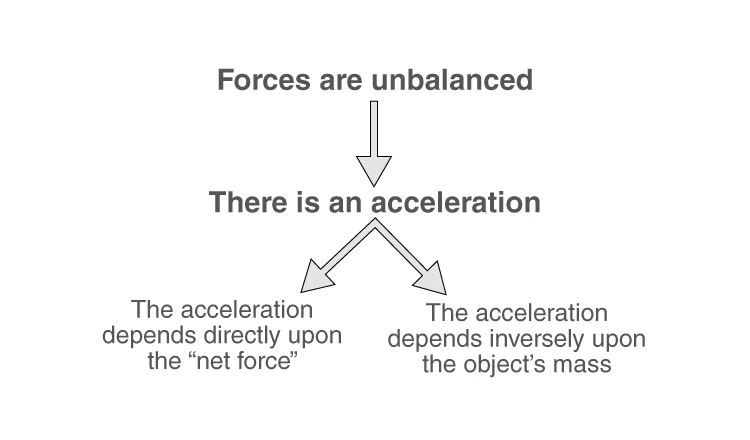
Visual representation of force, mass, and acceleration relationship
Stepwise Derivation of the Law
The law can be derived from the concept of momentum, which is the product of mass and velocity. The force acting on an object equals the rate of change of its momentum:
\[ \vec{F} = \frac{d\vec{p}}{dt} \]
where momentum \( \vec{p} = m \vec{v} \). For cases where mass remains constant, this simplifies to:
\[ \vec{F} = m \frac{d\vec{v}}{dt} = m \vec{a} \]
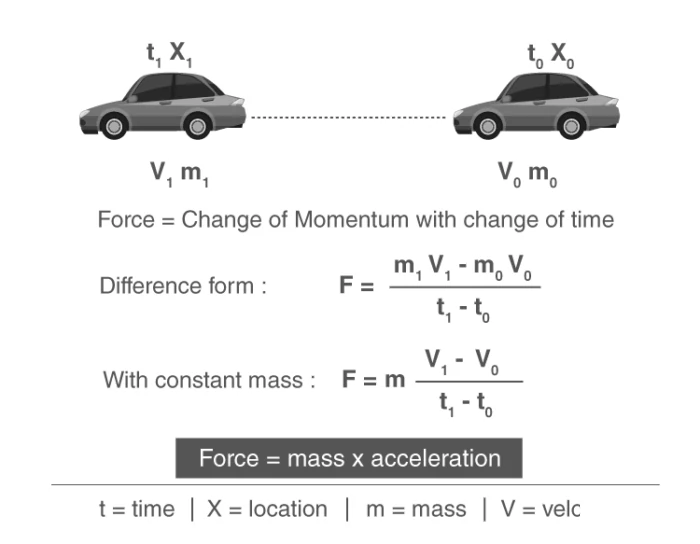
Force related to change in momentum over time
Example Problem: Calculating Force from Momentum Change
Problem: A vehicle initially at position \( x_0 \) with mass \( 1500 \text{ kg} \) and velocity \( 10 \text{ m/s} \) accelerates to velocity \( 20 \text{ m/s} \) at position \( x_1 \) over 5 seconds. Assuming mass remains constant, find the net force applied.
Solution:
Given:
Mass, \( m = 1500 \text{ kg} \)
Initial velocity, \( v_0 = 10 \text{ m/s} \)
Final velocity, \( v_1 = 20 \text{ m/s} \)
Time interval, \( \Delta t = 5 \text{ s} \)
Acceleration is:
\[ a = \frac{v_1 - v_0}{\Delta t} = \frac{20 - 10}{5} = 2 \text{ m/s}^2 \]
Using Newton’s second law:
\[ F = m a = 1500 \times 2 = 3000 \text{ N} \]
The net force applied to the vehicle is \( 3000 \text{ N} \) in the direction of acceleration.
Analyzing Forces and Mass Variations
Understanding Net Force and Its Calculation
Net force is the vector sum of all forces acting on an object. It determines the object's acceleration according to Newton’s second law. For example, if two forces act in opposite directions, the net force is their difference, considering direction.
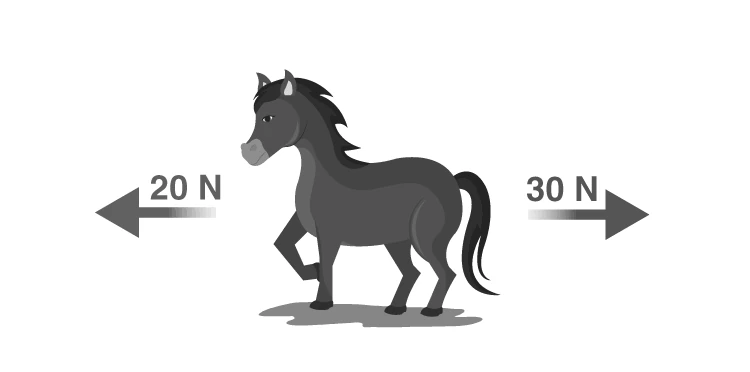
Illustration of forces acting in opposite directions on a horse
Suppose a force of \( 35 \text{ N} \) pulls to the right and another force of \( 25 \text{ N} \) pulls to the left. Taking right as positive:
\[ F_{net} = 35 \text{ N} - 25 \text{ N} = 10 \text{ N} \quad \text{to the right} \]
Newton’s Second Law with Variable Mass
In some scenarios, such as rockets burning fuel, the mass changes over time. Here, the force relates to the rate of change of momentum, not just acceleration. The general form is:
\[ \vec{F} = \frac{d}{dt}(m \vec{v}) = m \frac{d\vec{v}}{dt} + \vec{v} \frac{dm}{dt} \]
This equation accounts for both acceleration and mass variation effects on force.
Example Problem: Net Force on a Moving Block
Problem: A block weighing \( 3 \text{ kg} \) experiences two forces: \( 25 \text{ N} \) to the right and \( 15 \text{ N} \) to the left. Calculate the block’s acceleration.
Solution:
Net force:
\[ F_{net} = 25 \text{ N} - 15 \text{ N} = 10 \text{ N} \]
Acceleration:
\[ a = \frac{F_{net}}{m} = \frac{10}{3} \approx 3.33 \text{ m/s}^2 \]
The block accelerates at approximately \( 3.33 \text{ m/s}^2 \) towards the right.
Practical Uses and Everyday Examples
Real-Life Applications of Newton’s Second Law
Newton’s second law is fundamental in understanding and predicting motion in daily life and technology. Some common examples include:
Kicking a ball: The harder the kick (greater force), the faster and farther the ball moves.
Pushing a shopping cart: An empty cart requires less force to accelerate than a loaded one due to lower mass.
Walking speed differences: Heavier individuals may accelerate slower due to greater mass, assuming similar applied forces.
Example of force applied when kicking a ball
Example Problem: Force Required to Accelerate a Car
Problem: Determine the force needed to accelerate a \( 1200 \text{ kg} \) car at \( 5 \text{ m/s}^2 \) on a straight road.
Solution:
Using Newton’s second law:
\[ F = m a = 1200 \times 5 = 6000 \text{ N} \]
The car requires a net force of \( 6000 \text{ N} \) to achieve the given acceleration.
Example Problem: Acceleration of a Block with Opposing Forces
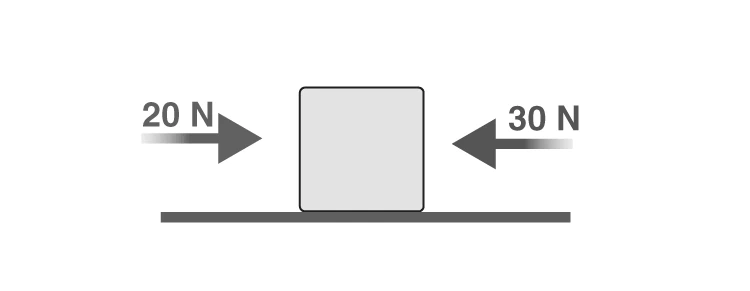
Block subjected to forces in opposite directions
Problem: A \( 2.5 \text{ kg} \) block is pushed with \( 18 \text{ N} \) force to the right and \( 12 \text{ N} \) force to the left. Find its acceleration.
Solution:
Calculate net force:
\[ F_{net} = 18 \text{ N} - 12 \text{ N} = 6 \text{ N} \]
Acceleration:
\[ a = \frac{F_{net}}{m} = \frac{6}{2.5} = 2.4 \text{ m/s}^2 \]
The block accelerates at \( 2.4 \text{ m/s}^2 \) towards the right.
Quick Reference: Key Points on Newton’s Second Law
Concept | Explanation | Formula |
|---|---|---|
Net Force | Vector sum of all forces acting on an object | \( \vec{F}_{net} = \sum \vec{F} \) |
Acceleration | Rate of change of velocity of an object | \( \vec{a} = \frac{d\vec{v}}{dt} \) |
Newton’s Second Law | Force causes acceleration proportional to mass | \( \vec{F} = m \vec{a} \) |
Momentum | Product of mass and velocity | \( \vec{p} = m \vec{v} \) |
Force and Momentum | Force equals rate of change of momentum | \( \vec{F} = \frac{d\vec{p}}{dt} \) |
Variable Mass | Force includes mass change and velocity change | \( \vec{F} = m \frac{d\vec{v}}{dt} + \vec{v} \frac{dm}{dt} \) |
Direction of Force | Force and acceleration vectors point in the same direction | — |
Units of Force | Measured in Newtons (N) | 1 N = 1 kg·m/s² |
Mass | Measure of an object's inertia | — |
Acceleration Units | Measured in meters per second squared | \( \text{m/s}^2 \) |
Glossary of Important Terms
Term | Meaning |
|---|---|
Acceleration | Change in velocity per unit time |
Force | Push or pull acting on an object |
Mass | Quantity of matter in an object |
Momentum | Product of mass and velocity |
Net Force | Sum of all forces acting on an object |
Newton (N) | Unit of force equal to kg·m/s² |
Velocity | Speed with direction |
Thrust | Force applied to propel an object forward |
Inertia | Resistance of an object to change in motion |
Momentum Change | Variation in momentum over time |
Frequently Asked Questions
How does Newton’s second law explain rocket propulsion?
Newton’s second law states that force equals mass times acceleration. In rockets, the thrust force generated by expelling fuel causes acceleration. The lighter the rocket and the greater the thrust, the higher the acceleration achieved.
What role does Newton’s second law play in car collisions?
During a collision, the force experienced depends on the mass and acceleration (or deceleration) of the vehicle. Higher mass or greater change in velocity results in larger forces, affecting the severity of impact.
Is Newton’s second law also called the law of acceleration?
Yes, Newton’s second law is often referred to as the law of acceleration because it relates force to the acceleration produced in an object.
Can you give examples of Newton’s second law in everyday life?
Examples include pushing a shopping cart, kicking a ball, and accelerating a car. In all cases, the force applied and the mass of the object determine the acceleration.
What is the formula for Newton’s second law when mass is constant?
When mass remains constant, the law is expressed as \( \vec{F} = m \vec{a} \), where force equals mass times acceleration.