Understanding Motional Electromotive Force (EMF)
Fundamentals of EMF Induction in Moving Conductors
How Motion Generates Electromotive Force
When a conductor moves through a magnetic field, an electromotive force (emf) is generated due to the interaction between the conductor's charges and the magnetic field. This phenomenon, known as motional emf, arises because the conductor cuts across magnetic field lines, causing a change in magnetic flux linked with the circuit.
Consider a straight conductor sliding within a rectangular loop placed in a uniform magnetic field oriented perpendicular to the loop's plane. As the conductor moves at a steady velocity, the area enclosed by the loop changes, altering the magnetic flux through it. This variation in flux induces an emf in the circuit.
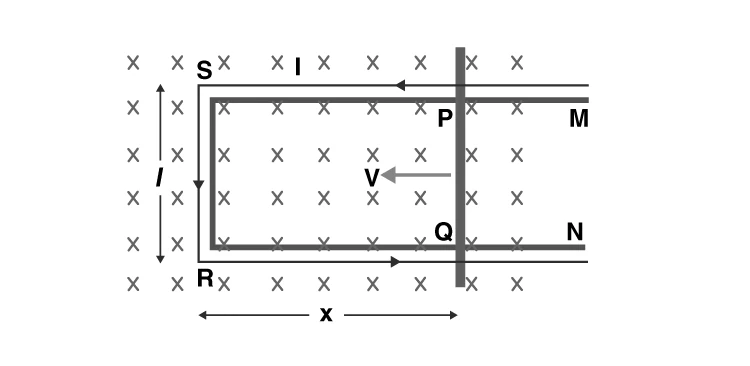
Illustration of Motional EMF in a Moving Conductor
The magnetic flux \( \Phi_B \) through the loop is given by:
\[ \Phi_B = B \times l \times x \]
where \( B \) is the magnetic field strength, \( l \) is the length of the conductor, and \( x \) is the position of the moving conductor, which changes over time.
The rate of change of flux induces an emf expressed as:
\[ \mathcal{E} = -\frac{d\Phi_B}{dt} = B l v \]
Here, \( v = \frac{dx}{dt} \) is the velocity of the conductor. This induced emf is the motional emf, generated due to the conductor's movement in the magnetic field.
Example Problem
A conductor of length 0.4 m moves at a speed of 3 m/s perpendicular to a uniform magnetic field of 0.5 T. Calculate the motional emf induced across the conductor.
Solution:
Given:
Length of conductor, \( l = 0.4 \text{ m} \)
Velocity, \( v = 3 \text{ m/s} \)
Magnetic field, \( B = 0.5 \text{ T} \)
The motional emf is calculated by:
\[ \mathcal{E} = B l v = 0.5 \times 0.4 \times 3 = 0.6 \text{ V} \]
Therefore, the induced emf across the conductor is 0.6 volts.
Role of Lorentz Force in Generating Motional EMF
Understanding the Force on Charges in a Moving Conductor
The origin of motional emf can be explained by the Lorentz force acting on free charges within the conductor. When the conductor moves through a magnetic field, the charges inside experience a force perpendicular to both their velocity and the magnetic field direction.
For a charge \( q \) moving with velocity \( \mathbf{v} \) in a magnetic field \( \mathbf{B} \), the Lorentz force is:
\[ \mathbf{F} = q (\mathbf{v} \times \mathbf{B}) \]
This force pushes positive and negative charges to opposite ends of the conductor, creating a potential difference or emf.
The work done to move a charge \( q \) across the conductor length \( l \) is:
\[ W = q v B l \]
Since emf is the work done per unit charge, it follows that:
\[ \mathcal{E} = \frac{W}{q} = B l v \]
Example Problem
A metal rod 0.6 m long moves at 2.5 m/s perpendicular to a magnetic field of 0.3 T. Calculate the Lorentz force acting on a charge of \( 1.6 \times 10^{-19} \text{ C} \) inside the rod.
Solution:
Given:
Length of rod, \( l = 0.6 \text{ m} \)
Velocity, \( v = 2.5 \text{ m/s} \)
Magnetic field, \( B = 0.3 \text{ T} \)
Charge, \( q = 1.6 \times 10^{-19} \text{ C} \)
The Lorentz force on the charge is:
\[ F = q v B = 1.6 \times 10^{-19} \times 2.5 \times 0.3 = 1.2 \times 10^{-19} \text{ N} \]
Thus, the force acting on the charge is \( 1.2 \times 10^{-19} \text{ newtons} \).
Distinguishing Motional EMF from Flux Change Induced EMF
Two Primary Mechanisms of EMF Generation
Electromotive force can be induced in circuits by two main processes:
Movement of a conductor through a magnetic field (motional emf).
Variation in magnetic flux through a stationary circuit (transformer emf).
Motional emf arises from the physical displacement of the conductor, while transformer emf results from a time-varying magnetic field or changing area of the loop without conductor motion.
Comparison of Motional EMF and Flux Change EMF
Understanding these differences is crucial for analyzing circuits involving electromagnetic induction.
Example Problem
A rectangular loop with sides 0.5 m and 0.3 m is placed in a magnetic field of 0.4 T. The loop is stationary, but the magnetic field decreases uniformly to zero in 0.2 seconds. Calculate the induced emf in the loop.
Solution:
Given:
Length, \( l = 0.5 \text{ m} \)
Width, \( w = 0.3 \text{ m} \)
Initial magnetic field, \( B_i = 0.4 \text{ T} \)
Final magnetic field, \( B_f = 0 \text{ T} \)
Time interval, \( \Delta t = 0.2 \text{ s} \)
Area of loop:
\[ A = l \times w = 0.5 \times 0.3 = 0.15 \text{ m}^2 \]
Change in magnetic flux:
\[ \Delta \Phi_B = A (B_f - B_i) = 0.15 \times (0 - 0.4) = -0.06 \text{ Wb} \]
Induced emf magnitude:
\[ \mathcal{E} = \left| \frac{\Delta \Phi_B}{\Delta t} \right| = \frac{0.06}{0.2} = 0.3 \text{ V} \]
The induced emf in the loop is 0.3 volts due to the changing magnetic field.
Quick Reference: Motional EMF Essentials
Concept | Definition / Formula |
|---|---|
Motional EMF | EMF induced when a conductor moves through a magnetic field |
Magnetic Flux (\( \Phi_B \)) | \( \Phi_B = B \times A \) where \( A \) is the area perpendicular to \( B \) |
Induced EMF | \( \mathcal{E} = -\frac{d\Phi_B}{dt} \) |
Velocity of Conductor | \( v = \frac{dx}{dt} \) |
Motional EMF Formula | \( \mathcal{E} = B l v \) |
Lorentz Force | \( \mathbf{F} = q (\mathbf{v} \times \mathbf{B}) \) |
Work Done on Charge | \( W = q v B l \) |
EMF as Work per Charge | \( \mathcal{E} = \frac{W}{q} \) |
Transformer EMF | EMF induced by changing magnetic flux in a stationary conductor |
Unit of EMF | Volt (V) |
Glossary of Key Terms
Term | Meaning |
|---|---|
Electromotive Force (EMF) | Potential difference generated by a source when no current flows |
Motional EMF | EMF induced due to the motion of a conductor in a magnetic field |
Magnetic Flux (\( \Phi_B \)) | Product of magnetic field and area perpendicular to it |
Lorentz Force | Force on a charged particle moving in a magnetic field |
Induced EMF | EMF generated due to change in magnetic flux |
Velocity (\( v \)) | Speed of the conductor moving through the magnetic field |
Work Done | Energy transferred to move charges against electric forces |
Transformer EMF | EMF induced by time-varying magnetic flux in a stationary circuit |
Magnetic Field (\( B \)) | Vector field representing magnetic influence on moving charges |
Flux Change Rate | Time rate of change of magnetic flux through a circuit |
Frequently Asked Questions
What is electric potential?
Electric potential is the work needed to move a unit positive charge from a reference point to a specific location against an electric field.
What does EMF stand for?
EMF stands for Electromotive Force, which is the voltage generated by a source when no current flows.
How is electromotive force defined?
Electromotive force is the potential difference across the terminals of a device when no current is flowing.
What is induced emf?
Induced emf is the voltage generated in a circuit due to a change in magnetic flux through it.
Can you explain motional emf?
Motional emf is the voltage induced in a conductor moving through a magnetic field, caused by the Lorentz force on charges inside the conductor.
Additional Visual Reference
Visual Aid for Motional EMF Concepts