Comprehensive Guide to Moment of Inertia in Rotational Dynamics
Understanding the Concept of Moment of Inertia
Defining Moment of Inertia and Its Significance
The moment of inertia quantifies how much a body resists changes in its rotational motion. It is calculated as the sum of each particle's mass multiplied by the square of its distance from the axis of rotation. This property determines the torque required to achieve a certain angular acceleration around a specific axis. Often referred to as rotational inertia or angular mass, its SI unit is kilogram meter squared (kg m2).
Since the moment of inertia depends on how mass is distributed relative to the chosen axis, it varies with different axes of rotation. This makes it a crucial parameter in analyzing rotational dynamics.
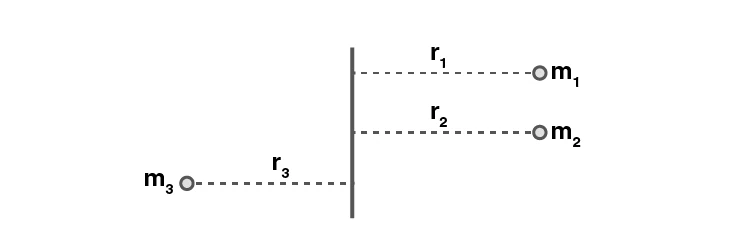
Example Problem
Calculate the moment of inertia for a system consisting of two masses, 0.8 kg and 0.6 kg, located 0.15 m and 0.35 m respectively from the axis of rotation.
Solution:
The moment of inertia \( I \) is given by:
\[ I = m_1 r_1^2 + m_2 r_2^2 \]
Substituting the values:
\[ I = (0.8)(0.15)^2 + (0.6)(0.35)^2 = 0.8 \times 0.0225 + 0.6 \times 0.1225 = 0.018 + 0.0735 = 0.0915 \text{ kg m}^2 \]
Therefore, the system's moment of inertia is \(0.0915 \text{ kg m}^2\).
Calculating Moment of Inertia for Rigid Bodies
Integral Approach to Continuous Mass Distributions
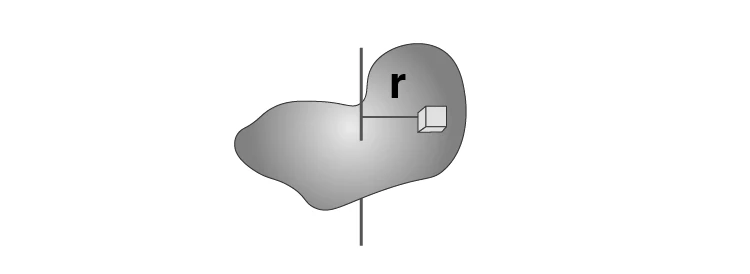
For rigid bodies with continuous mass distribution, the moment of inertia is determined by integrating over infinitesimal mass elements. If \( dm \) is a small mass element at a distance \( r \) from the axis, then:
\[ I = \int r^2 \, dm \]
This integral sums the contributions of all mass elements, accounting for their distances squared from the axis.
Stepwise Computation: Uniform Rod about Its Midpoint
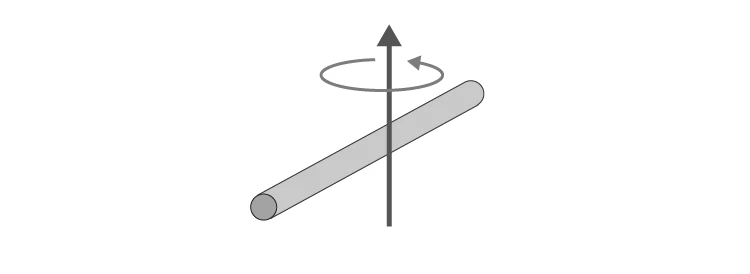
Consider a uniform rod of length \( L \) and mass \( M \), rotating about an axis perpendicular to the rod through its center. To find its moment of inertia:
- Divide the rod into infinitesimal segments \( dx \) at a distance \( x \) from the center.
- Mass per unit length is constant: \( \lambda = \frac{M}{L} \).
- Mass element: \( dm = \lambda dx = \frac{M}{L} dx \).
- Moment of inertia element: \( dI = x^2 dm = x^2 \frac{M}{L} dx \).
Integrating over the rod length from \( -\frac{L}{2} \) to \( \frac{L}{2} \):
\[ I = \int_{-\frac{L}{2}}^{\frac{L}{2}} x^2 \frac{M}{L} dx = \frac{M}{L} \left[ \frac{x^3}{3} \right]_{-\frac{L}{2}}^{\frac{L}{2}} = \frac{M}{L} \times \frac{L^3}{12} = \frac{ML^2}{12} \]
Thus, the moment of inertia of the rod about its midpoint is \( \frac{ML^2}{12} \).
Example Problem
Find the moment of inertia of a 2 m long uniform rod weighing 3 kg about an axis through its center.
Solution:
Using the formula:
\[ I = \frac{ML^2}{12} = \frac{3 \times (2)^2}{12} = \frac{3 \times 4}{12} = 1 \text{ kg m}^2 \]
The rod's moment of inertia about the center is \(1 \text{ kg m}^2\).
Moment of Inertia for Various Geometrical Bodies
Key Formulas for Common Shapes
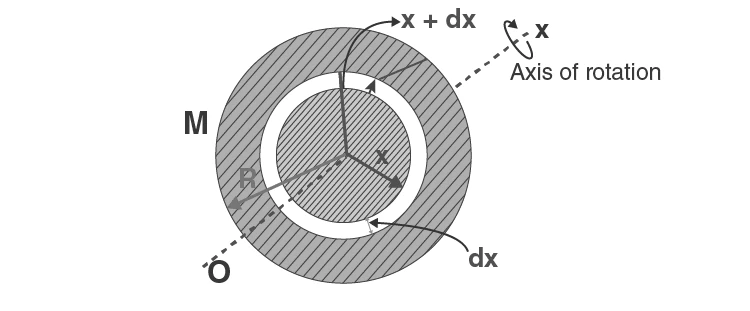
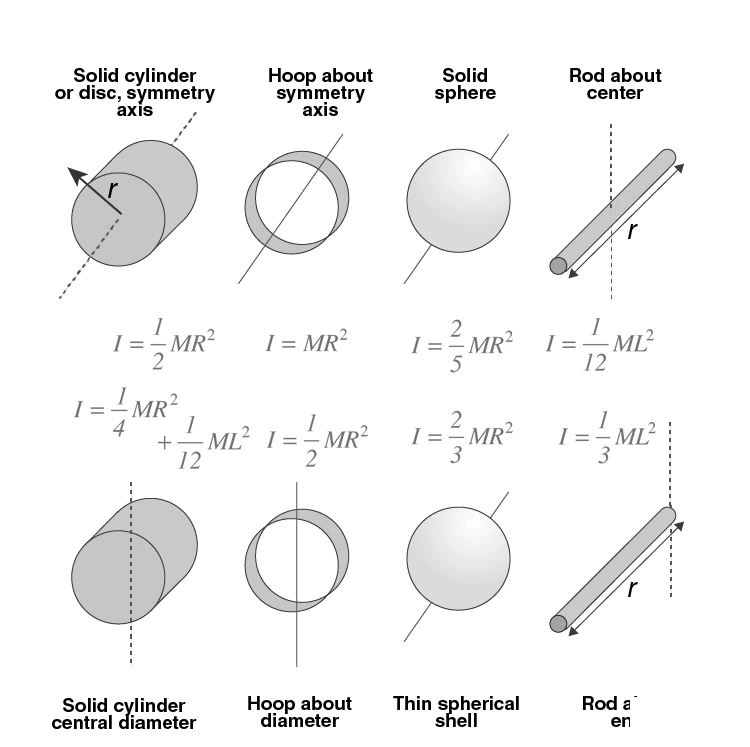
The moment of inertia varies with shape and axis of rotation. Below are formulas for some standard objects about their central axes:
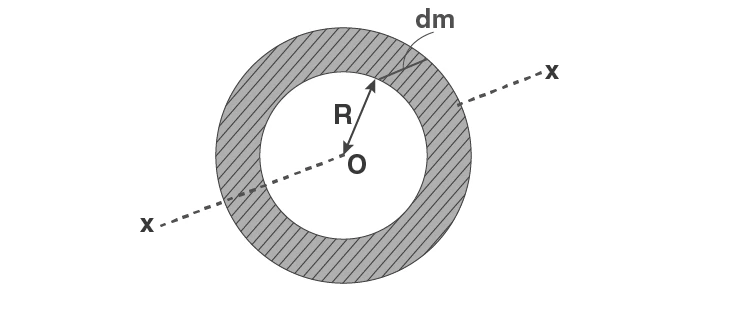
- Circular Ring: \( I = MR^2 \)
- Uniform Circular Plate: \( I = \frac{1}{2} MR^2 \)
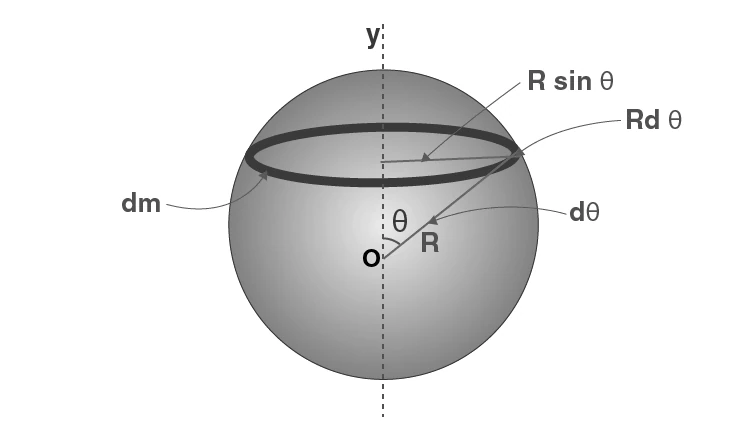
- Thin Spherical Shell (Hollow Sphere): \( I = \frac{2}{3} MR^2 \)
- Solid Sphere: \( I = \frac{2}{5} MR^2 \)
- Rectangular Plate (about axis through center parallel to edge): \( I = \frac{1}{12} ML^2 \)
Example Problem
Calculate the moment of inertia of a solid sphere of mass 5 kg and radius 0.3 m about its central axis.
Solution:
Using the formula for a solid sphere:
\[ I = \frac{2}{5} MR^2 = \frac{2}{5} \times 5 \times (0.3)^2 = \frac{2}{5} \times 5 \times 0.09 = 0.18 \text{ kg m}^2 \]
The moment of inertia is \(0.18 \text{ kg m}^2\).
Applying Theorems to Determine Moment of Inertia
Parallel Axis Theorem Explained
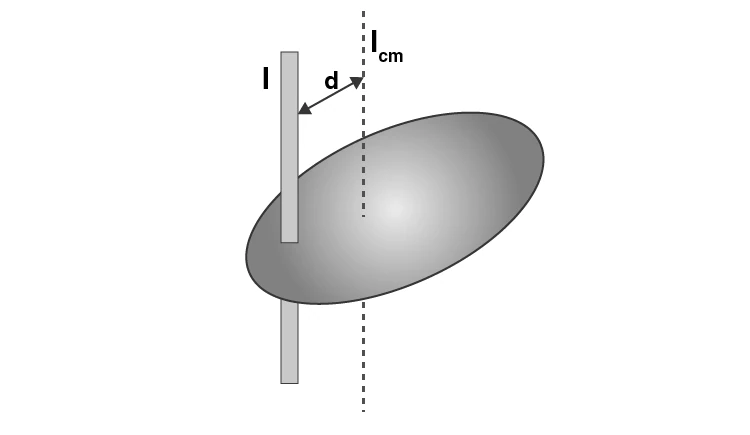
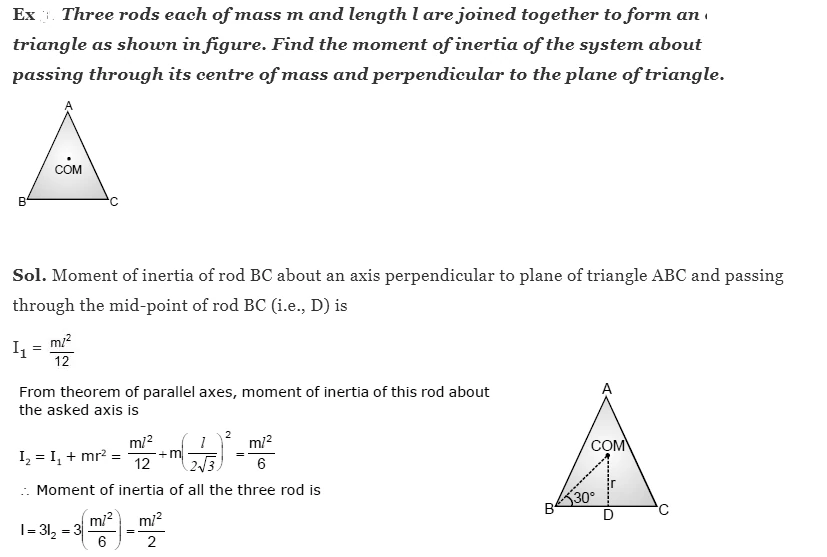
The moment of inertia about any axis parallel to one passing through the center of mass (COM) can be found using the parallel axis theorem:
\[ I = I_{\text{COM}} + Md^2 \]
Here, \( I_{\text{COM}} \) is the moment of inertia about the axis through the COM, \( M \) is the total mass, and \( d \) is the distance between the two axes.
Radius of Gyration Concept
The moment of inertia can also be expressed in terms of the radius of gyration \( k \), which is the distance from the axis where the entire mass can be assumed to be concentrated:
\[ I = Mk^2 \]
For example, the radius of gyration for a solid sphere is:
\[ k = \sqrt{\frac{2}{5}} R \]
Example Problem
A uniform circular disc of radius \( R \) and mass \( 8M \) has a smaller disc of radius \( \frac{R}{4} \) removed from its edge. Find the moment of inertia of the remaining disc about an axis perpendicular to its plane through the center.
Solution:
Moment of inertia of the full disc:
\[ I_{\text{full}} = \frac{1}{2} \times 8M \times R^2 = 4MR^2 \]
Mass of the removed small disc:
\[ m = 8M \times \left(\frac{\pi (R/4)^2}{\pi R^2}\right) = 8M \times \frac{1}{16} = 0.5M \]
Moment of inertia of the removed disc about its own center:
\[ I_{\text{small, center}} = \frac{1}{2} \times 0.5M \times \left(\frac{R}{4}\right)^2 = \frac{1}{2} \times 0.5M \times \frac{R^2}{16} = \frac{0.5M R^2}{32} = \frac{M R^2}{64} \]
Distance from the center of the large disc to the center of the small disc:
\[ d = R - \frac{R}{4} = \frac{3R}{4} \]
Using parallel axis theorem, moment of inertia of the removed disc about the large disc's center:
\[ I_{\text{small}} = I_{\text{small, center}} + m d^2 = \frac{M R^2}{64} + 0.5M \times \left(\frac{3R}{4}\right)^2 = \frac{M R^2}{64} + 0.5M \times \frac{9R^2}{16} = \frac{M R^2}{64} + \frac{9M R^2}{32} = \frac{M R^2}{64} + \frac{18M R^2}{64} = \frac{19M R^2}{64} \]
Therefore, the moment of inertia of the remaining disc is:
\[ I_{\text{remaining}} = I_{\text{full}} - I_{\text{small}} = 4MR^2 - \frac{19M R^2}{64} = \frac{256M R^2}{64} - \frac{19M R^2}{64} = \frac{237M R^2}{64} \approx 3.70 M R^2 \]
Practical Examples to Reinforce Understanding
Example 1: Moment of Inertia of Two Masses Connected by a Rod
Two spheres of masses 0.65 kg and 0.45 kg are connected by a light rod. The distances from the axis of rotation to the masses are 0.12 m and 0.38 m respectively. Calculate the system's moment of inertia about the axis.
Solution:
\[ I = m_1 r_1^2 + m_2 r_2^2 = 0.65 \times (0.12)^2 + 0.45 \times (0.38)^2 = 0.65 \times 0.0144 + 0.45 \times 0.1444 = 0.00936 + 0.065 = 0.07436 \text{ kg m}^2 \]
Example 2: Moment of Inertia of Four Identical Masses on a Cord
Four identical balls each of mass 0.25 kg are attached to a cord forming a rectangle 0.9 m long and 0.5 m wide. Find the moment of inertia about an axis perpendicular to the plane of the rectangle passing through its center.
Solution:
Distance of each ball from the center is half the diagonal:
\[ r = \sqrt{\left(\frac{0.9}{2}\right)^2 + \left(\frac{0.5}{2}\right)^2} = \sqrt{0.2025 + 0.0625} = \sqrt{0.265} \approx 0.515 \text{ m} \]
Moment of inertia:
\[ I = 4 \times m \times r^2 = 4 \times 0.25 \times (0.515)^2 = 1 \times 0.265 = 0.265 \text{ kg m}^2 \]
Summary Table: Moment of Inertia Formulas for Common Shapes
| Object | Axis of Rotation | Moment of Inertia \(I\) |
|---|---|---|
| Uniform Rod | Perpendicular bisector | \( \frac{1}{12} ML^2 \) |
| Circular Ring | Axis through center, perpendicular to plane | \( MR^2 \) |
| Uniform Circular Plate | Axis through center, perpendicular to plane | \( \frac{1}{2} MR^2 \) |
| Thin Spherical Shell | Axis through center | \( \frac{2}{3} MR^2 \) |
| Solid Sphere | Axis through center | \( \frac{2}{5} MR^2 \) |
| Rectangular Plate | Axis through center, parallel to edge | \( \frac{1}{12} ML^2 \) |
Glossary of Key Terms
| Term | Definition |
|---|---|
| Moment of Inertia | Measure of an object's resistance to changes in its rotational motion. |
| Axis of Rotation | Imaginary line about which an object rotates. |
| Torque | Rotational equivalent of force causing angular acceleration. |
| Angular Acceleration | Rate of change of angular velocity over time. |
| Radius of Gyration | Distance from axis where entire mass can be assumed concentrated for same inertia. |
| Rigid Body | Object with fixed shape and size, not deforming under force. |
| Linear Mass Density | Mass per unit length of an object. |
| Surface Mass Density | Mass per unit area of a surface. |
| Volume Mass Density | Mass per unit volume of a solid. |
| Parallel Axis Theorem | Method to find moment of inertia about any axis parallel to one through center of mass. |
Frequently Asked Questions (FAQs)
What does moment of inertia represent in rotational motion?
It represents how much an object resists changes in its rotational speed, depending on mass distribution relative to the axis.
Does the moment of inertia change with rotational speed?
No, it depends solely on the mass distribution and axis, not on how fast the object spins.
Which has a larger moment of inertia: a solid disc or a hollow cylinder of the same radius?
The hollow cylinder has a larger moment of inertia because its mass is distributed farther from the axis.
Is moment of inertia a scalar or vector quantity?
It is a scalar quantity, representing magnitude without direction.
What is the moment of inertia formula for a solid sphere?
It is given by \( I = \frac{2}{5} MR^2 \), where \( M \) is mass and \( R \) is radius.