Understanding the Mean Free Path of Gas Molecules
Fundamentals of Molecular Travel in Gases
Defining the Mean Free Path
Gas molecules are in constant motion, but their paths are never perfectly straight or uninterrupted. This is because they frequently collide with one another, causing sudden changes in their speed and direction. The mean free path is the average distance a molecule travels between these successive collisions.
In simpler terms, if you observe a single molecule moving through a gas, the mean free path represents the typical length it covers before bumping into another molecule.
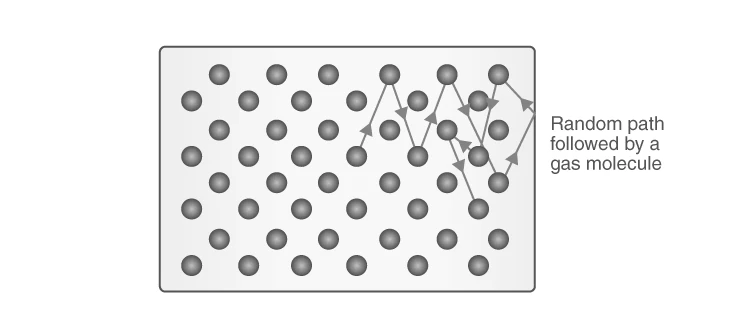
Illustration of the mean free path concept
The mean free path depends on the density of molecules and their size. Specifically, it decreases as the number of molecules per unit volume increases, since more molecules mean more frequent collisions. Similarly, larger molecules have a smaller mean free path because their bigger size increases the chance of collision.
Deriving the Formula for Mean Free Path
Step-by-Step Derivation
To derive the mean free path mathematically, consider a single spherical molecule of diameter \( d \) moving through a stationary field of other molecules treated as points. The molecule travels at speed \( v \) and sweeps out a cylindrical volume as it moves.
In a small time interval \( t \), the molecule covers a distance \( vt \), sweeping a cylinder with cross-sectional area \( \pi d^2 \). The volume of this cylinder is therefore:
\[ V = \pi d^2 \times v t \]
If the number density of molecules is \( \frac{N}{V} \) (number of molecules per unit volume), then the expected number of collisions in time \( t \) is:
\[ \text{Number of collisions} = \frac{N}{V} \times V = \frac{N}{V} \pi d^2 v t \]
The mean free path \( \lambda \) is the average distance traveled between collisions, which is the total distance divided by the number of collisions:
\[ \lambda = \frac{v t}{\text{Number of collisions}} = \frac{v t}{\frac{N}{V} \pi d^2 v t} = \frac{1}{\frac{N}{V} \pi d^2} \]
However, this derivation assumes all other molecules are stationary, which is not true in reality. Since molecules move relative to each other, the relative velocity is higher by a factor of \( \sqrt{2} \). Incorporating this correction, the refined formula becomes:
\[ \lambda = \frac{1}{\sqrt{2} \pi d^2 \frac{N}{V}} \]
At standard atmospheric conditions, the mean free path is approximately \( 0.1 \) micrometers.
Example Problem
A gas contains molecules with diameter \( 3.5 \times 10^{-10} \text{ m} \) and number density \( 2.5 \times 10^{25} \text{ molecules/m}^3 \). Calculate the mean free path of a molecule in this gas.
Solution:
Given:
Diameter, \( d = 3.5 \times 10^{-10} \text{ m} \)
Number density, \( \frac{N}{V} = 2.5 \times 10^{25} \text{ m}^{-3} \)
Using the formula:
\[ \lambda = \frac{1}{\sqrt{2} \pi d^2 \frac{N}{V}} \]
Calculate \( d^2 \):
\[ d^2 = (3.5 \times 10^{-10})^2 = 1.225 \times 10^{-19} \text{ m}^2 \]
Now substitute values:
\[ \lambda = \frac{1}{\sqrt{2} \times 3.1416 \times 1.225 \times 10^{-19} \times 2.5 \times 10^{25}} \]
\[ = \frac{1}{1.414 \times 3.1416 \times 1.225 \times 2.5 \times 10^{6}} \]
\[ = \frac{1}{13.6 \times 10^{6}} = 7.35 \times 10^{-8} \text{ m} \]
Therefore, the mean free path is approximately \( 7.35 \times 10^{-8} \text{ m} \) or 73.5 nanometers.
Key Influences on the Mean Free Path
Factors Affecting Molecular Travel Distance
The mean free path is influenced by several physical parameters:
Molecular Density: Higher density means molecules are packed closer, reducing the mean free path.
Molecular Size: Larger molecules have bigger collision cross-sections, decreasing the mean free path.
Number of Molecules: More molecules in a given volume increase collision frequency.
Temperature and Pressure: These affect molecular speed and density, indirectly influencing the mean free path.
Visualizing factors that impact the mean free path
Example Problem
How does doubling the pressure of a gas at constant temperature affect the mean free path of its molecules?
Solution:
At constant temperature, increasing pressure doubles the number density \( \frac{N}{V} \) because molecules are compressed into a smaller volume.
Since mean free path \( \lambda \) is inversely proportional to number density:
\[ \lambda \propto \frac{1}{\frac{N}{V}} \]
Doubling \( \frac{N}{V} \) halves the mean free path:
\[ \lambda_{\text{new}} = \frac{\lambda_{\text{original}}}{2} \]
Thus, the mean free path decreases by half when pressure is doubled at constant temperature.
Quick Reference: Summary of Mean Free Path Concepts
Parameter | Effect on Mean Free Path | Relation |
|---|---|---|
Number Density \( \frac{N}{V} \) | Increases collisions, reduces mean free path | \( \lambda \propto \frac{1}{\frac{N}{V}} \) |
Molecular Diameter \( d \) | Larger size increases collision cross-section, reduces mean free path | \( \lambda \propto \frac{1}{d^2} \) |
Temperature | Affects molecular speed and density, indirectly influences mean free path | Complex relation via \( v \) and \( \frac{N}{V} \) |
Pressure | Higher pressure increases density, reduces mean free path | \( \lambda \propto \frac{1}{P} \) (at constant temperature) |
Glossary of Important Terms
Term | Definition |
|---|---|
Mean Free Path (\( \lambda \)) | Average distance a molecule travels between collisions |
Number Density (\( \frac{N}{V} \)) | Number of molecules per unit volume |
Collision Cross-Section | Effective area for collision, proportional to \( \pi d^2 \) |
Relative Velocity | Speed of one molecule relative to another |
Elastic Collision | Collision where kinetic energy and momentum are conserved |
Diameter (\( d \)) | Size of a molecule considered as a sphere |
Ideal Gas | Gas model where molecules do not interact except by elastic collisions |
Velocity (\( v \)) | Speed of a molecule in a given direction |
Micrometer | Unit of length equal to \( 10^{-6} \) meters |
Number of Molecules (\( N \)) | Total molecules in a given volume |
Frequently Asked Questions
What factors determine the mean free path of gas molecules?
The mean free path depends mainly on the molecular size, number density of molecules, temperature, and pressure of the gas.
What assumptions are made in the kinetic theory of gases related to collisions?
It assumes that collisions between molecules and with container walls are perfectly elastic, conserving both momentum and kinetic energy.
What is the SI unit of temperature?
The SI unit of temperature is the kelvin (K).
What unit is used for molar mass?
Molar mass is expressed in grams per mole (g/mol).
How is average velocity of gas molecules defined?
Average velocity is the mean speed of molecules in a gas, averaged over all directions and molecules.