Understanding Nuclear Binding Energy and Mass Defect
Fundamentals of Mass Defect and Nuclear Energy
Concept of Mass Defect in Atomic Nuclei
Atoms consist of a central nucleus surrounded by electrons in orbitals. The nucleus itself is composed of protons and neutrons, collectively called nucleons. Intuitively, one might expect the nucleus's mass to equal the sum of the masses of its constituent protons and neutrons. However, experimental observations reveal that the actual mass of a nucleus is less than this sum. This shortfall in mass is known as the mass defect.
The mass defect (\( \Delta m \)) can be expressed as:
\[ \Delta m = Z m_p + (A - Z) m_n - m_{\text{nuc}} \]
where:
\( Z \) is the number of protons, each with mass \( m_p \)
\( A \) is the mass number (total nucleons)
\( m_n \) is the mass of a neutron
\( m_{\text{nuc}} \) is the actual mass of the nucleus
According to Einstein's mass-energy equivalence principle, mass and energy are interchangeable, described by the equation \( E = mc^2 \). This means the missing mass corresponds to energy released when nucleons bind together, known as the binding energy.
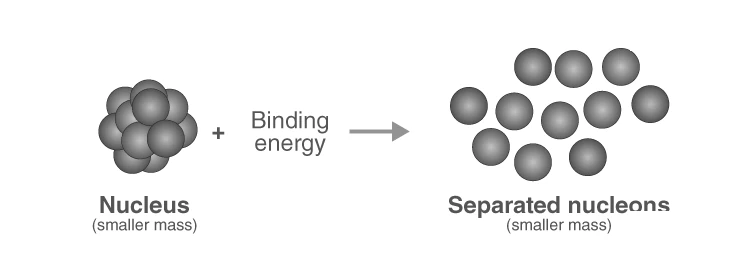
Illustration of mass defect in an atomic nucleus
Example: Calculating Mass Defect for a Helium Nucleus
Consider a helium nucleus with 2 protons and 2 neutrons. Given:
Mass of proton, \( m_p = 1.0073 \text{ u} \)
Mass of neutron, \( m_n = 1.0087 \text{ u} \)
Actual mass of helium nucleus, \( m_{\text{nuc}} = 4.0015 \text{ u} \)
Calculate the mass defect.
Solution:
\[ \Delta m = Z m_p + (A - Z) m_n - m_{\text{nuc}} = 2 \times 1.0073 + 2 \times 1.0087 - 4.0015 \]
\[ = 2.0146 + 2.0174 - 4.0015 = 4.0320 - 4.0015 = 0.0305 \text{ u} \]
The mass defect is \( 0.0305 \text{ u} \), which corresponds to the energy released when the nucleus forms.
Exploring Nuclear Binding Energy and Its Significance
Definition and Importance of Nuclear Binding Energy
Nuclear binding energy is the minimum energy required to disassemble a nucleus into its individual protons and neutrons. It represents the energy equivalent of the mass defect and is a measure of the nucleus's stability. The greater the binding energy, the more stable the nucleus.
Mathematically, the binding energy \( E_b \) is calculated by converting the mass defect into energy using Einstein's relation:
\[ E_b = \Delta m \times c^2 \]
where \( c \) is the speed of light in vacuum (\( 3 \times 10^8 \text{ m/s} \)). This energy is typically expressed in electron volts (eV) or mega electron volts (MeV).
Binding energy per nucleon is often used to compare the stability of different nuclei.
Example: Binding Energy of a Lithium-6 Nucleus
Given:
Number of protons, \( Z = 3 \)
Number of neutrons, \( A - Z = 3 \)
Mass of proton, \( m_p = 1.0073 \text{ u} \)
Mass of neutron, \( m_n = 1.0087 \text{ u} \)
Actual mass of lithium-6 nucleus, \( m_{\text{nuc}} = 6.0151 \text{ u} \)
1 atomic mass unit (u) = \( 931.5 \text{ MeV}/c^2 \)
Calculate the binding energy.
Solution:
First, find the mass defect:
\[ \Delta m = Z m_p + (A - Z) m_n - m_{\text{nuc}} = 3 \times 1.0073 + 3 \times 1.0087 - 6.0151 \]
\[ = 3.0219 + 3.0261 - 6.0151 = 6.0480 - 6.0151 = 0.0329 \text{ u} \]
Now, convert mass defect to energy:
\[ E_b = \Delta m \times 931.5 \text{ MeV} = 0.0329 \times 931.5 = 30.65 \text{ MeV} \]
The lithium-6 nucleus has a binding energy of approximately 30.65 MeV, indicating the energy needed to break it into individual nucleons.
Stepwise Approach to Calculate Nuclear Binding Energy
Procedure for Determining Binding Energy from Mass Defect
To find the nuclear binding energy, follow these steps:
Calculate the total mass of protons and neutrons separately using their counts and individual masses.
Measure or obtain the actual mass of the nucleus.
Determine the mass defect by subtracting the nucleus mass from the sum of individual nucleon masses.
Convert the mass defect into energy using \( E = \Delta m c^2 \).
Express the energy in convenient units such as MeV.
This method highlights the conversion of mass difference into the energy that holds the nucleus together.
Visual representation of nuclear binding energy calculation
Example: Binding Energy of a Deuteron
Given data:
Mass of proton, \( m_p = 938.3 \text{ MeV}/c^2 \)
Mass of neutron, \( m_n = 939.6 \text{ MeV}/c^2 \)
Mass of deuteron, \( m_D = 1876.1 \text{ MeV}/c^2 \)
Atomic number \( Z = 1 \), mass number \( A = 2 \)
Calculate the mass defect and binding energy.
Solution:
Mass defect:
\[ \Delta m = Z m_p + (A - Z) m_n - m_D = 1 \times 938.3 + 1 \times 939.6 - 1876.1 = 1877.9 - 1876.1 = 1.8 \text{ MeV}/c^2 \]
Binding energy:
\[ E_b = \Delta m \times c^2 = 1.8 \text{ MeV} \]
This means 1.8 MeV of energy is required to separate the deuteron into a proton and a neutron, demonstrating the strong nuclear force binding them.
Quick Reference: Key Formulas and Concepts
Term | Formula / Definition |
|---|---|
Mass Defect (\( \Delta m \)) | \( \Delta m = Z m_p + (A - Z) m_n - m_{\text{nuc}} \) |
Binding Energy (\( E_b \)) | \( E_b = \Delta m \times c^2 \) |
Mass-Energy Equivalence | \( E = mc^2 \) |
Proton Mass (\( m_p \)) | Approximately 1.0073 u or 938.3 MeV/\( c^2 \) |
Neutron Mass (\( m_n \)) | Approximately 1.0087 u or 939.6 MeV/\( c^2 \) |
Atomic Mass Unit (u) | 1 u = 931.5 MeV/\( c^2 \) |
Speed of Light (\( c \)) | \( 3 \times 10^8 \text{ m/s} \) |
Binding Energy per Nucleon | \( \frac{E_b}{A} \) |
Nucleons | Protons and neutrons in the nucleus |
Nuclear Stability | Higher binding energy indicates greater stability |
Glossary of Important Terms
Term | Meaning |
|---|---|
Atomic Number (Z) | Number of protons in the nucleus |
Mass Number (A) | Total number of protons and neutrons |
Mass Defect | Difference between sum of nucleon masses and actual nucleus mass |
Binding Energy | Energy required to separate a nucleus into individual nucleons |
Nucleon | Either a proton or a neutron in the nucleus |
Proton | Positively charged particle in the nucleus |
Neutron | Neutral particle in the nucleus |
Mass-Energy Equivalence | Principle that mass can be converted to energy and vice versa |
Electron Volt (eV) | Unit of energy commonly used in atomic and nuclear physics |
Deuteron | Nucleus of deuterium, consisting of one proton and one neutron |
Frequently Asked Questions
What causes the mass defect in a nucleus?
The mass defect arises because the mass of a bound nucleus is less than the sum of its free protons and neutrons due to the energy released when nucleons bind together.
How is nuclear binding energy related to mass defect?
Binding energy is the energy equivalent of the mass defect, calculated by converting the missing mass into energy using \( E = \Delta m c^2 \).
Why is binding energy important for nuclear stability?
A higher binding energy means nucleons are held more tightly, making the nucleus more stable against disintegration.
What units are used to express binding energy?
Binding energy is commonly expressed in electron volts (eV), kilo electron volts (keV), or mega electron volts (MeV).
How does nuclear binding energy compare to chemical bond energies?
Nuclear binding energies are millions of times greater than chemical bond energies, reflecting the strength of nuclear forces compared to electromagnetic forces.