Magnetic Field Along the Axis of a Circular Current Loop
Fundamentals of Magnetic Fields and Their Relation to Electric Currents
Understanding the Biot–Savart Law and Its Application
Electric currents generate magnetic fields, and the Biot–Savart law provides a mathematical description of this phenomenon. It relates the magnetic field produced by a small segment of current-carrying conductor to the current's magnitude, the length of the segment, the distance from the point of observation, and the angle between the current element and the position vector.
The Biot–Savart law is expressed as:
\[ d\mathbf{B} = \frac{\mu_0}{4\pi} \frac{I \, d\mathbf{l} \times \hat{\mathbf{r}}}{r^2} \]
where:
- \( \mu_0 = 4\pi \times 10^{-7} \, \text{T}\cdot\text{m/A} \) is the permeability of free space,
- \( I \) is the steady current,
- \( d\mathbf{l} \) is the vector length element of the conductor,
- \( \hat{\mathbf{r}} \) is the unit vector from the current element to the point of observation,
- \( r \) is the distance between the current element and the point where the field is calculated.
This law is fundamental in calculating magnetic fields generated by various current configurations.
Example Problem
A straight conductor segment of length 0.5 m carries a current of 3 A. Calculate the magnetic field at a point located 0.2 m perpendicular to the midpoint of the conductor.
Solution:
For a finite straight conductor, the magnetic field at a perpendicular distance \( r \) from its midpoint is given by:
\[ B = \frac{\mu_0 I}{4\pi r} ( \sin \theta_1 + \sin \theta_2 ) \]
Here, \( \theta_1 \) and \( \theta_2 \) are the angles subtended by the conductor at the point. Since the point is at the midpoint, both angles are equal:
\[ \theta_1 = \theta_2 = \tan^{-1} \left( \frac{L/2}{r} \right) = \tan^{-1} \left( \frac{0.25}{0.2} \right) \approx 51.34^\circ \]
Calculating the magnetic field:
\[ B = \frac{4\pi \times 10^{-7} \times 3}{4\pi \times 0.2} ( \sin 51.34^\circ + \sin 51.34^\circ ) = \frac{3 \times 10^{-7}}{0.2} \times 2 \times 0.78 = 2.34 \times 10^{-6} \, \text{T} \]
Thus, the magnetic field at the point is approximately \( 2.34 \, \mu\text{T} \).
Deriving the Magnetic Field Along the Axis of a Circular Loop
Step-by-Step Derivation Using Biot–Savart Law
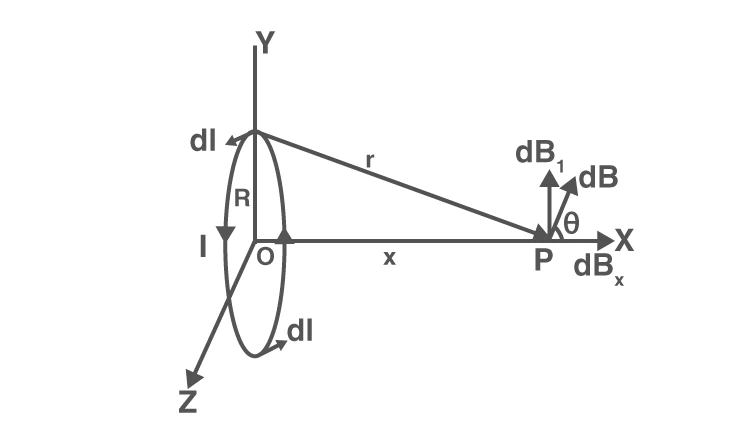
Consider a circular loop of radius \( R \) lying in the y-z plane, centered at the origin. The loop carries a steady current \( I \). We want to find the magnetic field at a point \( P \) located on the x-axis at a distance \( x \) from the center.
Each infinitesimal current element \( d\mathbf{l} \) produces a magnetic field \( d\mathbf{B} \) at point \( P \). By symmetry, the components of \( d\mathbf{B} \) perpendicular to the x-axis cancel out when integrated over the loop, leaving only the x-component.
The magnitude of the magnetic field contribution from each element is:
\[ dB = \frac{\mu_0}{4\pi} \frac{I \, dl \sin \theta}{r^2} \]
where \( r = \sqrt{R^2 + x^2} \) is the distance from the element to point \( P \), and \( \theta \) is the angle between \( d\mathbf{l} \) and the position vector \( \mathbf{r} \).
The x-component of \( d\mathbf{B} \) is:
\[ dB_x = dB \cos \theta = \frac{\mu_0}{4\pi} \frac{I \, dl \sin \theta \cos \theta}{r^2} \]
Since \( \sin \theta = \frac{R}{r} \) and \( \cos \theta = \frac{x}{r} \), substituting these gives:
\[ dB_x = \frac{\mu_0}{4\pi} \frac{I \, dl}{r^2} \times \frac{R}{r} \times \frac{x}{r} = \frac{\mu_0}{4\pi} \frac{I \, dl \, R \, x}{r^4} \]
Integrating over the entire loop, where the circumference is \( 2\pi R \), the total magnetic field at point \( P \) is:
\[ B_x = \int dB_x = \frac{\mu_0 I R^2}{2 (R^2 + x^2)^{3/2}} \]
At the center of the loop (\( x=0 \)), the magnetic field simplifies to:
\[ B_0 = \frac{\mu_0 I}{2R} \]
This field is directed along the axis of the loop, following the right-hand thumb rule.
Example Problem
A single circular loop of radius 0.15 m carries a current of 2 A. Calculate the magnetic field at a point 0.1 m along the axis from the center of the loop.
Solution:
Given: \( R = 0.15 \, \text{m} \), \( I = 2 \, \text{A} \), \( x = 0.1 \, \text{m} \)
Using the formula for the magnetic field on the axis:
\[ B_x = \frac{\mu_0 I R^2}{2 (R^2 + x^2)^{3/2}} \]
Calculate denominator:
\[ (R^2 + x^2)^{3/2} = (0.15^2 + 0.1^2)^{3/2} = (0.0225 + 0.01)^{3/2} = (0.0325)^{3/2} \]
\[ (0.0325)^{3/2} = (0.0325)^{1} \times \sqrt{0.0325} = 0.0325 \times 0.1803 = 0.00586 \]
Calculate numerator:
\[ \mu_0 I R^2 = 4\pi \times 10^{-7} \times 2 \times (0.15)^2 = 4\pi \times 10^{-7} \times 2 \times 0.0225 = 5.6549 \times 10^{-8} \]
Therefore,
\[ B_x = \frac{5.6549 \times 10^{-8}}{2 \times 0.00586} = \frac{5.6549 \times 10^{-8}}{0.01172} = 4.82 \times 10^{-6} \, \text{T} \]
The magnetic field at the point is approximately \( 4.82 \, \mu\text{T} \), directed along the axis of the loop.
Practical Application: Magnetic Field in Multi-Turn Circular Coils
Calculating Magnetic Field for Coils with Multiple Turns
When a coil consists of multiple turns, the magnetic field at the center or along the axis is amplified proportionally to the number of turns \( N \). The total magnetic field is the sum of the fields produced by each turn.
The magnetic field at the center of a coil with \( N \) turns is:
\[ B = \frac{\mu_0 N I}{2 R} \]
This formula assumes all turns are closely wound and the coil is circular.
Example Problem
A coil with 80 turns has a radius of 0.10 m and carries a current of 0.5 A. Determine the magnetic field at the center of the coil and specify its direction if the current flows clockwise when viewed from the right side.
Solution:
Given: \( N = 80 \), \( R = 0.10 \, \text{m} \), \( I = 0.5 \, \text{A} \)
Using the formula:
\[ B = \frac{\mu_0 N I}{2 R} = \frac{4\pi \times 10^{-7} \times 80 \times 0.5}{2 \times 0.10} = \frac{4\pi \times 10^{-7} \times 40}{0.20} \]
\[ B = \frac{5.0265 \times 10^{-5}}{0.20} = 2.513 \times 10^{-4} \, \text{T} \]
The magnetic field magnitude is \( 2.51 \times 10^{-4} \, \text{T} \) or 0.251 mT.
Since the current is clockwise when viewed from the right, by the right-hand thumb rule, the magnetic field points towards the left along the axis.
Summary of Key Concepts and Formulas
| Concept | Formula / Description |
|---|---|
| Biot–Savart Law | \( d\mathbf{B} = \frac{\mu_0}{4\pi} \frac{I \, d\mathbf{l} \times \hat{\mathbf{r}}}{r^2} \) |
| Magnetic Field on Axis of Circular Loop | \( B_x = \frac{\mu_0 I R^2}{2 (R^2 + x^2)^{3/2}} \) |
| Magnetic Field at Center of Loop | \( B_0 = \frac{\mu_0 I}{2 R} \) |
| Magnetic Field at Center of Multi-turn Coil | \( B = \frac{\mu_0 N I}{2 R} \) |
| Permeability of Free Space | \( \mu_0 = 4\pi \times 10^{-7} \, \text{T}\cdot\text{m/A} \) |
| Right-Hand Thumb Rule | Direction of magnetic field along the axis follows the curl of fingers in current direction; thumb points along field. |
| Radius of Loop | Distance from center to wire, denoted \( R \) |
| Current Element | Infinitesimal segment \( d\mathbf{l} \) carrying current \( I \) |
| Distance to Point on Axis | \( r = \sqrt{R^2 + x^2} \) |
| Magnetic Field Components | Only axial components add; perpendicular components cancel by symmetry |
Glossary of Important Terms
| Term | Definition |
|---|---|
| Biot–Savart Law | Mathematical relation describing magnetic field due to a current element. |
| Current Element | Small segment of a conductor carrying current, treated as a vector. |
| Magnetic Field (\( \mathbf{B} \)) | Vector field representing magnetic influence of electric currents and magnets. |
| Permeability of Free Space (\( \mu_0 \)) | Constant defining magnetic permeability in vacuum, \( 4\pi \times 10^{-7} \, \text{T}\cdot\text{m/A} \). |
| Right-Hand Thumb Rule | Rule to determine direction of magnetic field around current-carrying conductor. |
| Radius (\( R \)) | Distance from center to wire in a circular loop. |
| Axial Point | Point located along the axis passing through the center of the loop. |
| Magnetic Field Components | Parts of magnetic field vector; axial components add, perpendicular cancel. |
| Current (\( I \)) | Flow of electric charge through a conductor. |
| Multi-turn Coil | Coil consisting of several loops of wire, increasing magnetic field strength. |
Frequently Asked Questions
What is the right-hand thumb rule?
It states that if you curl the fingers of your right hand in the direction of current flow in a circular wire, your thumb points in the direction of the magnetic field along the axis.
Which law describes the magnetic field due to a current element?
The Biot–Savart law provides the formula to calculate the magnetic field generated by a small current-carrying segment.
What is electromagnetic force?
It is a fundamental force that governs interactions between electrically charged particles, combining both electric and magnetic forces.
How is the magnetic field on the axis of a circular loop calculated?
Using the formula \( B_x = \frac{\mu_0 I R^2}{2 (R^2 + x^2)^{3/2}} \), where \( x \) is the distance along the axis from the center.
Is the current element a scalar or vector quantity?
The current element \( d\mathbf{l} \) is treated as a vector quantity, having both magnitude and direction.