Understanding Magnetic Dipole Moments and Their Applications
Fundamentals of Magnetic Dipole Moments
Concept and Physical Meaning of Magnetic Dipole Moment
The magnetic dipole moment is a vector quantity that characterizes the strength and orientation of a magnetic source, such as a magnet or a current-carrying loop. It essentially represents the magnetic equivalent of an electric dipole, consisting of a pair of opposite magnetic poles separated by a small distance. This dipole moment determines the magnetic field pattern produced by the source.
In terms of units, the magnetic dipole moment is measured in ampere-square meters (\(\text{A} \cdot \text{m}^2\)) in the SI system, which corresponds to the product of current and the area enclosed by the current loop. In the CGS system, it is expressed as ergs per gauss, where 1000 ergs per gauss equals one ampere-square meter.
Example: A circular loop of wire with radius 0.05 m carries a current of 3 A. Calculate the magnetic dipole moment of the loop.
Solution:
The area of the loop is \( A = \pi R^2 = \pi \times (0.05)^2 = 7.85 \times 10^{-3} \text{ m}^2 \).
The magnetic dipole moment is given by \( \mu = I \times A = 3 \times 7.85 \times 10^{-3} = 0.02355 \text{ A} \cdot \text{m}^2 \).
Thus, the magnetic dipole moment of the loop is \(0.02355 \text{ A} \cdot \text{m}^2\).
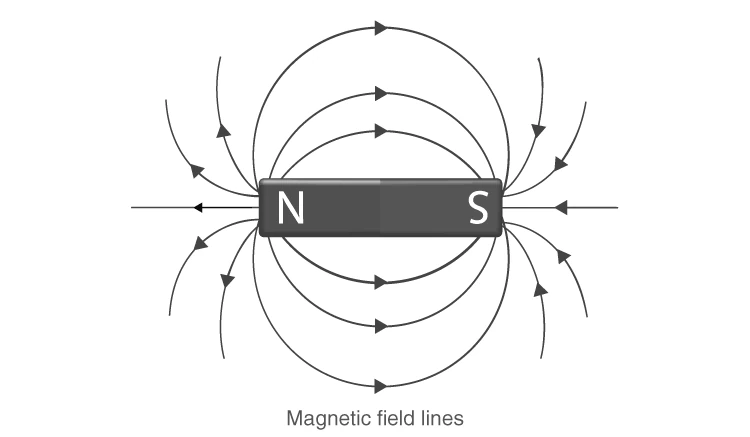
Magnetic Dipole Moment Representation
Deriving the Magnetic Dipole Moment from a Current Loop
Mathematical Derivation and Physical Interpretation
Consider a circular loop of radius \(R\) carrying a steady current \(I\). The magnetic field \(B\) at a point along the axis of the loop, at a distance \(l\) from its center, is given by:
\[ B = \frac{\mu_0 I R^2}{2 (R^2 + l^2)^{3/2}} \]
When the observation point is far from the loop such that \(l \gg R\), the expression simplifies to:
\[ B \approx \frac{\mu_0 I \pi R^2}{2 \pi l^3} = \frac{\mu_0}{4 \pi} \frac{2 \mu}{l^3} \]
Here, the magnetic moment \(\mu\) is defined as:
\[ \mu = I A = I \pi R^2 \]
This vector \(\mu\) points along the axis of the loop, following the right-hand rule, and fully characterizes the magnetic field at large distances.
Unlike electric charges, magnetic monopoles do not exist; magnetic fields always arise from dipoles with both north and south poles. This fundamental property means that magnetic dipoles are the smallest units capable of producing magnetic fields.
Example: A coil with 50 turns, each of radius 0.1 m, carries a current of 0.2 A. Calculate the total magnetic dipole moment of the coil.
Solution:
Area of one loop: \( A = \pi (0.1)^2 = 0.0314 \text{ m}^2 \).
Total magnetic moment: \( \mu = N I A = 50 \times 0.2 \times 0.0314 = 0.314 \text{ A} \cdot \text{m}^2 \).
Therefore, the coil's magnetic dipole moment is \(0.314 \text{ A} \cdot \text{m}^2\).
Magnetic Dipole Moments in Atomic and Subatomic Systems
Electron Spin and Orbital Contributions to Magnetic Moments
At the atomic scale, electrons moving around the nucleus generate magnetic dipole moments analogous to current loops. The electron's orbital motion creates a magnetic moment proportional to its angular momentum. The magnetic moment \(\mu_l\) associated with an electron revolving in an orbit is given by:
\[ \mu_l = \frac{e}{2m} l \]
where \(e\) is the electron charge, \(m\) its mass, and \(l\) its orbital angular momentum. The ratio \(\frac{\mu_l}{l} = \frac{e}{2m}\) is known as the gyromagnetic ratio.
Moreover, electrons possess an intrinsic magnetic moment due to their spin, which does not arise from any physical rotation but is a fundamental quantum property.
Example: Calculate the magnetic dipole moment of an electron with orbital angular momentum \(l = 1.05 \times 10^{-34} \text{ J} \cdot \text{s}\). Use \(e = 1.6 \times 10^{-19} \text{ C}\) and \(m = 9.11 \times 10^{-31} \text{ kg}\).
Solution:
Using the formula:
\[ \mu_l = \frac{e}{2m} l = \frac{1.6 \times 10^{-19}}{2 \times 9.11 \times 10^{-31}} \times 1.05 \times 10^{-34} = 9.22 \times 10^{-24} \text{ A} \cdot \text{m}^2 \]
This value corresponds to the Bohr magneton, the fundamental unit of magnetic moment in atomic physics.
Atomic Behavior as Magnetic Dipoles
Electrons orbiting the nucleus behave like tiny current loops, producing magnetic dipole moments. The direction of electron motion is opposite to the direction of the equivalent current, resulting in a magnetic north and south pole within the atom. This intrinsic property causes atoms to exhibit magnetic characteristics.
Example: Explain why an atom behaves like a magnetic dipole.
Answer:
Electrons revolve around the nucleus, creating a loop of moving charge.
This motion is equivalent to a current loop generating a magnetic field.
The magnetic field has a north and south pole, forming a dipole.
The combined effect of all electrons' magnetic moments determines the atom's overall magnetic behavior.
Magnetic Dipole Moment of a Current-Carrying Loop
Definition and Direction of Magnetic Moment Vector
The magnetic dipole moment \(\vec{\mu}\) of a planar current loop is defined as the product of the current \(I\) and the area \(A\) enclosed by the loop:
\[ |\vec{\mu}| = I A \]
The direction of \(\vec{\mu}\) is perpendicular to the plane of the loop, determined by the right-hand rule: if the fingers curl in the direction of current, the thumb points along \(\vec{\mu}\).
Example: A square loop of side 0.2 m carries a current of 5 A. Find the magnitude and direction of its magnetic dipole moment.
Solution:
Area of the loop: \( A = (0.2)^2 = 0.04 \text{ m}^2 \).
Magnetic dipole moment magnitude: \( \mu = I A = 5 \times 0.04 = 0.2 \text{ A} \cdot \text{m}^2 \).
The direction is perpendicular to the loop's plane, following the right-hand rule based on current direction.
Magnetic Field Lines of a Current Loop
Summary of Key Magnetic Dipole Concepts
Concept | Description | Formula / Unit |
|---|---|---|
Magnetic Dipole Moment (\(\mu\)) | Measure of magnetic strength and orientation of a magnet or current loop | \(\mu = I A\), unit: \(\text{A} \cdot \text{m}^2\) |
Gyromagnetic Ratio | Ratio of magnetic moment to angular momentum for a revolving charge | \(\frac{\mu_l}{l} = \frac{e}{2m}\) |
Magnetic Field on Axis of Loop | Magnetic field at distance \(l\) along axis of current loop | \(B = \frac{\mu_0 I R^2}{2 (R^2 + l^2)^{3/2}}\) |
Electron Magnetic Moment | Intrinsic magnetic moment due to electron spin and orbital motion | Bohr magneton \(\approx 9.27 \times 10^{-24} \text{ A} \cdot \text{m}^2\) |
Magnetic Dipole | Pair of north and south magnetic poles separated by a small distance | Fundamental source of magnetic fields |
Glossary of Magnetic Dipole Terminology
Term | Definition |
|---|---|
Magnetic Dipole Moment | Vector quantity representing magnetic strength and orientation |
Current Loop | A closed conducting path carrying electric current |
Gyromagnetic Ratio | Ratio of magnetic moment to angular momentum for charged particles |
Bohr Magneton | Fundamental unit of magnetic moment for electrons |
Magnetic Field | Vector field produced by moving charges and magnetic dipoles |
Angular Momentum | Quantity of rotational motion of a particle or system |
Electron Spin | Intrinsic form of angular momentum carried by electrons |
Magnetic Monopole | Hypothetical single magnetic pole, not observed in nature |
Right-Hand Rule | Mnemonic to determine direction of magnetic moment or field |
Magnetic Flux Density | Measure of magnetic field strength per unit area |
Frequently Asked Questions on Magnetic Dipole Moments
What is the physical significance of the magnetic dipole moment?
The magnetic dipole moment quantifies the strength and orientation of a magnetic source, determining the magnetic field it produces.
Why can't magnetic monopoles exist according to current understanding?
Magnetic fields always arise from dipoles with both north and south poles; isolated magnetic monopoles have not been observed experimentally.
How is the magnetic dipole moment related to current and area?
It is the product of the current flowing through a loop and the area enclosed by the loop, \(\mu = I A\).
What role does the gyromagnetic ratio play in magnetic moments?
It relates the magnetic moment of a particle to its angular momentum, important in understanding electron behavior in atoms.
How do electrons contribute to the magnetic properties of atoms?
Electrons orbiting the nucleus create current loops, producing magnetic dipole moments that give atoms their magnetic characteristics.