Understanding Linear Momentum and Its Conservation
Fundamentals of Linear Momentum
Defining Momentum and Its Characteristics
Momentum is a physical quantity that measures the motion of an object. It is calculated as the product of an object's mass and its velocity, making it a vector quantity that has both magnitude and direction. The standard unit for momentum is kilogram meter per second (\(\text{kg m s}^{-1}\)).
Mathematically, momentum \( \mathbf{p} \) is expressed as:
\[ \mathbf{p} = m \mathbf{v} \]
where \(m\) is the mass of the object and \(\mathbf{v}\) is its velocity vector.
There is a direct relationship between kinetic energy and momentum. For an object, kinetic energy \(K\) is given by:
\[ K = \frac{1}{2} m v^2 \]
By expressing velocity in terms of momentum, we get:
\[ p = m v \implies v = \frac{p}{m} \]
Substituting into the kinetic energy formula:
\[ K = \frac{1}{2} m \left(\frac{p}{m}\right)^2 = \frac{p^2}{2m} \]
This shows that for two objects with the same kinetic energy, the one with smaller mass will have less momentum.
Example:
A 3 kg object moves with a velocity of \(4 \text{ m/s}\). Calculate its momentum and kinetic energy.
Solution:
Momentum:
\[ p = m v = 3 \times 4 = 12 \text{ kg m/s} \]
Kinetic Energy:
\[ K = \frac{1}{2} \times 3 \times 4^2 = \frac{1}{2} \times 3 \times 16 = 24 \text{ J} \]
Formulas and Units for Momentum
Calculating Momentum and Its Rate of Change
Momentum is calculated by multiplying mass and velocity, as previously discussed. The unit of momentum is \(\text{kg m s}^{-1}\), which reflects its vector nature.
Newton's Second Law connects force to the rate at which momentum changes over time. It states that the force applied on an object is equal to the time rate of change of its momentum:
\[ \mathbf{F} = \frac{d\mathbf{p}}{dt} \]
This means that any change in momentum over time results in a force acting on the object.
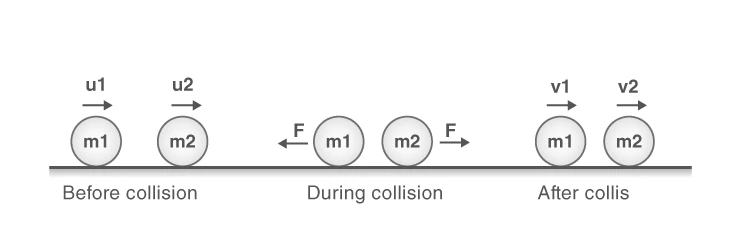
Diagram illustrating the relationship between force and momentum change
Example:
A 5 kg object initially at rest is accelerated to \(10 \text{ m/s}\) in 4 seconds. Calculate the average force applied.
Solution:
Initial momentum, \(p_i = 5 \times 0 = 0\)
Final momentum, \(p_f = 5 \times 10 = 50 \text{ kg m/s}\)
Change in momentum, \(\Delta p = p_f - p_i = 50 - 0 = 50 \text{ kg m/s}\)
Time interval, \(\Delta t = 4 \text{ s}\)
Average force:
\[ F = \frac{\Delta p}{\Delta t} = \frac{50}{4} = 12.5 \text{ N} \]
Principle of Momentum Conservation
Understanding Momentum Conservation in Systems
The law of conservation of momentum states that if no external force acts on a system, the total momentum of that system remains constant. This principle is fundamental in analyzing collisions and interactions between objects.
Consider two objects with masses \(m_1\) and \(m_2\), moving with initial velocities \(u_1\) and \(u_2\) respectively. After interaction, their velocities change to \(v_1\) and \(v_2\). The total momentum before and after the event is given by:
\[ m_1 u_1 + m_2 u_2 = m_1 v_1 + m_2 v_2 \]
This equation holds true only when the net external force on the system is zero. It is important to note that momentum conservation applies to the entire system, not to individual objects if external forces act on them.
Collision between two bodies demonstrating momentum conservation
Example:
Two carts on a frictionless track have masses 2 kg and 3 kg. The 2 kg cart moves at \(5 \text{ m/s}\) towards the stationary 3 kg cart. After collision, the 2 kg cart moves at \(2 \text{ m/s}\). Find the velocity of the 3 kg cart after collision.
Solution:
Initial momentum:
\[ p_i = m_1 u_1 + m_2 u_2 = 2 \times 5 + 3 \times 0 = 10 \text{ kg m/s} \]
Final momentum:
\[ p_f = m_1 v_1 + m_2 v_2 = 2 \times 2 + 3 \times v_2 = 4 + 3 v_2 \]
By conservation of momentum:
\[ 10 = 4 + 3 v_2 \implies 3 v_2 = 6 \implies v_2 = 2 \text{ m/s} \]
The 3 kg cart moves at \(2 \text{ m/s}\) after the collision.
Quick Reference Summary
Concept | Formula | Unit | Notes |
|---|---|---|---|
Momentum | \( \mathbf{p} = m \mathbf{v} \) | \(\text{kg m s}^{-1}\) | Vector quantity; depends on mass and velocity |
Kinetic Energy | \( K = \frac{p^2}{2m} \) | \(\text{Joule (J)}\) | Related to momentum and mass |
Force | \( \mathbf{F} = \frac{d\mathbf{p}}{dt} \) | \(\text{Newton (N)}\) | Rate of change of momentum |
Conservation of Momentum | \( m_1 u_1 + m_2 u_2 = m_1 v_1 + m_2 v_2 \) | — | Valid when net external force is zero |
Glossary of Key Terms
Term | Definition |
|---|---|
Momentum | The product of an object's mass and velocity, representing its motion. |
Vector Quantity | A quantity having both magnitude and direction. |
Kinetic Energy | Energy possessed by a body due to its motion. |
Newton's Second Law | Law stating that force equals the rate of change of momentum. |
Force | An interaction that changes the motion of an object. |
Conservation of Momentum | Principle that total momentum remains constant if no external force acts. |
Mass | Measure of the amount of matter in an object. |
Velocity | Speed of an object in a specified direction. |
System | A group of interacting objects considered for analysis. |
Impulse | Change in momentum resulting from a force applied over time. |
Frequently Asked Questions
What is the law of conservation of momentum and its unit?
The law states that in the absence of external forces, the total momentum of a system remains constant. Momentum is measured in kilogram meter per second (\(\text{kg m s}^{-1}\)).
How does Newton’s second law explain rocket propulsion?
Newton’s second law shows that the force (thrust) generated by expelling gases changes the rocket’s momentum, causing it to accelerate upwards.
Why is momentum not conserved for a single object during a collision?
Because external forces act on individual objects during collisions, their momentum can change. Conservation applies only to the entire system where external forces are absent.
What is another name for Newton’s second law?
It is also known as the law of force and acceleration.
Can you give examples of Newton’s second law in daily life?
Examples include a car accelerating when the gas pedal is pressed and a ball speeding up as it falls due to gravity.