Understanding Hooke’s Law and Its Applications
Fundamentals of Elasticity and Hooke’s Principle
Concept of Proportionality Between Force and Extension
During the 19th century, Robert Hooke observed that many elastic materials exhibit a direct proportionality between the force applied and the resulting extension, as long as the material remains within its elastic limit. This proportional relationship is the foundation of what is now known as Hooke’s Law.
In essence, when a material is stretched or compressed slightly, the deformation it undergoes is directly proportional to the applied force, provided the material is not permanently deformed.
Mathematically, Hooke’s Law is expressed as:
\[ F = -k x \]
Here, \(F\) represents the restoring force exerted by the material, \(x\) is the displacement or extension from the equilibrium position, and \(k\) is the spring constant, a measure of the stiffness of the material, expressed in \(\text{N/m}\).
The negative sign indicates that the force exerted by the spring opposes the direction of displacement.
Example: Consider a spring stretched by 3 cm with a restoring force of 150 N. Calculate the spring constant \(k\).
Solution:
Convert the extension to meters: \(3 \text{ cm} = 0.03 \text{ m}\).
Using Hooke’s Law magnitude:
\[ k = \frac{F}{x} = \frac{150 \text{ N}}{0.03 \text{ m}} = 5000 \text{ N/m} \]
Therefore, the spring constant is \(5000 \text{ N/m}\).
Experimental Verification of Hooke’s Law
Observing Spring Behavior Under Different Loads
To verify Hooke’s Law, a spring is subjected to varying loads, and the corresponding extensions are measured. Initially, the spring is at rest with no load. When a load of 1 N is applied, the spring stretches by a length \(x\). Doubling the load to 2 N causes the spring to extend by \(2x\), demonstrating the linear relationship between force and extension.
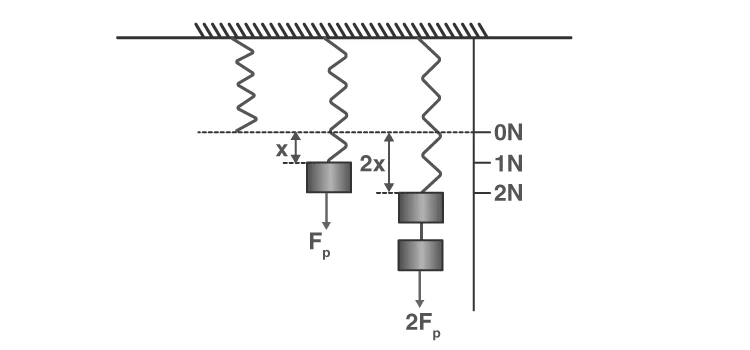
Illustration of spring elongation under varying forces
Each spring has a unique spring constant \(k\), which can be calculated by substituting the measured force and extension values into Hooke’s Law. This experiment confirms the proportionality and helps determine the stiffness of the spring.
Example: A spring stretches by 4 cm when a force of 2 N is applied. What is the spring constant?
Solution:
Convert extension to meters: \(4 \text{ cm} = 0.04 \text{ m}\).
Calculate \(k\):
\[ k = \frac{F}{x} = \frac{2 \text{ N}}{0.04 \text{ m}} = 50 \text{ N/m} \]
The spring constant is \(50 \text{ N/m}\).
Graphical Representation of Elastic Behavior
Interpreting the Stress-Strain Curve for Elastic Materials
The stress-strain graph for materials like low carbon steel illustrates how the material behaves under tensile forces. Initially, the graph shows a straight line from the origin to the proportional limit, indicating that stress and strain are directly proportional and the material obeys Hooke’s Law.
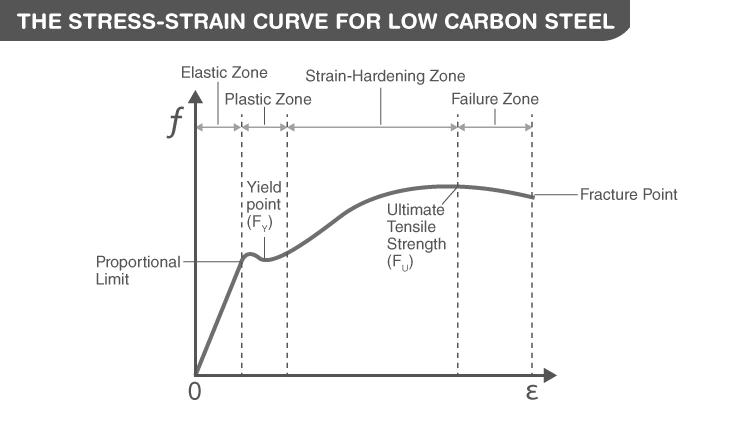
Stress-strain curve depicting elastic and plastic deformation regions
Beyond the proportional limit, the material enters the plastic region where permanent deformation occurs, and Hooke’s Law no longer applies. The yield strength marks the transition point where elasticity is lost. The ultimate tensile strength is the maximum stress the material can withstand before rupture.
Example: A steel wire exhibits a proportional limit at a stress of \(250 \times 10^6 \text{ Pa}\). If the strain at this point is \(0.001\), verify if Hooke’s Law holds and calculate the Young’s modulus.
Solution:
Since the stress and strain are proportional up to the proportional limit, Hooke’s Law is valid here.
Young’s modulus \(E\) is given by:
\[ E = \frac{\text{Stress}}{\text{Strain}} = \frac{250 \times 10^6 \text{ Pa}}{0.001} = 2.5 \times 10^{11} \text{ Pa} \]
This value represents the stiffness of the steel wire within the elastic region.
Practical Uses of Hooke’s Principle
Applications in Everyday Instruments and Science
Hooke’s Law is fundamental in designing devices that rely on elastic deformation. It is the principle behind the operation of manometers, spring scales, and the balance wheels in mechanical clocks. These devices measure force or pressure by observing the displacement of a spring.
Moreover, Hooke’s Law underpins fields such as seismology, where it helps in understanding earth vibrations, acoustics for sound wave propagation, and molecular mechanics in material science.
Spring scale demonstrating Hooke’s Law in force measurement
Example: A spring scale is calibrated such that a force of 10 N causes an extension of 2 cm. What is the spring constant, and what extension will a force of 25 N cause?
Solution:
Convert extension to meters: \(2 \text{ cm} = 0.02 \text{ m}\).
Calculate spring constant:
\[ k = \frac{10 \text{ N}}{0.02 \text{ m}} = 500 \text{ N/m} \]
For a force of 25 N, extension \(x\) is:
\[ x = \frac{F}{k} = \frac{25 \text{ N}}{500 \text{ N/m}} = 0.05 \text{ m} = 5 \text{ cm} \]
The spring will extend by 5 cm under 25 N force.
Limitations and Constraints of Hooke’s Law
When Does Hooke’s Law Cease to Apply?
Hooke’s Law is valid only within the elastic limit of materials. Beyond this limit, materials undergo plastic deformation, and the linear relationship between force and extension no longer holds.
Additionally, Hooke’s Law is applicable primarily to solid materials experiencing small deformations. It does not universally apply to all materials or large strains.
Diagram illustrating elastic and plastic deformation regions
Understanding these limitations is crucial for engineers and scientists to avoid material failure in practical applications.
Example: A wire is stretched beyond its elastic limit and does not return to its original length. Explain why Hooke’s Law is not applicable in this case.
Answer:
The wire has undergone plastic deformation, meaning permanent changes in shape.
Hooke’s Law only describes elastic behavior where deformation is reversible.
Beyond the elastic limit, the stress-strain relationship is nonlinear.
Therefore, Hooke’s Law fails to predict the behavior of the wire after permanent deformation.
Quick Reference: Key Points on Hooke’s Law
Concept | Details |
|---|---|
Hooke’s Law Formula | \(F = -k x\) |
Spring Constant (\(k\)) | Measure of stiffness, units: \(\text{N/m}\) |
Elastic Limit | Maximum stress for reversible deformation |
Proportional Limit | Stress up to which Hooke’s Law is valid |
Plastic Deformation | Permanent deformation beyond elastic limit |
Young’s Modulus | Ratio of stress to strain in elastic region |
Applications | Manometers, spring scales, clocks, seismology |
Limitations | Valid only for small deformations and elastic materials |
Force Direction | Opposes displacement (negative sign in formula) |
Units of Force and Extension | Force in Newtons (N), extension in meters (m) |
Glossary of Important Terms
Term | Definition |
|---|---|
Elastic Limit | The maximum stress a material can withstand without permanent deformation. |
Spring Constant (\(k\)) | A constant that measures the stiffness of a spring or elastic material. |
Stress | Force applied per unit area within materials. |
Strain | Measure of deformation representing the displacement between particles in the material body. |
Plastic Deformation | Permanent change in shape or size of a material after stress is removed. |
Proportional Limit | The highest stress at which stress is directly proportional to strain. |
Young’s Modulus | Ratio of stress to strain in the elastic region of a material. |
Hooke’s Law | The principle stating that force is proportional to extension within elastic limits. |
Elastic Potential Energy | Energy stored in a stretched or compressed elastic material. |
Ultimate Tensile Strength | The maximum stress a material can withstand before failure. |
Frequently Asked Questions
Does Hooke’s Law apply to all materials?
Hooke’s Law is valid only for materials that exhibit elastic behavior and within their elastic limits. It does not apply to materials undergoing plastic deformation or large strains.
Is the relationship in Hooke’s Law always linear?
Yes, within the elastic limit, the force and extension are linearly related. Beyond this limit, the relationship becomes nonlinear.
Why does Hooke’s Law include a negative sign?
The negative sign indicates that the restoring force exerted by the spring acts in the opposite direction to the displacement.
When does Hooke’s Law fail to describe material behavior?
It fails when the material is stretched beyond its elastic limit, resulting in permanent deformation or when the forces and deformations are too large.
Why is Hooke’s Law important in engineering?
It helps predict how materials will respond to forces, ensuring safety and functionality in structures and mechanical devices.