Understanding Heat Transfer: Modes and Applications
Fundamentals of Heat Transfer
Overview of Heat Movement Between Bodies
Heat transfer occurs when there is a temperature difference between two objects or between an object and its surroundings. The natural flow of heat is always from a region of higher temperature to one of lower temperature until thermal equilibrium is reached. This phenomenon explains why a pan of water heats up on a stove and cools down once removed from the heat source.
Heat transfer can happen through three primary mechanisms: conduction, convection, and radiation. Each mode involves different physical processes and applies to different states of matter and conditions.
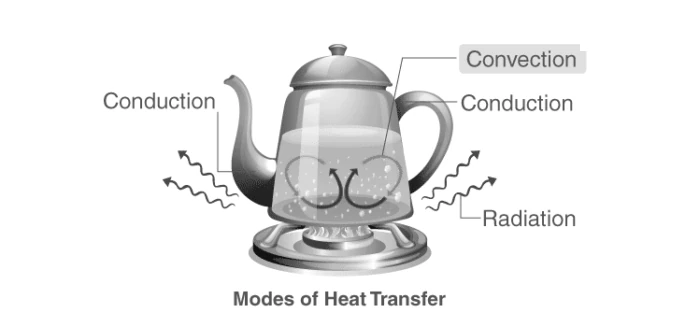
Illustration of the three main heat transfer methods: conduction, convection, and radiation
Example Problem
A metal rod is heated at one end, causing heat to flow to the cooler end. Explain the process by which heat travels through the rod and identify the mode of heat transfer involved.
Solution:
Heat moves from the hot end to the cold end through the vibration and interaction of atoms and molecules within the rod.
There is no bulk movement of the rod’s material; only energy is transferred.
This process is known as conduction, which primarily occurs in solids where particles are closely packed.
Heat Transfer by Conduction
Mechanism and Characteristics of Conduction
Conduction is the transfer of heat through a solid or between solids in direct contact, without any movement of the material as a whole. The energy is passed from one molecule to another via their vibrational motion. This mode is most effective in solids due to their tightly packed particles.
Materials that allow heat to pass through them easily are called conductors, such as metals. Conversely, materials that resist heat flow are insulators, like wood or plastic.
Example Problem
A copper rod 0.5 m long with a cross-sectional area of \(2 \times 10^{-4} \text{ m}^2\) has one end maintained at \(100^\circ \text{C}\) and the other at \(25^\circ \text{C}\). Given the thermal conductivity of copper as \(400 \text{ W/m} \cdot \text{K}\), calculate the rate of heat conduction through the rod.
Solution:
The rate of heat transfer by conduction is given by Fourier’s law:
\[ \frac{\Delta Q}{\Delta t} = K A \frac{(T_1 - T_2)}{L} \]
Where:
\(K = 400 \text{ W/m} \cdot \text{K}\)
\(A = 2 \times 10^{-4} \text{ m}^2\)
\(T_1 = 100^\circ \text{C}\), \(T_2 = 25^\circ \text{C}\)
\(L = 0.5 \text{ m}\)
Substituting values:
\[ \frac{\Delta Q}{\Delta t} = 400 \times 2 \times 10^{-4} \times \frac{100 - 25}{0.5} = 400 \times 2 \times 10^{-4} \times 150 = 12 \text{ W} \]
Therefore, the heat conduction rate is \(12 \text{ watts}\).
Heat Transfer by Convection
Understanding Heat Movement in Fluids
Convection involves the transfer of heat through liquids and gases by the actual movement of the fluid itself. When a fluid is heated, it becomes less dense and rises, while cooler, denser fluid sinks, creating a circulation pattern that transfers heat.
This mode of heat transfer is common in everyday phenomena such as boiling water or atmospheric circulation.
Convection currents transferring heat in liquids and gases
Example Problem
Explain how convection causes the heating of milk in a pan placed on a stove.
Solution:
The milk at the bottom of the pan heats up first, becoming less dense and rising upwards.
Cooler milk descends to replace the rising warm milk, creating a circular flow called convection currents.
This continuous movement distributes heat throughout the milk, warming it evenly.
Heat Transfer by Radiation
Heat Movement Without a Medium
Radiation is the transfer of heat through electromagnetic waves and does not require any medium to travel. This means heat can be transferred through a vacuum, such as the heat from the Sun reaching Earth.
Devices like microwaves use radiation to heat substances directly without heating the surrounding air or medium.
Heat transfer through radiation without a medium
Example Problem
Describe how radiation heats food in a microwave oven.
Solution:
Microwaves emit electromagnetic waves that penetrate the food.
The water molecules inside the food absorb this energy, causing them to vibrate and generate heat.
This process heats the food directly without warming the air or container significantly.
Factors Influencing the Rate of Heat Transfer
Quantitative Relationship and Analogies
The speed at which heat transfers depends on several factors including the surface area, temperature difference, thickness of the material, and the material’s thermal conductivity. The general relation can be expressed as:
\[ \frac{\Delta Q}{\Delta t} \propto A \frac{(T_1 - T_2)}{x} \]
Where \(A\) is the area, \(T_1\) and \(T_2\) are temperatures of the two bodies, and \(x\) is the thickness of the material.
Introducing the heat transfer coefficient \(K\), the equation becomes:
\[ \frac{\Delta Q}{\Delta t} = K A \frac{(T_1 - T_2)}{x} \]
This formula resembles Ohm’s law in electricity, where temperature difference acts like voltage, heat flow like current, and thermal resistance like electrical resistance.
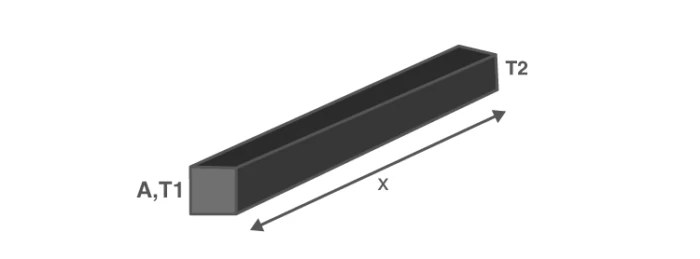
Factors affecting heat transfer and their practical applications
Heat Transfer Through Multiple Layers in Series
When heat passes through several materials arranged one after another, the overall heat flow depends on each layer’s properties. For two rods joined together with a junction temperature \(T\), the heat flow rates are:
For the first rod:
\[ \frac{\Delta Q}{\Delta t} = K_1 A_1 \frac{(T_1 - T)}{L_1} \]
For the second rod:
\[ \frac{\Delta Q}{\Delta t} = K_2 A_2 \frac{(T - T_2)}{L_2} \]
Since the junction temperature remains steady, the heat flow rates through both rods are equal. This allows calculation of the junction temperature \(T\).
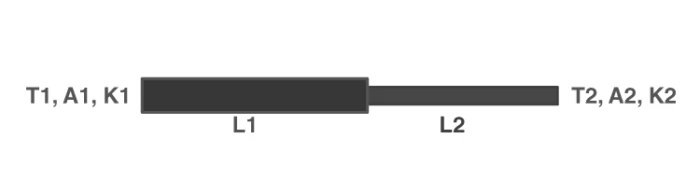
Heat conduction through rods connected in series
Heat Transfer Through Parallel Paths
When heat flows through multiple paths simultaneously, such as rods arranged in parallel, the total heat flow is the sum of heat flows through each path:
For rod 1:
\[ \frac{\Delta Q}{\Delta t} = K_1 A_1 \frac{(T_1 - T_2)}{L} \]
For rod 2:
\[ \frac{\Delta Q}{\Delta t} = K_2 A_2 \frac{(T_1 - T_2)}{L} \]
Total heat flow is the sum of these two.
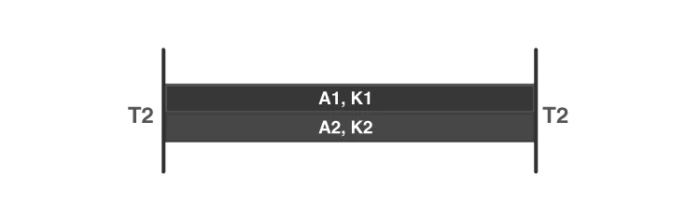
Heat conduction through rods arranged in parallel
Application: Freezing Time of a Lake
Consider a lake of depth \(h\) with outside temperature \(T\). The time required to freeze the entire lake can be estimated using heat transfer principles. The rate of heat loss is:
\[ \frac{dQ}{dt} = K A T x \]
Where \(x\) is the thickness of the ice layer formed, \(K\) is thermal conductivity, and \(A\) is the surface area.
The mass of ice formed in thickness \(dx\) is:
\[ dm = \rho A dx \]
Heat released during freezing is:
\[ dQ = dm \cdot L = \rho A L dx \]
Equating heat loss and heat released:
\[ K A T x dt = \rho A L dx \]
Separating variables and integrating from 0 to \(t\) and 0 to \(h\):
\[ \int_0^t dt = \frac{\rho L}{K T} \int_0^h x dx \]
Evaluating the integral:
\[ t = \frac{\rho L h^2}{2 K T} \]
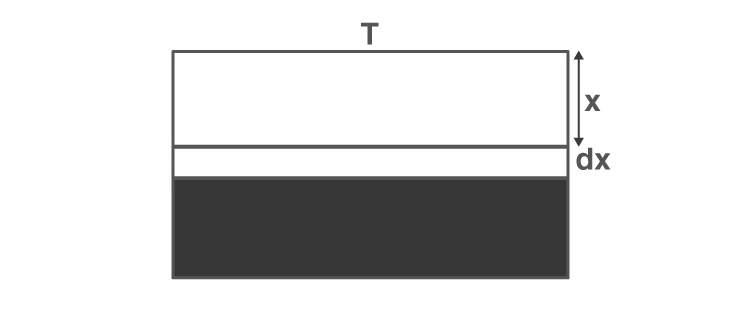
Estimating freezing time of a lake using heat transfer concepts
Example Problem
A lake 4 m deep is exposed to an outside temperature of \(-10^\circ \text{C}\). Given the density of ice \(\rho = 900 \text{ kg/m}^3\), latent heat of fusion \(L = 3.3 \times 10^5 \text{ J/kg}\), and thermal conductivity \(K = 2.2 \text{ W/m} \cdot \text{K}\), estimate the time required to freeze the lake.
Solution:
Using the formula:
\[ t = \frac{\rho L h^2}{2 K T} \]
Substituting values (taking \(T = 10^\circ \text{C}\) as temperature difference):
\[ t = \frac{900 \times 3.3 \times 10^5 \times 4^2}{2 \times 2.2 \times 10} = \frac{900 \times 3.3 \times 10^5 \times 16}{44} \]
\[ t = \frac{4.752 \times 10^9}{44} = 1.08 \times 10^8 \text{ seconds} \]
Converting to days:
\[ \frac{1.08 \times 10^8}{86400} \approx 1250 \text{ days} \]
Thus, it would take approximately 1250 days to freeze the lake under these conditions.
Quick Reference: Summary of Heat Transfer Concepts
Mode of Heat Transfer | Medium | Mechanism | Example |
|---|---|---|---|
Conduction | Solids | Vibrational energy transfer between molecules | Heating a pan on a stove |
Convection | Liquids and gases | Bulk movement of fluid carrying heat | Boiling water or heating milk |
Radiation | Vacuum or any medium | Electromagnetic wave emission and absorption | Sunlight warming Earth, microwave heating |
Factor | Effect on Heat Transfer |
|---|---|
Temperature Difference (\(T_1 - T_2\)) | Greater difference increases heat flow rate |
Surface Area (A) | Larger area allows more heat transfer |
Thickness (x) | Greater thickness reduces heat flow |
Thermal Conductivity (K) | Higher conductivity increases heat transfer |
Glossary of Key Terms
Term | Definition |
|---|---|
Conduction | Heat transfer through direct molecular contact without bulk movement. |
Convection | Heat transfer by fluid motion carrying energy from one place to another. |
Radiation | Transfer of heat via electromagnetic waves without needing a medium. |
Thermal Conductivity (K) | Material property indicating ability to conduct heat. |
Latent Heat (L) | Heat required for phase change without temperature change. |
Thermal Equilibrium | State where two objects have the same temperature and no net heat flow. |
Heat Transfer Coefficient | Proportionality constant in heat transfer equations. |
Temperature Gradient | Rate of temperature change with distance in a material. |
Insulator | Material that resists heat flow. |
Conductor | Material that allows heat to pass through easily. |
Frequently Asked Questions
What are the primary methods by which heat is transferred?
Heat is mainly transferred through conduction, convection, and radiation.
How does conduction differ from convection?
Conduction transfers heat through direct contact without fluid movement, while convection involves heat transfer by the movement of fluids.
Can heat transfer occur without a medium?
Yes, radiation transfers heat through electromagnetic waves and does not require a medium.
What factors affect the rate of heat transfer?
The rate depends on temperature difference, surface area, material thickness, and thermal conductivity.
Why do metals conduct heat better than wood?
Metals have free electrons that facilitate energy transfer, making them good conductors, whereas wood lacks these free electrons and acts as an insulator.