Fundamentals and Applications of Wave Motion
Understanding Wave Motion and Its Characteristics
Nature and Propagation of Mechanical Waves
A wave is a disturbance that moves through space, carrying energy from one point to another without the physical transport of matter. In mechanical waves, particles of the medium oscillate about their equilibrium positions, transferring energy through these vibrations while remaining essentially fixed in place. The medium undergoes temporary deformation, which is restored by internal forces, allowing the wave to propagate.
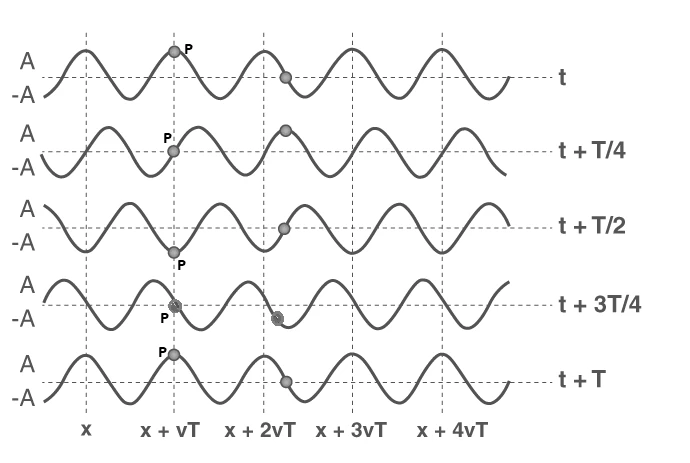
Depiction of wave traveling through a medium
Example 1: Identifying Wave Properties
A wave travels along a stretched string with a maximum displacement of 0.15 m. If the particles oscillate but do not move from their mean positions, explain how energy is transmitted through the string.
Solution:
The particles vibrate perpendicular to the direction of wave travel, transferring energy via oscillations.
Energy moves along the string, but particles only oscillate about fixed points.
The restoring force in the string causes the medium to return to its original shape after deformation.
Mathematical Representation of Sinusoidal Waves
When a string under tension oscillates, points on it execute simple harmonic motion between fixed limits. Such waves are sinusoidal and can be described by a sine or cosine function incorporating amplitude, wave number, angular frequency, and phase. The general expression for a traveling wave is:
\[ y(x,t) = A \sin(kx - \omega t + \phi) \]
where:
\(A\) is the wave's amplitude (maximum displacement)
\(k = \frac{2\pi}{\lambda}\) is the wave number, with \(\lambda\) as the wavelength
\(\omega = 2\pi f\) is the angular frequency, with \(f\) as the frequency
\(\phi\) is the initial phase angle
\(kx - \omega t + \phi\) represents the instantaneous phase of the wave
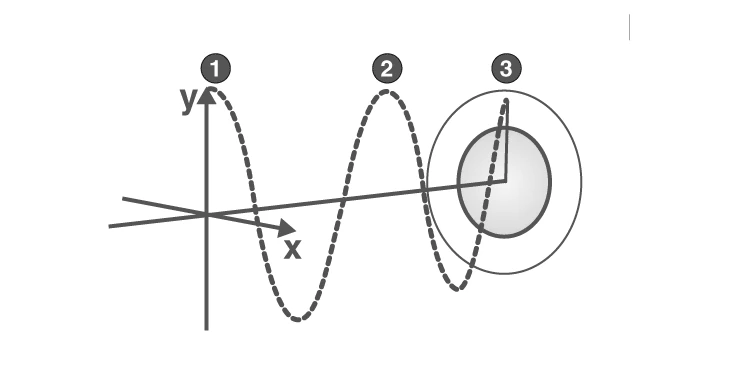
Graph showing sinusoidal wave displacement over time and position
Example 2: Calculating Wave Parameters
A wave on a string is described by \( y(x,t) = 0.25 \sin(5.0x - 2.0t) \) where \(y\) is in meters, \(x\) in meters, and \(t\) in seconds. Determine the amplitude, period, and wave speed.
Solution:
Amplitude, \(A = 0.25 \text{ m}\)
Angular frequency, \(\omega = 2.0 \text{ s}^{-1}\)
Wave number, \(k = 5.0 \text{ m}^{-1}\)
Time period, \(T = \frac{2\pi}{\omega} = \frac{2 \times 3.14}{2.0} = 3.14 \text{ s}\)
Wave speed, \(v = \frac{\omega}{k} = \frac{2.0}{5.0} = 0.4 \text{ m/s}\)
Phase Relationships and Wave Synchronization
Points on a wave that differ in phase by multiples of \(2n\pi\) oscillate synchronously, meaning they reach their maximum and minimum displacements simultaneously. This phase coherence is essential in understanding wave interference and superposition.
Example 3: Determining Wavelength from Wave Equation
The wave equation is given as \( y = 0.3 \sin(0.03x + 0.05t - \frac{\pi}{4}) \), where \(x\) is in centimeters and \(t\) in seconds. Calculate the wavelength of the wave.
Solution:
Wave number, \(k = 0.03 \text{ cm}^{-1}\)
Wavelength, \(\lambda = \frac{2\pi}{k} = \frac{2 \times 3.14}{0.03} = 209.33 \text{ cm}\)
Practical Applications and Calculations Involving Wave Equations
Analyzing Particle Displacement in a Traveling Wave
The displacement of particles in a medium due to a wave can be calculated by substituting specific values of position and time into the wave equation. This allows prediction of the particle's instantaneous position during wave propagation.
Example 4: Computing Particle Displacement
Given the wave equation \( y = 0.003 \sin 2\pi(4t - \frac{x}{10}) \), where \(y\) and \(x\) are in meters and \(t\) in seconds, find the displacement of the particle located 8 m from the origin at \(t = 0.25 \text{ s}\).
Solution:
Substitute \(x = 8\) m and \(t = 0.25\) s:
\[ y = 0.003 \sin 2\pi \left(4 \times 0.25 - \frac{8}{10}\right) = 0.003 \sin 2\pi (1 - 0.8) = 0.003 \sin 2\pi (0.2) \]
Calculate the argument:
\[ 2\pi \times 0.2 = 0.4\pi \]
Using \(\sin 0.4\pi \approx \sin 72^\circ = 0.9511\),
\[ y = 0.003 \times 0.9511 = 0.00285 \text{ m} \]
The particle displacement is approximately \(0.00285 \text{ m}\).
Wave Speed and Period from Wave Parameters
Wave speed can be derived from the ratio of angular frequency to wave number, while the time period is the reciprocal of frequency. These relationships are fundamental in characterizing wave motion.
Example 5: Finding Wave Speed and Period
A wave is described by \( y = 0.15 \sin(8x - 4t) \), where \(x\) and \(y\) are in meters and \(t\) in seconds. Calculate the wave's speed and period.
Solution:
Angular frequency, \(\omega = 4 \text{ s}^{-1}\)
Wave number, \(k = 8 \text{ m}^{-1}\)
Time period, \(T = \frac{2\pi}{\omega} = \frac{2 \times 3.14}{4} = 1.57 \text{ s}\)
Wave speed, \(v = \frac{\omega}{k} = \frac{4}{8} = 0.5 \text{ m/s}\)
Wave traveling along a stretched string under tension
Summary Table of Key Wave Concepts
Parameter | Symbol | Definition | Formula |
|---|---|---|---|
Amplitude | \(A\) | Maximum displacement of particles from equilibrium | Given in wave equation |
Wavelength | \(\lambda\) | Distance between two consecutive crests or troughs | \(\lambda = \frac{2\pi}{k}\) |
Wave Number | \(k\) | Number of wave cycles per unit distance | \(k = \frac{2\pi}{\lambda}\) |
Frequency | \(f\) | Number of oscillations per second | \(f = \frac{\omega}{2\pi}\) |
Angular Frequency | \(\omega\) | Rate of change of phase with time | \(\omega = 2\pi f\) |
Time Period | \(T\) | Time for one complete oscillation | \(T = \frac{1}{f} = \frac{2\pi}{\omega}\) |
Wave Speed | \(v\) | Speed at which wave propagates through medium | \(v = \frac{\omega}{k} = f \lambda\) |
Phase | \(\phi\) | Initial angle determining wave's starting point | Given in wave equation |
Displacement | \(y\) | Instantaneous position of particle in medium | From wave equation \(y(x,t)\) |
Instantaneous Phase | \(kx - \omega t + \phi\) | Phase of wave at position \(x\) and time \(t\) | Used in sinusoidal wave expression |
Glossary of Essential Wave Terminology
Term | Meaning |
|---|---|
Amplitude | Maximum displacement of a particle from its rest position during oscillation |
Wavelength | Distance between two successive points in phase on a wave, such as crest to crest |
Frequency | Number of complete oscillations or cycles per second |
Period | Time taken for one complete oscillation |
Wave Number | Number of wavelengths per unit distance, \(k = \frac{2\pi}{\lambda}\) |
Angular Frequency | Rate of change of phase with time, \(\omega = 2\pi f\) |
Phase | Initial angle determining the wave's starting point in its cycle |
Crest | Highest point of a wave where particle displacement is maximum and positive |
Trough | Lowest point of a wave where particle displacement is maximum and negative |
Displacement | Instantaneous position of a particle relative to its equilibrium |
Frequently Asked Questions on Wave Motion
What defines the crest of a wave?
The crest is the peak point of a wave where the medium's particles reach their highest positive displacement.
How is the trough of a wave characterized?
The trough is the lowest point in a wave cycle where particles have maximum negative displacement.
Can you give examples of transverse waves?
Examples include waves on a stretched string and electromagnetic waves, where particle displacement is perpendicular to wave direction.
What is the meaning of wavelength?
Wavelength is the distance between two consecutive crests or troughs in a wave, representing one complete cycle.
How do particles in a medium move when a wave passes?
Particles oscillate about fixed points without net movement, transferring energy through these vibrations.