Fundamentals and Laws of Thermodynamics
Introduction to Thermodynamics and Its Scope
Understanding the Science of Heat and Energy
Thermodynamics is the branch of physics that explores the relationships between heat, work, temperature, and energy. It focuses on how thermal energy transforms into other energy forms and how matter responds to these changes. Unlike microscopic studies, thermodynamics examines systems at a macroscopic level, analyzing bulk properties without delving into molecular details. The term was first introduced by William Thomson in 1749.
Watch this concise video summarizing key thermodynamics concepts and previous exam questions to reinforce your understanding.
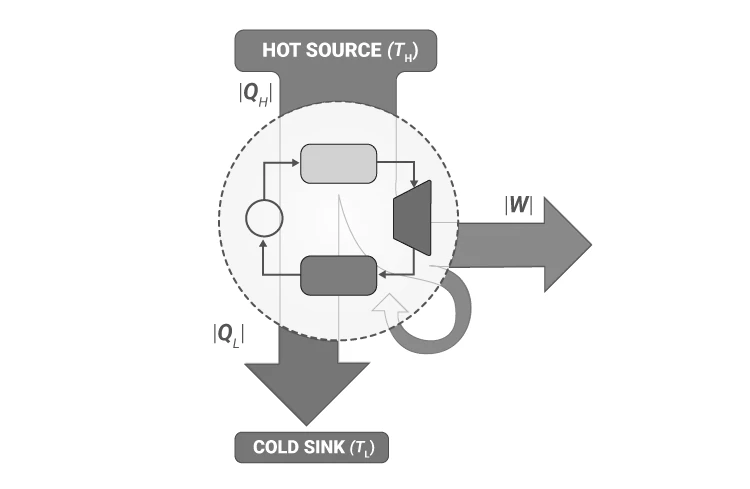
Comparing Mechanics and Thermodynamics
While mechanics studies the motion of bodies and particles under forces and torques, thermodynamics concentrates on the internal state of a system rather than its overall motion. It examines energy changes within the system, focusing on properties like pressure, volume, and temperature rather than trajectories or velocities.
Historical Development of Thermodynamics
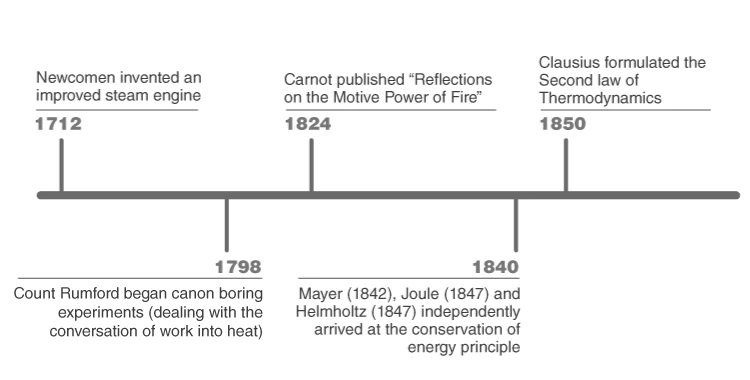
Branches and Core Concepts of Thermodynamics
Overview of Thermodynamics Subfields
Thermodynamics is divided into four main branches, each focusing on different aspects of energy and matter:
- Classical Thermodynamics: Studies macroscopic properties like temperature and pressure to predict system behavior.
- Statistical Thermodynamics: Analyzes molecular interactions and properties to explain bulk phenomena.
- Chemical Thermodynamics: Examines heat and work in chemical reactions and phase changes.
- Equilibrium Thermodynamics: Focuses on energy and matter transformations as systems reach equilibrium.
Classical Thermodynamics Explained
This branch uses macroscopic variables to describe matter's behavior during processes, enabling calculations of properties and predictions without molecular details.
Statistical Thermodynamics Insights
By considering individual molecules and their interactions, this approach provides a microscopic foundation for thermodynamic properties observed at larger scales.
Chemical Thermodynamics Focus
This field studies the interplay of heat and work during chemical reactions and phase transitions, crucial for understanding reaction energetics.
Equilibrium Thermodynamics Fundamentals
It investigates how systems evolve towards equilibrium, where macroscopic properties stabilize and no net changes occur.
Essential Thermodynamic Terminology and Systems
Defining Thermodynamic Systems and Surroundings
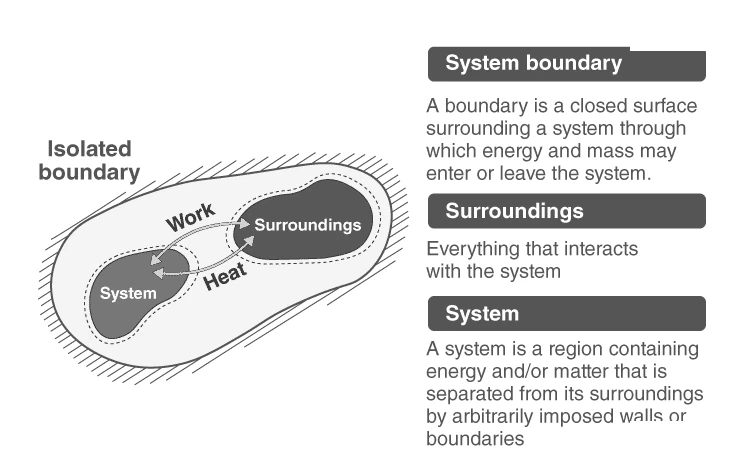
A thermodynamic system is a defined portion of matter separated by boundaries, which can be real or imaginary, fixed or flexible. The surroundings include everything outside the system that influences it.
Systems are categorized as:
- Isolated System: No exchange of energy or matter with surroundings (e.g., the universe).
- Closed System: Energy can cross boundaries, but matter cannot (e.g., a sealed piston-cylinder).
- Open System: Both energy and matter can be exchanged (e.g., a steam turbine).
Types of Thermodynamic Processes
Thermodynamic processes describe changes in a system's state involving energy transfer and property variations. Key process types include:
- Adiabatic Process: No heat exchange with surroundings.
- Isochoric Process: Volume remains constant; no work done.
- Isobaric Process: Pressure remains constant during the process.
- Isothermal Process: Temperature remains unchanged throughout.
A thermodynamic cycle is a sequence of processes returning a system to its initial state, often used in engines and refrigerators.
Understanding Thermodynamic Equilibrium
A system is in thermodynamic equilibrium when its properties remain constant over time without external influence. This includes:
- Thermal Equilibrium: Uniform temperature throughout.
- Mechanical Equilibrium: No pressure gradients within the system.
- Chemical Equilibrium: Stable chemical composition over time.
- Phase Equilibrium: Balanced mass distribution between phases.
Only when all these conditions are met is the system considered fully in thermodynamic equilibrium.
Key Thermodynamic Properties and Potentials
Classification of Thermodynamic Properties
Properties describe the state of a system and are divided into:
- Intensive Properties: Independent of system size (e.g., pressure, temperature).
- Extensive Properties: Depend on system mass or size (e.g., volume, internal energy, enthalpy).
Defining Enthalpy
Enthalpy (\(H\)) represents the total heat content of a system and is calculated as the sum of internal energy (\(E\)) and the product of pressure (\(P\)) and volume (\(V\)):
\[ H = E + PV \]
Concept of Entropy
Entropy measures the degree of disorder or randomness in a system. For instance, gases have higher entropy than solids due to greater molecular freedom. It is a fundamental quantity in understanding spontaneous processes and energy dispersal.
Thermodynamic Potentials Overview
Potentials quantify the stored energy available for work under different constraints. They help track energy changes as systems move between states. Common potentials include internal energy, Helmholtz free energy, Gibbs free energy, and enthalpy, each useful depending on conditions like constant temperature or pressure.
Application of Thermodynamics Laws with Examples
Calculating Gibbs Free Energy Change
Consider the reaction at 300 K:
\[ 2NO_{(g)} + O_{2(g)} \rightarrow 2NO_{2(g)} \]
Given enthalpy change \(\Delta H = -130 \text{kJ}\) and entropy change \(\Delta S = -160 \text{J/K}\), calculate \(\Delta G\).
Solution:
Convert entropy to kJ/K:
\[ \Delta S = -160 \text{J/K} = -0.160 \text{kJ/K} \]
Use Gibbs free energy formula:
\[ \Delta G = \Delta H - T \Delta S = -130 - 300 \times (-0.160) = -130 + 48 = -82 \text{kJ} \]
Thus, \(\Delta G = -82 \text{kJ}\), indicating the reaction is spontaneous at 300 K.
Exploring the Zeroth Law of Thermodynamics
The Zeroth Law states that if two systems are each in thermal equilibrium with a third system, they are in equilibrium with each other. This principle underpins temperature measurement.
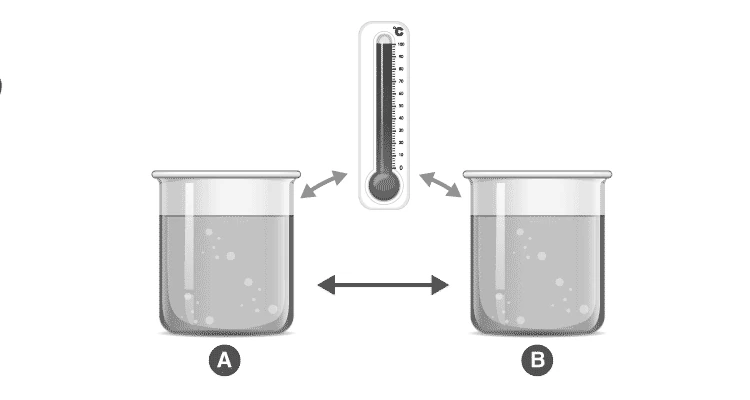
For example, if a thermometer reads 100 °C in cup A and then reads the same in cup B, cups A and B are in thermal equilibrium.
First Law of Thermodynamics in Everyday Life
This law states energy conservation: energy cannot be created or destroyed, only transformed. Examples include:
- Plants converting sunlight into chemical energy via photosynthesis.
- Humans converting chemical energy from food into mechanical energy.
- Electrical energy transforming into light and heat in bulbs.
Understanding the Second Law of Thermodynamics
The second law asserts that entropy of an isolated system always increases, driving systems toward disorder and equilibrium. For instance, a messy room tends to become more disordered over time unless energy is expended to clean it.
Third Law of Thermodynamics Explained
This law states that as temperature approaches absolute zero, the entropy of a perfect crystal approaches zero. For example, steam has high entropy due to free molecular motion, which decreases as it condenses to water and then freezes to ice, with entropy approaching zero near absolute zero temperature.
Practical Applications of Thermodynamics
Thermodynamics in Daily Technology
Thermodynamics principles are integral to many technologies and natural phenomena, such as:
- Operation of vehicles including airplanes, trucks, and ships based on energy transformations.
- Heat transfer methods used in radiators, heaters, and air conditioners.
- Functioning of power plants like thermal and nuclear plants.
Quick Reference: Summary of Thermodynamics Laws and Concepts
| Law/Concept | Key Idea | Example |
|---|---|---|
| Zeroth Law | If two systems are each in thermal equilibrium with a third, they are in equilibrium with each other. | Using a thermometer to compare temperatures of two objects. |
| First Law | Energy is conserved; it can change forms but not be created or destroyed. | Photosynthesis converting sunlight to chemical energy. |
| Second Law | Entropy of an isolated system always increases; systems evolve toward disorder. | A room becoming messier over time without cleaning. |
| Third Law | Entropy approaches zero as temperature approaches absolute zero for a perfect crystal. | Entropy of ice decreasing as temperature nears absolute zero. |
| Enthalpy (H) | Total heat content of a system: \(H = E + PV\) | Heat released or absorbed during chemical reactions. |
| Entropy (S) | Measure of disorder or randomness in a system. | Gas molecules have higher entropy than solids. |
| Thermodynamic System | Defined portion of matter under study, separated by boundaries. | Steam turbine as an open system exchanging mass and energy. |
| Thermodynamic Process | Change in system state involving energy transfer. | Isothermal expansion of gas in a piston. |
| Thermodynamic Equilibrium | State where system properties remain constant over time. | Uniform temperature and pressure in a sealed container. |
| Thermodynamic Potentials | Energy measures used to predict system behavior under constraints. | Gibbs free energy predicting reaction spontaneity. |
Glossary of Key Thermodynamics Terms
| Term | Definition |
|---|---|
| Adiabatic Process | A process with no heat exchange between system and surroundings. |
| Closed System | A system where energy can cross boundaries but matter cannot. |
| Entropy | A measure of disorder or randomness in a system. |
| Enthalpy | Total heat content of a system, \(H = E + PV\). |
| Equilibrium | State where system properties do not change over time. |
| Extensive Property | Property dependent on system size or mass (e.g., volume). |
| Intensive Property | Property independent of system size (e.g., temperature). |
| Isothermal Process | A process occurring at constant temperature. |
| Open System | A system exchanging both energy and matter with surroundings. |
| Thermodynamic Cycle | A series of processes returning a system to its initial state. |
Frequently Asked Questions
Why are the laws of thermodynamics important?
They provide fundamental principles governing energy transformations and system behavior, essential for understanding natural phenomena and engineering applications.
What is an example of negative work in thermodynamics?
When a gas compresses and work is done on the system by the surroundings, the work done by the system is negative.
Can energy be destroyed or lost?
No, energy cannot be destroyed; it only changes form according to the first law of thermodynamics.
Which law explains the conversion of electrical energy to mechanical energy in fans?
The first law of thermodynamics explains this energy transformation, emphasizing energy conservation.
Does the human body follow the laws of thermodynamics?
Yes, the human body obeys these laws, converting chemical energy from food into mechanical work and heat.