Understanding Energy and Oscillatory Motion
Fundamentals of Energy and Its Transformations
Concept and Conservation of Energy
Energy is a measurable attribute of matter that enables it to perform work. It is defined as the capacity to do work and is essential for all types of motion and physical changes. Energy can cause deformation depending on its magnitude. The principle of conservation of energy states that energy cannot be created or destroyed; it only transforms from one form to another. The standard unit for measuring energy in the International System is the Joule (J).
Various forms of energy exist, and many objects store energy to perform specific tasks. For instance, batteries hold chemical and potential energy, petroleum and biomass contain chemical energy, stretched rubber bands possess mechanical energy, solar energy is a form of radiant energy, rocks positioned at heights have gravitational potential energy, and lightning embodies electrical energy.
Energy conversion is evident in everyday examples: gasoline combusts inside a car engine converting chemical energy into mechanical energy, and solar cells transform light energy into electrical energy. These examples illustrate that energy is never lost but changes form to serve different purposes.
Energy transfer occurs through several mechanisms:
Radiation: Transfer via light or sound waves.
Mechanical means: Transfer through applied forces.
Electrical conduction: Transfer by electric current flow.
Heating: Transfer through conduction, convection, or radiation.
Example Problem
A stretched spring stores mechanical energy of 0.5 J. If the spring is compressed to half its original displacement, calculate the new potential energy stored in the spring.
Solution:
The potential energy stored in a spring is given by
\[ PE = \frac{1}{2} k x^2 \]
where \(k\) is the spring constant and \(x\) is the displacement.
Given the initial potential energy \(PE_1 = 0.5 \text{ J}\) at displacement \(x_1\), then
\[ 0.5 = \frac{1}{2} k x_1^2 \]
When compressed to half displacement, \(x_2 = \frac{x_1}{2}\), the new potential energy is
\[ PE_2 = \frac{1}{2} k \left(\frac{x_1}{2}\right)^2 = \frac{1}{2} k \frac{x_1^2}{4} = \frac{1}{4} \times \frac{1}{2} k x_1^2 = \frac{1}{4} \times 0.5 = 0.125 \text{ J} \]
Thus, the potential energy stored is 0.125 Joules when the spring is compressed to half its original displacement.
Oscillations and Their Characteristics
Understanding Oscillatory Motion
Oscillations refer to repetitive, periodic fluctuations of a quantity around a central equilibrium point. This motion involves the system moving back and forth between two or more states in a regular time interval. Oscillations are common in various scientific fields and dynamic systems.
A classic example is the swinging of a simple pendulum, which moves periodically about its resting position.
Example Problem
A pendulum completes one full oscillation in 2 seconds. Calculate its frequency and angular frequency.
Solution:
Time period \(T = 2 \text{ s}\).
Frequency \(f = \frac{1}{T} = \frac{1}{2} = 0.5 \text{ Hz}\).
Angular frequency \(\omega = 2 \pi f = 2 \pi \times 0.5 = \pi \text{ rad/s}\).
Therefore, the pendulum oscillates with a frequency of 0.5 Hz and an angular frequency of \(\pi\) radians per second.
Simple Harmonic Motion Explained
Simple Harmonic Motion (SHM) is a specific type of oscillation where the restoring force acting on the object is directly proportional to its displacement from the mean position and is directed towards that position. The motion occurs along a straight line between two extreme points, with the mean position representing a stable equilibrium.
It is important to note that while all SHM is oscillatory and periodic, not all oscillations qualify as SHM.
Example Problem
A particle of mass 0.2 kg attached to a spring oscillates with an amplitude of 0.1 m and angular frequency \(5 \text{ rad/s}\). Calculate the spring constant \(k\) and the maximum restoring force.
Solution:
Given mass \(m = 0.2 \text{ kg}\), amplitude \(A = 0.1 \text{ m}\), angular frequency \(\omega = 5 \text{ rad/s}\).
Spring constant is related to mass and angular frequency by
\[ k = m \omega^2 = 0.2 \times 5^2 = 0.2 \times 25 = 5 \text{ N/m} \]
Maximum restoring force occurs at maximum displacement \(x = A\):
\[ F_{\text{max}} = k A = 5 \times 0.1 = 0.5 \text{ N} \]
Thus, the spring constant is 5 N/m and the maximum restoring force is 0.5 N.
Energy Dynamics in Simple Harmonic Motion
Interplay of Kinetic and Potential Energy
In SHM, energy continuously shifts between kinetic and potential forms. The system performing SHM is called a harmonic oscillator. At the equilibrium position, the particle's displacement is zero, so potential energy is zero and kinetic energy is at its peak. Conversely, at the maximum displacement, potential energy reaches its maximum while kinetic energy drops to zero. At intermediate points, both energies vary between these extremes.
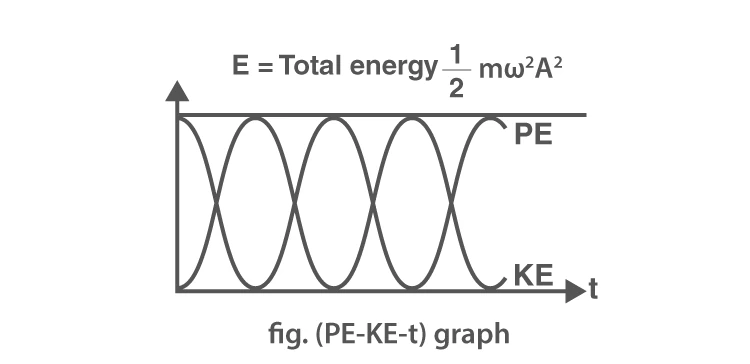
Graph illustrating kinetic and potential energy changes during SHM
Consider a particle of mass \(m\) undergoing linear SHM with angular frequency \(\omega\) and amplitude \(A\). The restoring force is given by
\[ F = -kx \]
where \(k = m \omega^2\).
The work done by the restoring force when the particle moves from the mean position \(x=0\) to a displacement \(x\) is
\[ dw = F \, dx = -kx \, dx \]
Potential energy \(U\) is the negative of this work:
\[ U = \frac{1}{2} k x^2 \]
Example Problem
A particle of mass 0.1 kg oscillates with amplitude 0.2 m and angular frequency 4 rad/s. Calculate the total mechanical energy of the system.
Solution:
Spring constant:
\[ k = m \omega^2 = 0.1 \times 4^2 = 0.1 \times 16 = 1.6 \text{ N/m} \]
Total mechanical energy \(E\) is the potential energy at maximum displacement:
\[ E = \frac{1}{2} k A^2 = \frac{1}{2} \times 1.6 \times (0.2)^2 = 0.5 \times 1.6 \times 0.04 = 0.032 \text{ J} \]
The total energy remains constant throughout the motion and equals 0.032 Joules.
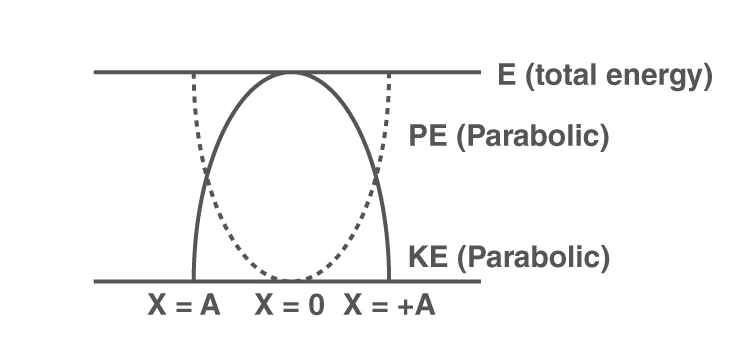
Variation of kinetic and potential energy with displacement in SHM
Quick Reference Summary
Concept | Definition / Formula | Unit |
|---|---|---|
Energy | Capacity to do work | Joule (J) |
Conservation of Energy | Energy cannot be created or destroyed, only transformed | — |
Oscillation | Periodic motion about an equilibrium point | — |
Simple Harmonic Motion (SHM) | Restoring force \(F = -kx\), \(k = m \omega^2\) | Force in Newton (N), displacement in meters (m) |
Potential Energy in SHM | \(U = \frac{1}{2} k x^2\) | Joule (J) |
Kinetic Energy in SHM | \(K = \frac{1}{2} m v^2\) | Joule (J) |
Total Mechanical Energy | \(E = \frac{1}{2} k A^2\) (constant) | Joule (J) |
Frequency | \(f = \frac{1}{T}\) | Hertz (Hz) |
Angular Frequency | \(\omega = 2 \pi f\) | Radians per second (rad/s) |
Restoring Force | Force directed towards equilibrium, proportional to displacement | Newton (N) |
Glossary of Key Terms
Term | Meaning |
|---|---|
Energy | The ability to perform work or cause change |
Joule | SI unit of energy |
Oscillation | Repeated back-and-forth motion about an equilibrium |
Simple Harmonic Motion | Oscillation with restoring force proportional to displacement |
Amplitude | Maximum displacement from equilibrium in SHM |
Angular Frequency | Rate of change of phase of oscillation, \(\omega = 2 \pi f\) |
Restoring Force | Force that pulls the system back to equilibrium |
Potential Energy | Energy stored due to position or configuration |
Kinetic Energy | Energy due to motion |
Frequency | Number of oscillations per second |
Frequently Asked Questions
What defines simple harmonic motion?
Simple harmonic motion is a periodic movement where the acceleration is proportional to displacement and directed towards the mean position.
Can you give an example of periodic motion?
The swinging of a pendulum is a classic example of periodic motion.
What is meant by periodic motion?
Motion that repeats itself at equal time intervals is called periodic motion.
State the law of conservation of energy.
Energy cannot be created or destroyed; it only changes from one form to another.
Provide an example of simple harmonic motion.
The oscillation of a simple pendulum is an example of simple harmonic motion.