Energy Dynamics of an Electric Dipole in a Uniform Field
Fundamentals of Dipole Interaction with Electric Fields
Understanding Forces and Torque on a Dipole
Imagine a dipole consisting of two opposite charges, \( +q \) and \( -q \), separated by a distance \( d \), placed within a uniform electric field of magnitude \( E \). Each charge experiences a force due to the field: the positive charge is pushed in the direction of the field with force \( qE \), while the negative charge experiences a force \( -qE \) opposite to the field direction. Although these forces are equal in magnitude and opposite in direction, they act at different points, creating a rotational effect rather than a net translational force.
This rotational effect is known as torque, denoted by \( \tau \), which tends to align the dipole with the electric field. The magnitude of this torque depends on the dipole moment \( \mathbf{p} \) and the angle \( \theta \) between the dipole axis and the field direction.
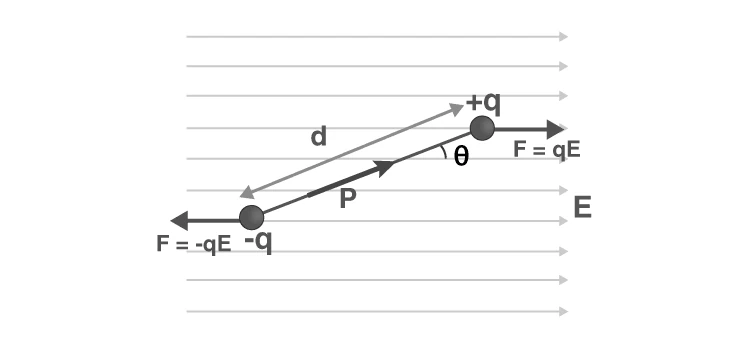
Dipole experiencing forces in a uniform electric field
The torque acting on the dipole is mathematically expressed as:
\[ \tau = pE \sin \theta \]
Torque exerted on a dipole in an external electric field
Example Problem
A dipole with a moment of \( 4 \times 10^{-29} \text{ C·m} \) is placed in a uniform electric field of \( 2 \times 10^{4} \text{ N/C} \). Calculate the torque when the dipole makes an angle of \( 60^\circ \) with the field.
Solution:
Given: \( p = 4 \times 10^{-29} \text{ C·m} \), \( E = 2 \times 10^{4} \text{ N/C} \), \( \theta = 60^\circ \)
Using the torque formula:
\[ \tau = pE \sin \theta = (4 \times 10^{-29})(2 \times 10^{4}) \sin 60^\circ \]
Calculate \( \sin 60^\circ = \frac{\sqrt{3}}{2} \approx 0.866 \):
\[ \tau = 8 \times 10^{-25} \times 0.866 = 6.93 \times 10^{-25} \text{ N·m} \]
Therefore, the torque on the dipole is \( 6.93 \times 10^{-25} \text{ N·m} \).
Work and Energy Considerations for a Dipole in an Electric Field
Calculating Work Done by External Torque
When an external torque is applied to rotate the dipole from an initial angle \( \theta_0 \) to a final angle \( \theta_1 \) at a very slow angular speed (quasi-static process), the work done by this torque can be determined by integrating the torque over the angular displacement. This work corresponds to the change in potential energy of the dipole in the electric field.
The infinitesimal work done \( dW \) in rotating the dipole by an angle \( d\theta \) is:
\[ dW = \tau_{\text{ext}} d\theta \]
Since the external torque balances the field torque, \( \tau_{\text{ext}} = -\tau = -pE \sin \theta \), the total work done in rotating from \( \theta_0 \) to \( \theta_1 \) is:
\[ W = -\int_{\theta_0}^{\theta_1} pE \sin \theta \, d\theta = pE (\cos \theta_1 - \cos \theta_0) \]

Work performed by an external torque during dipole rotation
Example Problem
A dipole with moment \( 3 \times 10^{-29} \text{ C·m} \) is rotated slowly from \( 90^\circ \) to \( 30^\circ \) in a uniform electric field of \( 1.5 \times 10^{4} \text{ N/C} \). Calculate the work done by the external torque.
Solution:
Given: \( p = 3 \times 10^{-29} \text{ C·m} \), \( E = 1.5 \times 10^{4} \text{ N/C} \), \( \theta_0 = 90^\circ \), \( \theta_1 = 30^\circ \)
Calculate:
\[ W = pE (\cos \theta_1 - \cos \theta_0) = (3 \times 10^{-29})(1.5 \times 10^{4})(\cos 30^\circ - \cos 90^\circ) \]
Using \( \cos 30^\circ = \frac{\sqrt{3}}{2} \approx 0.866 \) and \( \cos 90^\circ = 0 \):
\[ W = 4.5 \times 10^{-25} \times 0.866 = 3.9 \times 10^{-25} \text{ J} \]
The work done by the external torque is \( 3.9 \times 10^{-25} \text{ J} \).
Potential Energy Profile of a Dipole in an Electric Field
Expression and Interpretation of Dipole Potential Energy
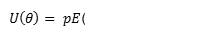
The potential energy \( U \) of a dipole in an external electric field depends on the orientation angle \( \theta \) between the dipole moment and the field. It is defined as the work done in bringing the dipole from a reference position to the angle \( \theta \). Choosing the reference where the potential energy is zero at \( \theta = 90^\circ \), the potential energy is given by:
\[ U(\theta) = -pE \cos \theta \]
Variation of potential energy with dipole orientation
This equation shows that the potential energy is minimum when the dipole aligns with the field (\( \theta = 0^\circ \)) and maximum when it is anti-aligned (\( \theta = 180^\circ \)). At \( \theta = 90^\circ \), the potential energy is zero, indicating a neutral equilibrium position.

Potential energy formula for a dipole in an external field
Example Problem
Calculate the potential energy of a dipole with moment \( 5 \times 10^{-29} \text{ C·m} \) placed in an electric field of \( 2.5 \times 10^{4} \text{ N/C} \) when the dipole makes an angle of \( 45^\circ \) with the field.
Solution:
Given: \( p = 5 \times 10^{-29} \text{ C·m} \), \( E = 2.5 \times 10^{4} \text{ N/C} \), \( \theta = 45^\circ \)
Using the potential energy formula:
\[ U = -pE \cos \theta = -(5 \times 10^{-29})(2.5 \times 10^{4}) \cos 45^\circ \]
Calculate \( \cos 45^\circ = \frac{\sqrt{2}}{2} \approx 0.707 \):
\[ U = -1.25 \times 10^{-24} \times 0.707 = -8.84 \times 10^{-25} \text{ J} \]
The negative sign indicates that the dipole is in a stable orientation relative to the field, with potential energy \( -8.84 \times 10^{-25} \text{ J} \).
Illustration of dipole orientation in an electric field
Summary of Key Concepts
Concept | Formula / Description |
|---|---|
Torque on Dipole | \( \tau = pE \sin \theta \) |
Work Done by External Torque | \( W = pE (\cos \theta_1 - \cos \theta_0) \) |
Potential Energy of Dipole | \( U = -pE \cos \theta \) |
Dipole Moment | Product of charge and separation distance, \( p = qd \) |
Equilibrium Positions | Stable at \( \theta = 0^\circ \), unstable at \( \theta = 180^\circ \) |
Glossary of Important Terms
Term | Definition |
|---|---|
Dipole | A pair of equal and opposite charges separated by a distance. |
Electric Field (\( E \)) | A region around a charge where force is exerted on other charges. |
Dipole Moment (\( p \)) | Vector quantity equal to charge times separation distance. |
Torque (\( \tau \)) | Rotational force that tends to align the dipole with the field. |
Potential Energy (\( U \)) | Energy stored due to the dipole's orientation in the field. |
Angle (\( \theta \)) | The angle between the dipole axis and the electric field direction. |
Stable Equilibrium | Position where the dipole has minimum potential energy. |
Unstable Equilibrium | Position where the dipole has maximum potential energy. |
Work Done | Energy required to rotate the dipole against the torque. |
Quasi-static Process | Slow rotation allowing equilibrium at every step. |
Frequently Asked Questions
What defines the potential energy of a dipole in an electric field?
The potential energy is the work done to orient the dipole at an angle \( \theta \) in the field and is given by \( U = -pE \cos \theta \).
What does the symbol \( p \) represent in dipole energy calculations?
\( p \) is the dipole moment, a vector quantity equal to the product of the charge magnitude and the separation distance between charges.
At which orientation is the dipole's potential energy at its maximum?
The potential energy is highest when the dipole is aligned opposite to the electric field, i.e., at \( \theta = 180^\circ \).
Is the dipole moment a scalar or a vector quantity?
The dipole moment is a vector, directed from the negative charge to the positive charge.
When does the dipole have minimum potential energy in an electric field?
The potential energy is minimum when the dipole aligns with the electric field, at \( \theta = 0^\circ \).