Understanding Magnetic Dipoles in Uniform Fields
Behavior of Magnetic Dipoles in Uniform Magnetic Fields
Fundamentals of Torque on a Magnetic Needle
When a magnetic dipole, such as a small compass needle, is placed in a uniform magnetic field, it experiences a torque that tends to align it with the field. This torque arises due to the interaction between the magnetic moment of the needle and the external magnetic field.
The torque vector \( \vec{\tau} \) acting on the dipole is given by the cross product of its magnetic moment \( \vec{m} \) and the magnetic field \( \vec{B} \):
\[ \vec{\tau} = \vec{m} \times \vec{B} \]
The magnitude of this torque is expressed as \( \tau = m B \sin \theta \), where \( \theta \) is the angle between the magnetic moment and the magnetic field directions. This torque acts as a restoring force, attempting to reduce the angle \( \theta \) to zero.
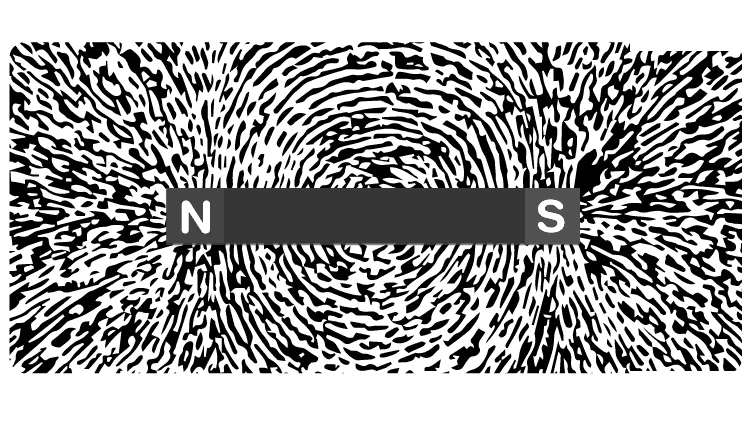
Magnetic dipole positioned within a uniform magnetic field
Example: Calculating Torque on a Magnetic Needle
A magnetic needle with a magnetic moment of \( 0.05 \, \text{A·m}^2 \) is placed in a uniform magnetic field of strength \( 0.2 \, \text{T} \). If the needle makes an angle of \( 30^\circ \) with the field, find the magnitude of the torque acting on it.
Solution:
The torque magnitude is given by:
\[ \tau = m B \sin \theta \]
Substituting the values:
\[ \tau = 0.05 \times 0.2 \times \sin 30^\circ = 0.05 \times 0.2 \times 0.5 = 0.005 \, \text{N·m} \]
Therefore, the torque acting on the needle is \( 0.005 \, \text{N·m} \).
Oscillatory Motion of a Magnetic Dipole in a Magnetic Field
Deriving the Equation of Motion and Time Period
When displaced slightly from its equilibrium position, the magnetic needle undergoes oscillations due to the restoring torque. The equation governing this motion can be derived by equating the torque to the angular acceleration multiplied by the moment of inertia \( I \) of the needle.
The rotational equation of motion is:
\[ I \frac{d^2 \theta}{dt^2} = -m B \sin \theta \]
For small angular displacements, \( \sin \theta \approx \theta \) (in radians), simplifying the equation to:
\[ I \frac{d^2 \theta}{dt^2} = -m B \theta \]
This is the standard form of simple harmonic motion (SHM), where the angular frequency \( \omega \) is:
\[ \omega = \sqrt{\frac{m B}{I}} \]
The corresponding time period \( T \) of oscillation is:
\[ T = 2 \pi \sqrt{\frac{I}{m B}} \]
Rearranging, the magnetic field strength can be determined from the oscillation period as:
\[ B = \frac{4 \pi^2 I}{m T^2} \]
Example: Finding the Magnetic Field from Oscillation Period
A magnetic needle with moment of inertia \( 2.0 \times 10^{-5} \, \text{kg·m}^2 \) and magnetic moment \( 0.04 \, \text{A·m}^2 \) oscillates with a period of \( 3.0 \, \text{s} \) in a magnetic field. Calculate the magnetic field strength.
Solution:
Using the formula:
\[ B = \frac{4 \pi^2 I}{m T^2} \]
Substitute the given values:
\[ B = \frac{4 \pi^2 \times 2.0 \times 10^{-5}}{0.04 \times (3.0)^2} = \frac{4 \times 9.8696 \times 2.0 \times 10^{-5}}{0.04 \times 9} = \frac{7.8957 \times 10^{-4}}{0.36} \approx 2.19 \times 10^{-3} \, \text{T} \]
The magnetic field strength is approximately \( 2.19 \times 10^{-3} \, \text{T} \).
Magnetic Potential Energy and Electrostatic Dipole Analogy
Energy Stored in a Magnetic Dipole and Its Electric Counterpart
The magnetic potential energy \( U_m \) of a dipole in a magnetic field is the work done to rotate the dipole from a reference position to an angle \( \theta \). It is calculated by integrating the torque over the angle:
\[ U_m = \int \tau(\theta) \, d\theta = \int m B \sin \theta \, d\theta = -m B \cos \theta + C \]
Choosing the constant \( C = 0 \), the potential energy simplifies to:
\[ U_m = -\vec{m} \cdot \vec{B} \]
This expression closely resembles the potential energy of an electric dipole in an electric field, highlighting the analogy between magnetic and electric dipoles.
The correspondence between magnetic and electric dipoles can be summarized as:
\[ E \rightarrow B, \quad p \rightarrow m, \quad \frac{1}{4 \pi \epsilon_0} \rightarrow \frac{\mu_0}{4 \pi} \]
For points far from the magnet (distance \( r \) much greater than the magnet length \( l \)), the magnetic field components due to a bar magnet are approximated as:
Equatorial field:
\[ B_E = -\frac{\mu_0 m}{4 \pi r^3} \]
Axial field:
\[ B_A = -\frac{\mu_0 2 m}{4 \pi r^3} \]
Example: Calculating the Axial Magnetic Field of a Bar Magnet
A bar magnet has a magnetic moment of \( 0.1 \, \text{A·m}^2 \). Find the axial magnetic field at a point \( 0.5 \, \text{m} \) away from the magnet. Use \( \mu_0 = 4 \pi \times 10^{-7} \, \text{T·m/A} \).
Solution:
The axial field is given by:
\[ B_A = -\frac{\mu_0 2 m}{4 \pi r^3} \]
Substitute the values:
\[ B_A = -\frac{(4 \pi \times 10^{-7}) \times 2 \times 0.1}{4 \pi \times (0.5)^3} = -\frac{8 \pi \times 10^{-8}}{4 \pi \times 0.125} = -\frac{8 \times 10^{-8}}{0.5} = -1.6 \times 10^{-7} \, \text{T} \]
The negative sign indicates direction opposite to the reference axis. The magnitude of the axial field is \( 1.6 \times 10^{-7} \, \text{T} \).
Quick Reference Summary
Concept | Formula | Description |
|---|---|---|
Torque on Magnetic Dipole | \( \tau = m B \sin \theta \) | Torque tends to align dipole with magnetic field |
Equation of Motion (Small Angle) | \( I \frac{d^2 \theta}{dt^2} = -m B \theta \) | Describes oscillations of magnetic needle |
Angular Frequency | \( \omega = \sqrt{\frac{m B}{I}} \) | Frequency of oscillation of dipole |
Time Period of Oscillation | \( T = 2 \pi \sqrt{\frac{I}{m B}} \) | Time for one complete oscillation |
Magnetic Field from Period | \( B = \frac{4 \pi^2 I}{m T^2} \) | Calculate magnetic field using oscillation period |
Magnetic Potential Energy | \( U_m = -\vec{m} \cdot \vec{B} \) | Energy stored in dipole in magnetic field |
Equatorial Magnetic Field | \( B_E = -\frac{\mu_0 m}{4 \pi r^3} \) | Field at point perpendicular to magnet axis |
Axial Magnetic Field | \( B_A = -\frac{\mu_0 2 m}{4 \pi r^3} \) | Field along the magnet's axis |
Electric-Magnetic Analogy | \( E \rightarrow B, \quad p \rightarrow m \) | Correspondence between electric and magnetic dipoles |
Glossary of Key Terms
Term | Definition |
|---|---|
Magnetic Dipole | A system with a magnetic moment, such as a small bar magnet or current loop. |
Magnetic Moment (\( \vec{m} \)) | A vector quantity representing the strength and orientation of a magnetic source. |
Torque (\( \vec{\tau} \)) | A rotational force that tends to rotate an object about an axis. |
Moment of Inertia (\( I \)) | A measure of an object's resistance to angular acceleration. |
Simple Harmonic Motion (SHM) | Periodic oscillatory motion where restoring force is proportional to displacement. |
Magnetic Field (\( \vec{B} \)) | A vector field representing magnetic influence in space. |
Potential Energy (\( U_m \)) | Energy stored due to the position or orientation of a magnetic dipole in a field. |
Equatorial Field | Magnetic field component perpendicular to the magnet's axis at a distant point. |
Axial Field | Magnetic field component along the magnet's axis at a distant point. |
Electric Dipole | Two equal and opposite electric charges separated by a small distance. |
Frequently Asked Questions
What defines an electric charge?
An electric charge is a fundamental property of matter that causes it to experience force in an electromagnetic field. Charges can be positive or negative.
How is electromagnetic induction described?
Electromagnetic induction refers to the generation of electromotive force (emf) in a conductor due to a changing magnetic field around it.
What is the nature of an electric field?
An electric field is a region around charged particles where other charges experience a force, either attractive or repulsive.
How is the magnitude of torque calculated?
The magnitude of torque on a dipole in a magnetic field is calculated by \( \tau = m B \sin \theta \), where \( m \) is magnetic moment, \( B \) is magnetic field strength, and \( \theta \) is the angle between them.
What constitutes an electric dipole?
An electric dipole consists of two equal and opposite charges separated by a fixed distance, creating a dipole moment.