Electron Diffraction and Wave Properties: Davisson-Germer Experiment
Experimental Setup for Demonstrating Electron Wave Behavior
Design and Components of the Electron Diffraction Apparatus
The Davisson-Germer experiment utilized a specialized apparatus to investigate the wave-like characteristics of electrons. Central to the setup was an electron gun, where a tungsten filament coated with barium oxide was heated by a low-voltage power source to emit electrons. These electrons were then accelerated by applying a high voltage, giving them a specific velocity.
To ensure a narrow and well-defined electron beam, the electrons passed through a cylindrical chamber perforated with fine holes aligned along its axis, producing a collimated beam. This beam was directed onto a nickel crystal surface, causing the electrons to scatter in multiple directions.
The intensity of the scattered electrons was detected by an electron detector connected to a sensitive galvanometer, which recorded the current. The detector was mounted on a circular scale, allowing measurement of scattered electron intensity at various angles \( \theta \), defined as the angle between the incident and scattered beams.
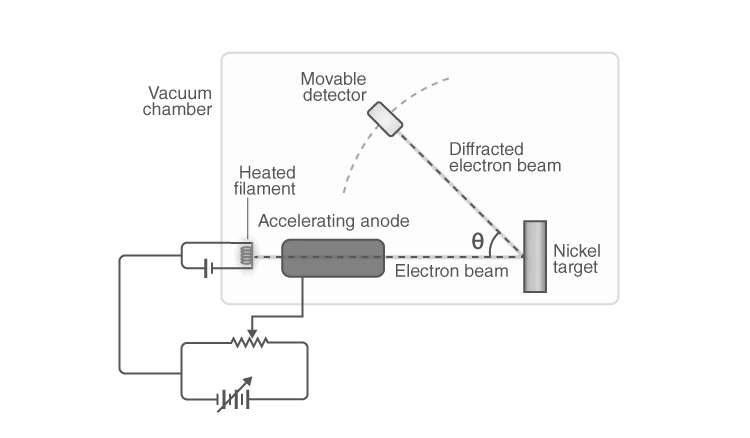
Schematic of the Davisson-Germer experiment apparatus
Example Problem: Calculating Electron Velocity
An electron is accelerated through a potential difference of 60 V in the Davisson-Germer setup. Calculate the velocity of the electron after acceleration. (Electron charge \( e = 1.6 \times 10^{-19} \text{C} \), electron mass \( m = 9.11 \times 10^{-31} \text{kg} \))
Solution:
The kinetic energy gained by the electron is equal to the electrical potential energy:
\[ \frac{1}{2} m v^2 = e V \]
Rearranging for velocity \( v \):
\[ v = \sqrt{\frac{2 e V}{m}} \]
Substituting values:
\[ v = \sqrt{\frac{2 \times 1.6 \times 10^{-19} \times 60}{9.11 \times 10^{-31}}} = \sqrt{\frac{1.92 \times 10^{-17}}{9.11 \times 10^{-31}}} \]
\[ v = \sqrt{2.11 \times 10^{13}} = 4.59 \times 10^{6} \text{ m/s} \]
The electron velocity after acceleration is approximately \(4.59 \times 10^{6} \text{ m/s}\).
Key Observations from Electron Scattering Experiments
Intensity Variation and Electron Diffraction Patterns
By systematically varying the angle \( \theta \) of the electron detector, the intensity of scattered electrons was recorded. The accelerating voltage was adjusted between 40 V and 70 V to observe changes in scattering behavior. A notable peak in intensity was observed at a scattering angle of approximately 52º when the accelerating voltage was set to 56 V.
This peak indicated constructive interference of electron waves scattered from the regularly spaced atomic layers of the nickel crystal, confirming the wave nature of electrons. The wavelength of these matter waves was experimentally determined to be around 0.162 nm.
Example Problem: Determining Electron Wavelength from Diffraction Peak
In an electron diffraction experiment, a strong intensity peak is observed at a scattering angle of 52º for electrons accelerated by 56 V. Calculate the wavelength of the electrons using the de Broglie relation and compare it with the experimental value of 0.162 nm.
Solution:
The de Broglie wavelength \( \lambda \) is given by:
\[ \lambda = \frac{h}{p} = \frac{h}{\sqrt{2 m e V}} \]
Where Planck's constant \( h = 6.626 \times 10^{-34} \text{Js} \), electron mass \( m = 9.11 \times 10^{-31} \text{kg} \), electron charge \( e = 1.6 \times 10^{-19} \text{C} \), and accelerating voltage \( V = 56 \text{V} \).
Calculate momentum \( p \):
\[ p = \sqrt{2 m e V} = \sqrt{2 \times 9.11 \times 10^{-31} \times 1.6 \times 10^{-19} \times 56} = \sqrt{1.63 \times 10^{-47}} = 1.28 \times 10^{-23} \text{ kg m/s} \]
Calculate wavelength:
\[ \lambda = \frac{6.626 \times 10^{-34}}{1.28 \times 10^{-23}} = 5.18 \times 10^{-11} \text{ m} = 0.052 \text{ nm} \]
The calculated wavelength is \(0.052 \text{ nm}\), which is smaller than the experimental value of 0.162 nm, indicating the need to consider crystal lattice spacing and diffraction conditions for precise matching.
Confirming de Broglie’s Hypothesis through Electron Diffraction
Correlation Between Experimental Data and Theoretical Predictions
De Broglie proposed that particles such as electrons exhibit wave-like properties, with wavelength \( \lambda \) related to momentum \( p \) by the formula:
\[ \lambda = \frac{h}{p} \]
In the Davisson-Germer experiment, the wavelength calculated from the observed diffraction pattern closely matched the value predicted by de Broglie’s relation. For example, at an accelerating voltage of 54 V, the wavelength was experimentally found to be approximately 0.165 nm, while the theoretical calculation yielded:
\[ \lambda = \frac{1.227}{\sqrt{54}} = 0.167 \text{ nm} \]
This strong agreement provided compelling evidence for the wave nature of electrons and validated the de Broglie hypothesis.
Exam Tip
Remember that the de Broglie wavelength depends inversely on the square root of the accelerating voltage. Always use the correct units and constants when calculating electron wavelengths.
Example Problem: Verifying de Broglie Wavelength at Different Voltages
Calculate the de Broglie wavelength of electrons accelerated through 36 V and compare it with the wavelength at 54 V.
Solution:
Using the formula:
\[ \lambda = \frac{1.227}{\sqrt{V}} \text{ nm} \]
For \( V = 36 \text{ V} \):
\[ \lambda = \frac{1.227}{\sqrt{36}} = \frac{1.227}{6} = 0.2045 \text{ nm} \]
For \( V = 54 \text{ V} \):
\[ \lambda = \frac{1.227}{\sqrt{54}} = 0.167 \text{ nm} \]
The wavelength decreases as the accelerating voltage increases, consistent with the inverse square root relationship.
Summary of Electron Wave Behavior and Diffraction Findings
Aspect | Details |
|---|---|
Electron Source | Tungsten filament coated with barium oxide |
Acceleration Voltage Range | 40 V to 70 V |
Observed Diffraction Angle | Approximately 50º to 52º |
Measured Electron Wavelength | ~0.162 nm to 0.165 nm |
De Broglie Relation | \( \lambda = \frac{h}{p} \), wavelength inversely proportional to \(\sqrt{V}\) |
Significance | Confirmed wave nature of electrons via diffraction |
Glossary of Key Terms
Term | Definition |
|---|---|
Electron Gun | Device that emits electrons by heating a filament |
Collimated Beam | A beam of particles or waves with parallel rays |
Diffraction | Bending and spreading of waves around obstacles |
Constructive Interference | When waves combine to produce a larger amplitude |
De Broglie Wavelength | Wavelength associated with a moving particle |
Galvanometer | Instrument for detecting and measuring electric current |
Momentum (\(p\)) | Product of mass and velocity of a particle |
Nickel Crystal | Regularly arranged atoms used as a diffraction target |
Scattering Angle (\(\theta\)) | Angle between incident and scattered electron beams |
Wave-Particle Duality | Concept that particles exhibit both wave and particle properties |
Frequently Asked Questions
What was the main purpose of the Davisson-Germer experiment?
It was designed to demonstrate the wave nature of electrons by observing electron diffraction patterns from a crystal surface.
How does the accelerating voltage affect the electron wavelength?
The electron wavelength decreases as the accelerating voltage increases, following the relation \( \lambda \propto \frac{1}{\sqrt{V}} \).
Why is a nickel crystal used in the experiment?
Nickel crystals have a regular atomic arrangement that acts as a diffraction grating for electrons, enabling observation of interference patterns.
What does a peak in scattered electron intensity indicate?
A peak corresponds to constructive interference of electron waves scattered from crystal planes, confirming their wave-like behavior.
How does this experiment support de Broglie’s hypothesis?
The measured electron wavelengths matched the values predicted by de Broglie’s formula, validating the concept of matter waves.