Fundamentals of Circular Motion and Its Applications
Understanding Circular Motion and Angular Quantities
Defining Circular Motion and Its Characteristics
Circular motion refers to the movement of an object along a circular trajectory. This motion can be classified as uniform, where the speed and angular velocity remain constant, or non-uniform, where these quantities vary over time. Unlike linear motion, circular motion involves continuous change in the direction of the velocity vector, making angular parameters essential for its description.
Common instances of circular motion include satellites orbiting planets, rotating fan blades, spinning wheels of vehicles, and the gears in turbines.
Angular Displacement and Its Measurement
Angular displacement quantifies the angle through which a particle moves on a circular path, measured in radians. It is the difference between the initial and final position vectors of the particle on the circumference.
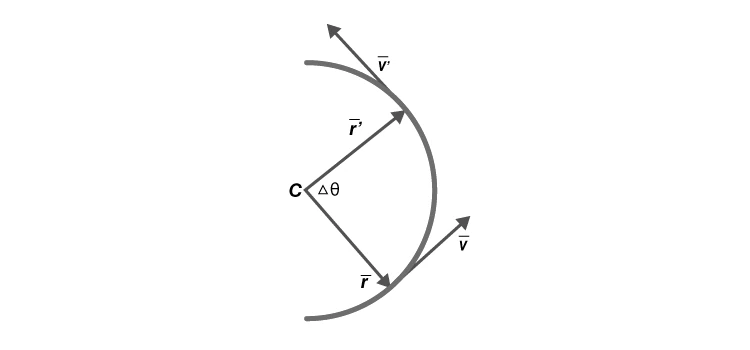
Angular displacement between position vectors on a circular path
Angular Velocity and Linear Velocity Relationship
Angular velocity, denoted by \( \omega \), is the rate at which angular displacement changes with time and is measured in radians per second. It is mathematically expressed as
\[ \omega = \lim_{\Delta t \to 0} \frac{\Delta \theta}{\Delta t} = \frac{d\theta}{dt} \]
Alongside angular velocity, a particle in circular motion also has linear velocity \( v \), which is the rate of change of its linear displacement \( s \):
\[ v = \frac{ds}{dt} \]
The linear velocity vector is related to angular velocity and the radius vector \( \mathbf{r} \) by the vector cross product:
\[ \mathbf{v} = \boldsymbol{\omega} \times \mathbf{r} \]
In magnitude form, this reduces to:
\[ v = r \omega \]
Example: Calculating Angular Velocity from Rotations
A particle completes 150 rotations every minute along a circular path. Determine its angular velocity in radians per second.
Solution:
Given frequency \( f = 150 \text{ rotations/min} \).
Convert to rotations per second:
\[ f = \frac{150}{60} = 2.5 \text{ rotations/s} \]
Angular velocity is:
\[ \omega = 2 \pi f = 2 \pi \times 2.5 = 5\pi \approx 15.71 \text{ rad/s} \]
Acceleration Components and Angular Acceleration in Circular Motion
Distinguishing Tangential and Radial Accelerations
Acceleration in circular motion has two distinct components:
Tangential acceleration (\( a_t \)): This component acts along the direction of the velocity vector and represents the rate of change of speed.
Radial (centripetal) acceleration (\( a_r \)): Directed towards the center of the circle, this component changes the direction of velocity without altering its magnitude.
Mathematically, these are expressed as:
\[ a_t = \frac{d|v|}{dt} \]
\[ a_r = \frac{v^2}{r} = r \omega^2 \]
Angular Acceleration and Its Significance
Angular acceleration \( \alpha \) measures how quickly the angular velocity changes with time. It is given by:
\[ \alpha = \frac{d\omega}{dt} = \frac{d^2 \theta}{dt^2} \]
Uniform circular motion occurs when \( \alpha = 0 \), meaning the speed remains constant, while non-uniform circular motion involves a non-zero angular acceleration.
Example: Finding Angular Deceleration of a Rotating Wheel
A wheel spins at 720 revolutions per minute and comes to rest in 90 seconds after power is cut off. Calculate its angular deceleration in rad/s².
Solution:
Initial angular velocity:
\[ \omega_0 = 720 \times \frac{2\pi}{60} = 75.4 \text{ rad/s} \]
Final angular velocity \( \omega = 0 \), time \( t = 90 \text{ s} \).
Using \( \omega = \omega_0 + \alpha t \), solve for \( \alpha \):
\[ 0 = 75.4 + \alpha \times 90 \implies \alpha = -\frac{75.4}{90} = -0.838 \text{ rad/s}^2 \]
The negative sign indicates deceleration.
Forces in Circular Motion and Practical Applications
Centripetal Force and Its Origins
For an object to maintain circular motion, a net inward force called centripetal force must act on it. This force is responsible for continuously changing the direction of the velocity vector and is given by:
\[ F_{\text{centripetal}} = m \frac{v^2}{r} \]
Here, \( m \) is the mass of the object, \( v \) its speed, and \( r \) the radius of the circular path.
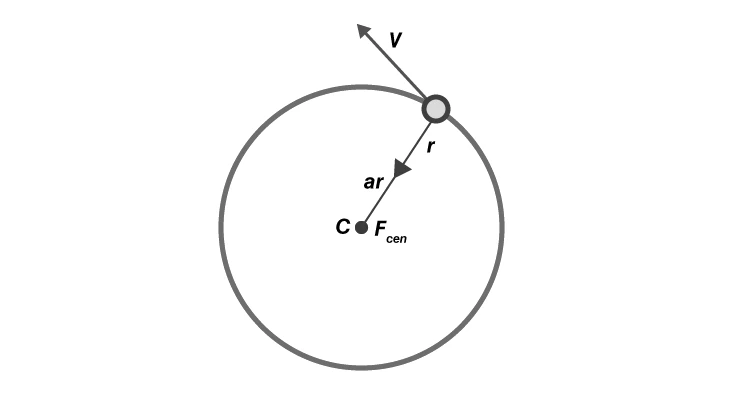
Centripetal force acting towards the center of the circular path
Examples of centripetal forces include gravitational attraction, tension in a string, and frictional force.
Analyzing Vehicle Motion on Level and Banked Curves
When a vehicle turns on a flat road, static friction provides the centripetal force necessary to keep it on the curved path. The forces acting on the vehicle include its weight \( W = mg \), normal reaction \( N \), and frictional force \( f_f \).
Vertically, the forces balance as:
\[ N = mg \]
The frictional force must satisfy:
\[ f_f = \frac{mv^2}{r} \leq \mu N \]
where \( \mu \) is the coefficient of static friction.
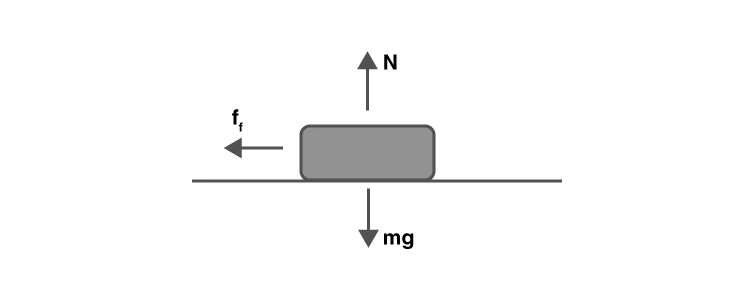
Forces on a vehicle negotiating a turn on a level road
Banked roads reduce reliance on friction by inclining the road at an angle \( \theta_0 \). The normal force and friction combine to provide the centripetal force:
Vertical force balance:
\[ N \cos \theta_0 = f \sin \theta_0 + mg \]
Centripetal force equation:
\[ \frac{mv^2}{r} = N \sin \theta_0 + f \cos \theta_0 \]
Substituting \( f = \mu N \) and solving yields the maximum safe speed:
\[ \tan \theta_0 = \frac{v_{\max}^2}{rg} \]
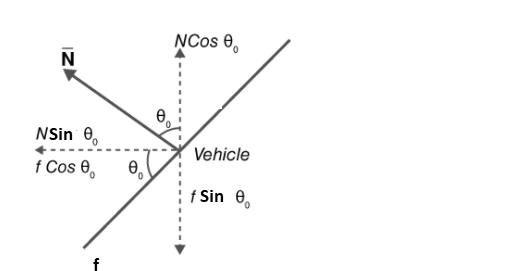
Forces acting on a vehicle moving on a banked curve
Example: Calculating the Angle of a Pendulum in a Moving Bus
A bus travels around a circular track of radius 12 m at a speed of 8 m/s. A pendulum of length 1.2 m hangs from the roof. Find the angle the pendulum makes with the vertical. Take \( g = 9.8 \text{ m/s}^2 \).
Solution:
The pendulum swings outward due to centripetal acceleration. The angle \( \theta \) satisfies:
\[ \tan \theta = \frac{v^2}{rg} = \frac{8^2}{12 \times 9.8} = \frac{64}{117.6} \approx 0.544 \]
Therefore,
\[ \theta = \tan^{-1}(0.544) \approx 28.5^\circ \]
Example: Minimum Speed to Prevent Skidding on a Curve
A car negotiates a curve of radius 100 m with a coefficient of static friction 0.5. Calculate the minimum speed to avoid skidding.
Solution:
Using the frictional force as centripetal force:
\[ v^2 = \mu r g = 0.5 \times 100 \times 9.8 = 490 \]
Thus,
\[ v = \sqrt{490} \approx 22.14 \text{ m/s} \]
Summary Table for Circular Motion Concepts
Quantity | Symbol | Definition | Unit | Formula |
|---|---|---|---|---|
Angular Displacement | \( \Delta \theta \) | Angle turned by particle on circular path | radian (rad) | — |
Angular Velocity | \( \omega \) | Rate of change of angular displacement | rad/s | \( \omega = \frac{d\theta}{dt} \) |
Linear Velocity | \( v \) | Rate of change of linear displacement | m/s | \( v = r \omega \) |
Tangential Acceleration | \( a_t \) | Change in speed along the tangent | m/s² | \( a_t = \frac{d|v|}{dt} \) |
Radial (Centripetal) Acceleration | \( a_r \) | Acceleration towards center of circle | m/s² | \( a_r = \frac{v^2}{r} = r \omega^2 \) |
Angular Acceleration | \( \alpha \) | Rate of change of angular velocity | rad/s² | \( \alpha = \frac{d\omega}{dt} \) |
Centripetal Force | \( F_c \) | Force causing centripetal acceleration | N | \( F_c = m \frac{v^2}{r} \) |
Coefficient of Friction | \( \mu \) | Ratio of frictional force to normal force | — | — |
Banking Angle | \( \theta_0 \) | Inclination angle of banked road | degrees (°) | \( \tan \theta_0 = \frac{v^2}{rg} \) |
Frequency | \( f \) | Number of rotations per unit time | Hz (rotations/s) | \( \omega = 2 \pi f \) |
Key Terms and Definitions
Term | Meaning |
|---|---|
Angular Displacement | The angle through which a point or line has been rotated in a specified sense about a specified axis. |
Angular Velocity | The rate at which an object rotates or revolves relative to another point, expressed in radians per second. |
Linear Velocity | The rate of change of position of an object along a path, measured in meters per second. |
Tangential Acceleration | Acceleration along the tangent to the circular path, indicating change in speed. |
Radial (Centripetal) Acceleration | Acceleration directed towards the center of the circle, responsible for changing direction. |
Angular Acceleration | The rate of change of angular velocity with respect to time. |
Centripetal Force | The net force causing an object to follow a circular path, directed inward. |
Coefficient of Friction | A dimensionless scalar value representing the frictional force between two bodies. |
Banked Curve | A road or track inclined at an angle to help vehicles negotiate curves safely. |
Frequency | The number of complete rotations or cycles per unit time. |
Frequently Asked Questions on Circular Motion
What defines circular motion in physics?
Circular motion is the movement of an object along the circumference of a circle or a circular path.
How do uniform and non-uniform circular motions differ?
Uniform circular motion has constant speed and angular velocity, while non-uniform circular motion involves changes in speed or angular velocity.
Can you provide a real-world example of circular motion?
Examples include satellites orbiting Earth, wheels rotating on vehicles, and blades of a ceiling fan spinning.
What is the acceleration in uniform circular motion?
It is the centripetal acceleration directed towards the center, calculated as \( a = \frac{v^2}{r} \).
Why is centripetal force necessary for circular motion?
Centripetal force continuously changes the direction of velocity, keeping the object moving along a circular path.