Fundamental Properties of Electromagnetic Waves
Nature and Generation of Electromagnetic Waves
Understanding the Transverse Wave Structure
Electromagnetic waves are characterized by oscillating electric and magnetic fields that are perpendicular to each other and to the direction of wave propagation. This transverse nature arises because a changing electric field induces a magnetic field, and vice versa, as described by Maxwell's equations. The two fields oscillate sinusoidally and remain in phase throughout the wave's travel.
This perpendicular arrangement ensures that the wave carries energy through space without requiring a physical medium.
Example: An electron oscillates in a radio antenna producing electromagnetic waves. If the electric field oscillates along the x-axis, along which axis will the magnetic field oscillate, and what is the direction of wave propagation?
Solution:
Since the electric field oscillates along the x-axis and the magnetic field is perpendicular to it, the magnetic field oscillates along the y-axis. The wave propagates in the direction perpendicular to both fields, which is along the z-axis, following the right-hand rule.
Key Characteristics and Behavior of Electromagnetic Waves
Propagation Speed and Medium Independence
Electromagnetic waves travel at a constant speed in vacuum, approximately \(3 \times 10^{8} \text{ m/s}\), denoted by \(c\). This speed is determined by the permittivity \(\epsilon_0\) and permeability \(\mu_0\) of free space, given by the relation:
\[ c = \frac{1}{\sqrt{\mu_0 \epsilon_0}} \]
Unlike mechanical waves, electromagnetic waves do not require any material medium for propagation, enabling them to travel through the vacuum of space.
Example: Calculate the speed of an electromagnetic wave in vacuum if \(\mu_0 = 4\pi \times 10^{-7} \text{ H/m}\) and \(\epsilon_0 = 8.85 \times 10^{-12} \text{ F/m}\).
Solution:
Using the formula:
\[ c = \frac{1}{\sqrt{\mu_0 \epsilon_0}} = \frac{1}{\sqrt{4\pi \times 10^{-7} \times 8.85 \times 10^{-12}}} \]
Calculate the denominator:
\[ \sqrt{4\pi \times 10^{-7} \times 8.85 \times 10^{-12}} = \sqrt{1.112 \times 10^{-18}} = 1.055 \times 10^{-9} \]
Therefore:
\[ c = \frac{1}{1.055 \times 10^{-9}} \approx 9.48 \times 10^{8} \text{ m/s} \]
This is an approximate calculation; the accepted value is \(3 \times 10^{8} \text{ m/s}\) due to rounding and constants.
Wave Properties and Energy Transmission
Frequency, Wavelength, and Energy Flow
The frequency of an electromagnetic wave remains constant when transitioning between different media, but its wavelength changes according to the refractive index \(n\) of the medium, which depends on the relative permeability \(\mu_r\) and permittivity \(\epsilon_r\):
\[ n = \sqrt{\mu_r \epsilon_r} \]
The ratio of the amplitudes of the electric field \(E_0\) and magnetic field \(B_0\) in an electromagnetic wave equals the wave's velocity \(c\):
\[ c = \frac{E_0}{B_0} \]
Energy carried by the wave is equally divided between the electric and magnetic fields, with energy densities \(u_E\) and \(u_M\) satisfying \(u_E = u_M\). The Poynting vector \(\vec{S}\) represents the rate of energy transfer per unit area and is given by:
\[ \vec{S} = \frac{1}{\mu} \vec{E} \times \vec{B} \]
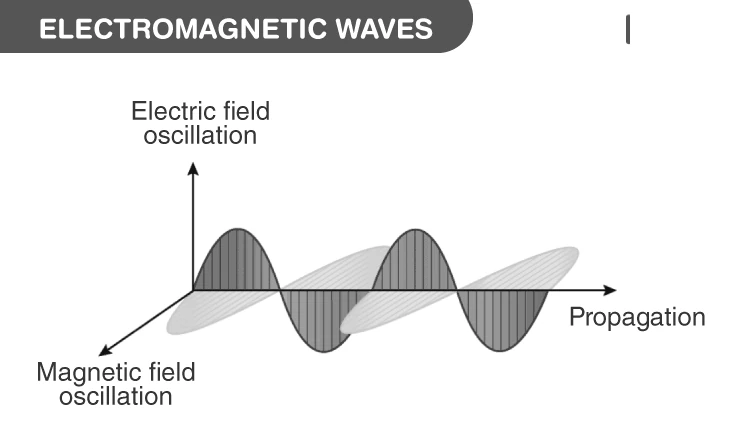
Illustration of Electromagnetic Wave Properties
Example: An electromagnetic wave in vacuum has an electric field amplitude of \(120 \text{ V/m}\). Find the corresponding magnetic field amplitude.
Solution:
Given \(E_0 = 120 \text{ V/m}\) and \(c = 3 \times 10^{8} \text{ m/s}\), use:
\[ B_0 = \frac{E_0}{c} = \frac{120}{3 \times 10^{8}} = 4 \times 10^{-7} \text{ T} \]
Applications and Observational Significance
Electromagnetic Waves in Astronomy and Technology
Electromagnetic radiation from space provides critical insights into the universe's structure and celestial bodies. The electric vector component of these waves is responsible for optical phenomena observed in various materials. Additionally, electromagnetic waves obey the principle of superposition, allowing multiple waves to coexist and interact without altering each other's properties.
Visualization of Electromagnetic Wave Propagation
Access to Learning Materials and Live Sessions
Example: Explain why electromagnetic waves can travel through the vacuum of space but sound waves cannot.
Solution:
Electromagnetic waves are self-propagating oscillations of electric and magnetic fields and do not require a medium.
Sound waves are mechanical waves that need a material medium to transmit vibrations.
Therefore, electromagnetic waves can travel through the vacuum of space, while sound waves cannot.
Quick Reference Summary
Property | Description | Formula/Value |
|---|---|---|
Wave Type | Transverse wave with perpendicular electric and magnetic fields | — |
Propagation Speed in Vacuum | Constant speed independent of source or observer | \(c = 3 \times 10^{8} \text{ m/s}\) |
Speed Formula | Depends on vacuum permittivity and permeability | \(c = \frac{1}{\sqrt{\mu_0 \epsilon_0}}\) |
Refractive Index | Determines wavelength change in different media | \(n = \sqrt{\mu_r \epsilon_r}\) |
Amplitude Ratio | Ratio of electric to magnetic field amplitudes equals wave speed | \(c = \frac{E_0}{B_0}\) |
Energy Distribution | Electric and magnetic energy densities are equal | \(u_E = u_M\) |
Poynting Vector | Represents energy flow per unit area | \(\vec{S} = \frac{1}{\mu} \vec{E} \times \vec{B}\) |
Medium Requirement | Does not require any material medium | — |
Frequency | Remains constant across media | — |
Wave Phase | Electric and magnetic fields oscillate in phase | — |
Glossary of Key Terms
Term | Definition |
|---|---|
Electromagnetic Wave | A wave consisting of oscillating electric and magnetic fields propagating through space. |
Transverse Wave | A wave where oscillations are perpendicular to the direction of propagation. |
Permittivity (\(\epsilon_0\)) | A measure of how an electric field affects and is affected by a medium. |
Permeability (\(\mu_0\)) | A measure of the ability of a material to support the formation of a magnetic field. |
Refractive Index (n) | The ratio indicating how much the speed of light is reduced inside a medium. |
Poynting Vector (\(\vec{S}\)) | A vector representing the directional energy flux of an electromagnetic wave. |
Frequency | The number of oscillations of the wave per second. |
Wavelength | The distance between successive crests or troughs of a wave. |
Amplitude | The maximum value of the electric or magnetic field in the wave. |
Superposition Principle | The principle that multiple waves can overlap without affecting each other's propagation. |
Frequently Asked Questions
Why are electromagnetic waves called transverse waves?
Because their electric and magnetic fields oscillate perpendicular to the direction in which the wave travels.
Can electromagnetic waves travel through a vacuum?
Yes, they do not require any medium and can propagate through empty space.
What determines the speed of electromagnetic waves in vacuum?
The speed depends on the permittivity and permeability of free space, given by \(c = \frac{1}{\sqrt{\mu_0 \epsilon_0}}\).
How does the wavelength of an electromagnetic wave change when entering a new medium?
The wavelength changes inversely with the refractive index of the medium, while the frequency remains constant.
What is the significance of the Poynting vector?
It represents the rate and direction of energy transfer per unit area carried by the electromagnetic wave.