Understanding Centripetal Acceleration and Force
Fundamentals of Centripetal Acceleration
Concept and Everyday Examples
Centripetal acceleration refers to the acceleration experienced by an object moving along a circular path, always directed towards the center of the circle. This inward acceleration is essential for maintaining circular motion. Unlike linear acceleration, centripetal acceleration changes the direction of velocity rather than its magnitude. Common instances include a car turning around a bend or a satellite orbiting a planet, both continuously accelerating towards the center of their circular paths.
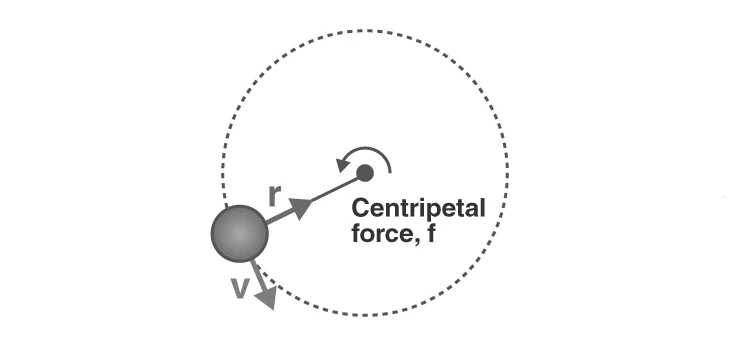
Illustration of Centripetal Acceleration Directed Inward
Example Problem
A cyclist moves at a speed of \(12 \text{ m/s}\) around a circular track with a radius of \(30 \text{ m}\). Calculate the centripetal acceleration of the cyclist.
Solution:
The formula for centripetal acceleration is:
\[ a_c = \frac{v^2}{r} \]
Substituting the given values:
\[ a_c = \frac{(12)^2}{30} = \frac{144}{30} = 4.8 \text{ m/s}^2 \]
Therefore, the cyclist experiences a centripetal acceleration of \(4.8 \text{ m/s}^2\) directed towards the center of the track.
Understanding the Force Behind Circular Motion
Nature and Direction of Centripetal Force
When an object moves in a circle, a force must act towards the center to continuously change the direction of its velocity. This inward force is called centripetal force. It is responsible for pulling the object towards the center, enabling circular motion. The magnitude of this force depends on the object's mass, speed, and the radius of the circle. Examples include gravitational force acting on planets, tension in a string for a swinging ball, and friction between tires and road for a turning car.
Example Problem
A ball of mass \(0.5 \text{ kg}\) is tied to a string and swung in a horizontal circle of radius \(2 \text{ m}\) at a speed of \(6 \text{ m/s}\). Find the centripetal force acting on the ball.
Solution:
First, calculate the centripetal acceleration:
\[ a_c = \frac{v^2}{r} = \frac{6^2}{2} = \frac{36}{2} = 18 \text{ m/s}^2 \]
Then, use Newton's second law to find the force:
\[ F_c = m \times a_c = 0.5 \times 18 = 9 \text{ N} \]
The tension in the string providing the centripetal force is \(9 \text{ N}\) directed towards the center of the circle.
Mathematical Expression and Physical Interpretation
Formula Derivation and Dimensional Analysis
Centripetal acceleration is quantitatively expressed as the square of the velocity divided by the radius of the circular path:
\[ a_c = \frac{v^2}{r} \]
Here, \(a_c\) is the centripetal acceleration in meters per second squared (\(\text{m/s}^2\)), \(v\) is the linear speed in meters per second (\(\text{m/s}\)), and \(r\) is the radius of the circle in meters (\(\text{m}\)). Although the speed may remain constant, the continuous change in direction means the velocity vector changes, resulting in acceleration.
Dimensional formula for centripetal acceleration can be derived as follows:
Velocity dimension: \([v] = \text{L T}^{-1}\)
Radius dimension: \([r] = \text{L}\)
Therefore, \[ [a_c] = \frac{[v]^2}{[r]} = \frac{\text{L}^2 \text{T}^{-2}}{\text{L}} = \text{L T}^{-2} \]
Example Problem
A car travels at a speed of \(20 \text{ m/s}\) around a circular track with a radius of \(50 \text{ m}\). Calculate the centripetal acceleration and verify its dimensional formula.
Solution:
Calculate centripetal acceleration:
\[ a_c = \frac{v^2}{r} = \frac{20^2}{50} = \frac{400}{50} = 8 \text{ m/s}^2 \]
Dimensional formula check:
Velocity dimension: \(\text{L T}^{-1}\), radius dimension: \(\text{L}\)
\[ [a_c] = \frac{(\text{L T}^{-1})^2}{\text{L}} = \frac{\text{L}^2 \text{T}^{-2}}{\text{L}} = \text{L T}^{-2} \]
This confirms the unit of acceleration is \(\text{m/s}^2\), consistent with the calculated value.
Quick Reference Summary
Parameter | Symbol | Unit | Formula |
|---|---|---|---|
Centripetal Acceleration | \(a_c\) | \(\text{m/s}^2\) | \(a_c = \frac{v^2}{r}\) |
Centripetal Force | \(F_c\) | \(\text{N}\) | \(F_c = m \times a_c = m \frac{v^2}{r}\) |
Velocity | \(v\) | \(\text{m/s}\) | Linear speed along circular path |
Radius of Circle | \(r\) | \(\text{m}\) | Distance from center to object |
Glossary of Key Terms
Term | Definition |
|---|---|
Centripetal Acceleration | Acceleration directed towards the center of a circular path. |
Centripetal Force | Force causing an object to move in a circular path, directed inward. |
Velocity | Speed of an object in a specific direction; a vector quantity. |
Speed | Scalar quantity representing how fast an object moves. |
Radius | Distance from the center of a circle to any point on its circumference. |
Vector | A quantity having both magnitude and direction. |
Scalar | A quantity having only magnitude, no direction. |
Newton's Second Law | Law stating that force equals mass times acceleration (\(F=ma\)). |
Orbit | The curved path of an object around a point in space due to gravity. |
Frictional Force | Force resisting motion between two surfaces in contact. |
Frequently Asked Questions
What force causes an object to follow a circular path?
The centripetal force, directed towards the center of the circle, is responsible for changing the direction of the object's velocity, enabling circular motion.
How are centripetal force and centripetal acceleration related?
Both centripetal force and centripetal acceleration point towards the center of the circle, with force causing the acceleration according to \(F = m a_c\).
What units are used to measure centripetal acceleration?
Centripetal acceleration is measured in meters per second squared (\(\text{m/s}^2\)).
What is the dimensional formula of centripetal acceleration?
The dimensional formula is \(\text{L T}^{-2}\), derived from velocity squared divided by radius.
Can an object moving at constant speed have acceleration?
Yes, if the direction of velocity changes, as in circular motion, the object experiences acceleration despite constant speed.