Comprehensive Guide to Capacitors and Their Functions
Fundamentals of Capacitors and Their Operation
Understanding the Capacitor and Its Basic Structure
A capacitor is an electrical component designed to store energy by accumulating electric charges on two separate conductive plates. These plates are isolated by a gap, which may be filled with air, vacuum, or an insulating substance called a dielectric. The capacity of a capacitor to hold charge is quantified by its capacitance.
Unlike batteries that generate electricity through chemical reactions, capacitors store energy electrostatically by maintaining opposite charges on their plates. The simplest form is the parallel plate capacitor, consisting of two flat metal plates positioned parallel to each other with a small separation.
Mechanism of Charge Storage and Energy Retention
Consider a parallel plate capacitor connected to a direct current (DC) voltage source. One plate becomes positively charged, while the other accumulates negative charge. Due to the insulating gap, current cannot flow directly between the plates, but an electric field develops across the dielectric.
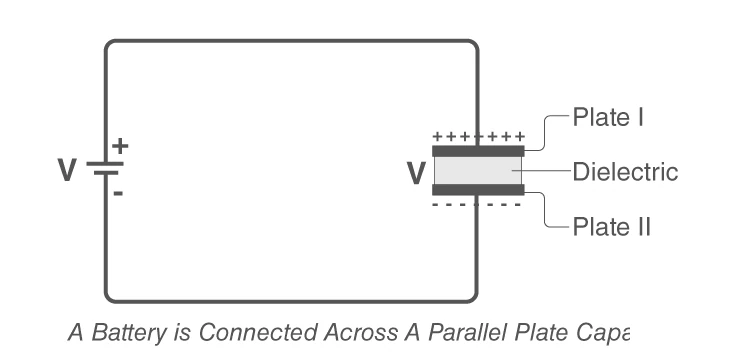
Charging a Capacitor
As the capacitor charges, it reaches a maximum charge capacity determined by its capacitance and the applied voltage. When disconnected from the power source, the capacitor retains the stored charge for a period, effectively acting as a temporary energy reservoir.
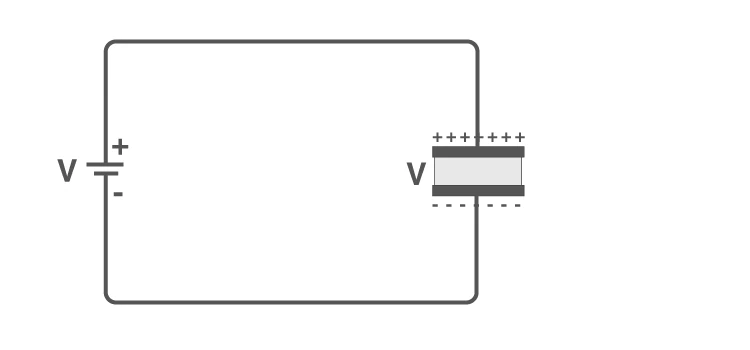
Capacitor as a source of energy
Upon connecting the charged plates to a load, the stored energy discharges as current flows until the charges neutralize. This discharge duration depends on the circuit and capacitor characteristics.
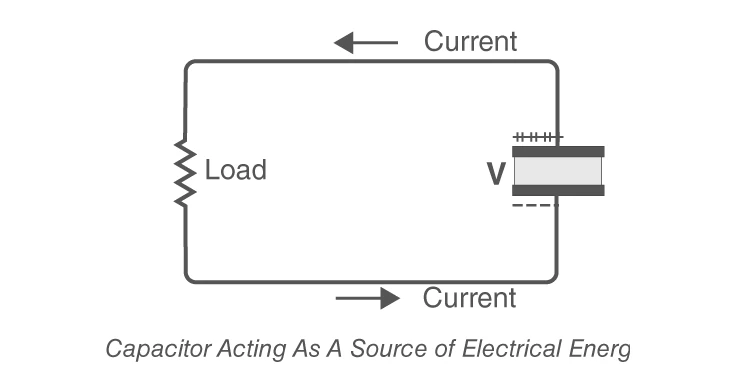
Discharging of Capacitor
Calculating Capacitance and Its Dependence on Physical Parameters
The capacitance \( C \) of a capacitor is defined as the ratio of the magnitude of charge \( Q \) on one plate to the potential difference \( V \) across the plates:
\[ C = \frac{Q}{V} \]
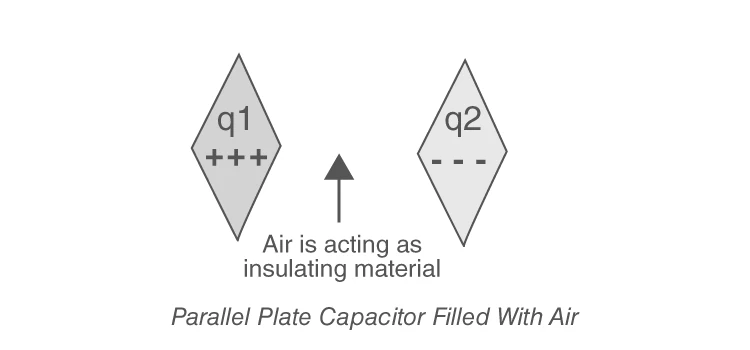
Capacitor
While the formula suggests capacitance depends on charge and voltage, it fundamentally relies on the capacitor's geometry and the dielectric material between the plates. Capacitance increases with larger plate area and decreases with greater separation distance.
Example Problem
Calculate the capacitance of a capacitor with two plates each having an area of 0.5 m² separated by 2 mm of air.
Solution:
Given:
Plate area, \( A = 0.5 \text{ m}^2 \)
Distance between plates, \( d = 2 \times 10^{-3} \text{ m} \)
Permittivity of free space, \( \epsilon_0 = 8.85 \times 10^{-12} \text{ F/m} \)
Capacitance of a parallel plate capacitor is given by:
\[ C = \epsilon_0 \frac{A}{d} \]
Substituting the values:
\[ C = 8.85 \times 10^{-12} \times \frac{0.5}{2 \times 10^{-3}} = 2.21 \times 10^{-9} \text{ F} = 2.21 \text{ nF} \]
Therefore, the capacitance is 2.21 nanofarads.
Capacitance in Different Configurations and Energy Storage
Capacitance of Parallel Plate Capacitors
In a parallel plate capacitor, the capacitance depends on the plate area \( A \), the distance \( d \) between the plates, and the dielectric constant \( \epsilon_r \) of the insulating material. The capacitance is expressed as:
\[ C = \epsilon_0 \epsilon_r \frac{A}{d} \]
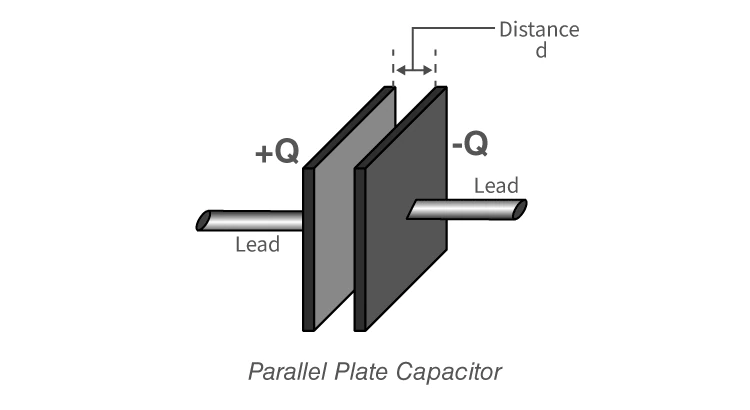
Parallel Plate Capacitor
Here, \( \epsilon_0 \) is the permittivity of free space, and \( \epsilon_r \) is the relative permittivity of the dielectric. Increasing the plate area or the dielectric constant increases capacitance, while increasing the plate separation reduces it.
Capacitance of Spherical Capacitors
Spherical capacitors consist of two concentric spherical conductors with radii \( R_1 \) and \( R_2 \) (where \( R_2 > R_1 \)). The capacitance is determined by the formula:
\[ C = 4 \pi \epsilon_0 \epsilon_r \frac{R_1 R_2}{R_2 - R_1} \]
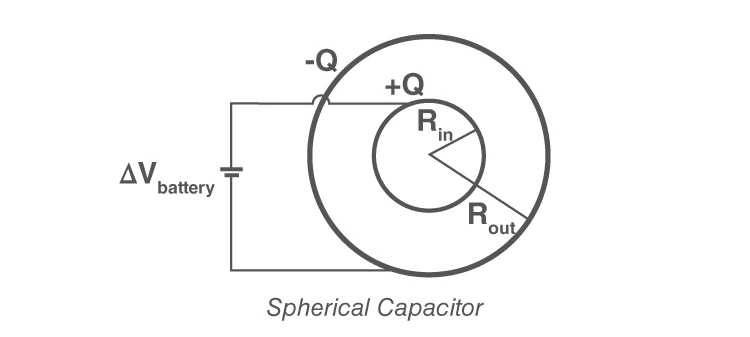
Spherical Capacitor
This formula accounts for the dielectric constant \( \epsilon_r \) of the material between the spheres.
Example Problem
Find the capacitance of a spherical capacitor with inner radius 10 cm and outer radius 11 cm, filled with a dielectric of constant 4.
Solution:
Given:
Inner radius, \( R_1 = 0.10 \text{ m} \)
Outer radius, \( R_2 = 0.11 \text{ m} \)
Dielectric constant, \( \epsilon_r = 4 \)
Permittivity of free space, \( \epsilon_0 = 8.85 \times 10^{-12} \text{ F/m} \)
Using the formula:
\[ C = 4 \pi \times 8.85 \times 10^{-12} \times 4 \times \frac{0.10 \times 0.11}{0.11 - 0.10} \]
Calculate numerator and denominator:
\[ \frac{0.10 \times 0.11}{0.01} = \frac{0.011}{0.01} = 1.1 \]
Therefore:
\[ C = 4 \pi \times 8.85 \times 10^{-12} \times 4 \times 1.1 = 4 \pi \times 8.85 \times 10^{-12} \times 4.4 \]
Calculate constants:
\[ 4 \pi \approx 12.566 \]
\[ C = 12.566 \times 8.85 \times 10^{-12} \times 4.4 = 12.566 \times 38.94 \times 10^{-12} = 489.3 \times 10^{-12} \text{ F} = 489.3 \text{ pF} \]
The capacitance is approximately 489.3 picofarads.
Energy Stored in Capacitors
When a capacitor is charged, it stores electrical potential energy. The energy \( U \) stored in a capacitor with capacitance \( C \) and voltage \( V \) is given by:
\[ U = \frac{1}{2} C V^2 \]
This energy can be released when the capacitor discharges, making capacitors useful for temporary energy storage in various electronic devices.
Influences on Capacitance and Practical Uses of Capacitors
Key Factors Affecting Capacitance
The capacitance of a capacitor is influenced by several physical factors:
Dielectric Material: Materials with higher permittivity increase capacitance by allowing more electric field flux between plates.
Plate Separation: Capacitance is inversely proportional to the distance between plates, mathematically expressed as \( C \propto \frac{1}{d} \).
Plate Area: Larger plate areas provide more surface to store charge, so capacitance is directly proportional to area, \( C \propto A \).
Applications of Capacitors in Technology
Capacitors serve multiple roles across various fields:
Energy Storage: Capacitors store electrical energy for short durations, useful in camera flashes, power supplies, and audio equipment. Supercapacitors with capacitances up to 2 kF enable advanced applications like electric vehicles and memory backup.
Power Conditioning: Capacitors filter and smooth power supplies by allowing AC signals to pass while blocking DC, reducing noise and improving circuit efficiency.
Sensing Devices: Capacitors detect changes in humidity, pressure, and fuel levels by monitoring variations in plate distance or dielectric properties.
Signal Processing: Capacitors are integral in tuning circuits, radio receivers, and dynamic RAM, where they represent binary data as charge states.
Example Problem
Explain how changing the dielectric material affects the capacitance of a parallel plate capacitor.
Answer:
The dielectric constant \( \epsilon_r \) of the material determines how much electric field can be sustained between the plates.
A higher dielectric constant increases the capacitance by allowing more charge to be stored for the same voltage.
Materials with low dielectric strength or conductivity reduce capacitor efficiency by allowing leakage currents.
Thus, selecting an appropriate dielectric is crucial for optimizing capacitor performance in specific applications.
Quick Reference: Capacitor Essentials
Parameter | Effect on Capacitance | Formula/Relation |
|---|---|---|
Plate Area (A) | Directly proportional | \( C \propto A \) |
Plate Separation (d) | Inversely proportional | \( C \propto \frac{1}{d} \) |
Dielectric Constant (\( \epsilon_r \)) | Directly proportional | \( C = \epsilon_0 \epsilon_r \frac{A}{d} \) |
Unit of Capacitance | Farad (F) | 1 F = 1 Coulomb/Volt |
Energy Stored (U) | Depends on \( C \) and \( V \) | \( U = \frac{1}{2} C V^2 \) |
Capacitance of Spherical Capacitor | Depends on radii and dielectric | \( C = 4 \pi \epsilon_0 \epsilon_r \frac{R_1 R_2}{R_2 - R_1} \) |
Glossary of Key Terms
Term | Definition |
|---|---|
Capacitor | An electrical device that stores energy in an electric field between two conductors. |
Capacitance | The ability of a capacitor to store charge per unit voltage, measured in Farads. |
Dielectric | An insulating material placed between capacitor plates to increase capacitance. |
Electric Field | A field around charged objects that exerts force on other charges. |
Potential Difference (Voltage) | The work done to move a unit charge between two points. |
Parallel Plate Capacitor | A capacitor with two flat, parallel conductive plates separated by a dielectric. |
Spherical Capacitor | A capacitor formed by two concentric spherical conductors. |
Permittivity (\( \epsilon_0 \)) | A constant representing the ability of free space to permit electric field lines. |
Supercapacitor | A capacitor with very high capacitance used for large energy storage. |
Energy Stored | The electrical potential energy held in a charged capacitor. |
Frequently Asked Questions
What is a variable capacitor and where is it used?
A variable capacitor allows adjustment of its capacitance by changing the relative position of its plates. It is commonly used to tune resonant frequencies in circuits such as radios.
How does the distance between capacitor plates influence capacitance?
Increasing the distance between plates reduces capacitance because the electric field strength decreases, making it harder to store charge.
What are ultracapacitors and how do they differ from regular capacitors?
Ultracapacitors, or supercapacitors, have much higher capacitance values than standard capacitors but operate at lower voltages, enabling large energy storage for applications like electric vehicles.
What type of energy is stored in a capacitor?
Capacitors store electrical potential energy, which depends on the charge and voltage across the plates.
Why is water not used as a dielectric in capacitors despite its high dielectric constant?
Although water has a high dielectric constant, its low dielectric strength causes it to conduct electricity, leading to leakage and inefficiency in capacitors.