Understanding Bragg’s Law and Its Applications in X-ray Diffraction
Fundamentals of Bragg’s Law and X-ray Interaction with Crystals
Conceptual Overview of Bragg’s Law
Bragg’s Law is a fundamental principle that explains how X-rays interact with the atomic planes in a crystal lattice. When X-rays strike a crystal, they are scattered by the electrons surrounding the atoms. This scattering can be coherent or incoherent, but Bragg’s Law specifically describes the conditions for constructive interference of the scattered waves, resulting in a distinct diffraction pattern.
In essence, the law states that the angle at which X-rays are incident on the crystal planes equals the angle at which they are reflected, and constructive interference occurs when the path difference between waves reflected from successive planes is an integer multiple of the wavelength.
This phenomenon is crucial for understanding the internal structure of crystals and is the basis for techniques such as X-ray diffraction (XRD).
Example: When X-rays with a wavelength of 0.08 nm hit a crystal, they reflect at an angle of 30°. If the distance between atomic layers is 0.15 nm, determine if constructive interference occurs for the first order (n=1).
Solution:
Using Bragg’s Law: \( n\lambda = 2d \sin \theta \)
Substitute values: \( 1 \times 0.08 = 2 \times 0.15 \times \sin 30^\circ \)
Calculate right side: \( 2 \times 0.15 \times 0.5 = 0.15 \)
Since \(0.08 \neq 0.15\), constructive interference does not occur at this angle for first order.
Mathematical Expression and Derivation of Bragg’s Equation
Formulating the Bragg Equation
The Bragg equation mathematically relates the wavelength of incident X-rays, the angle of incidence, and the spacing between crystal planes. It is expressed as:
\[ n \lambda = 2 d \sin \theta \]
Here, \(n\) is an integer representing the order of diffraction, \(\lambda\) is the wavelength of the X-rays, \(d\) is the distance between atomic layers, and \(\theta\) is the angle of incidence (also equal to the angle of reflection).
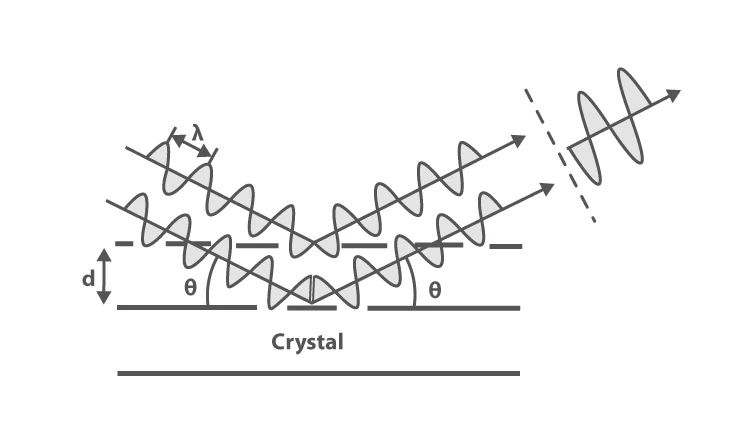
Diagram illustrating the Bragg Equation and X-ray reflection
This equation explains why X-rays are reflected at specific angles by crystal faces, producing a diffraction pattern that reveals the crystal’s atomic structure.
Step-by-Step Derivation of Bragg’s Law
Consider two parallel X-ray beams striking successive crystal planes at an angle \(\theta\). The path difference between the beams reflected from adjacent planes must be an integer multiple of the wavelength for constructive interference.
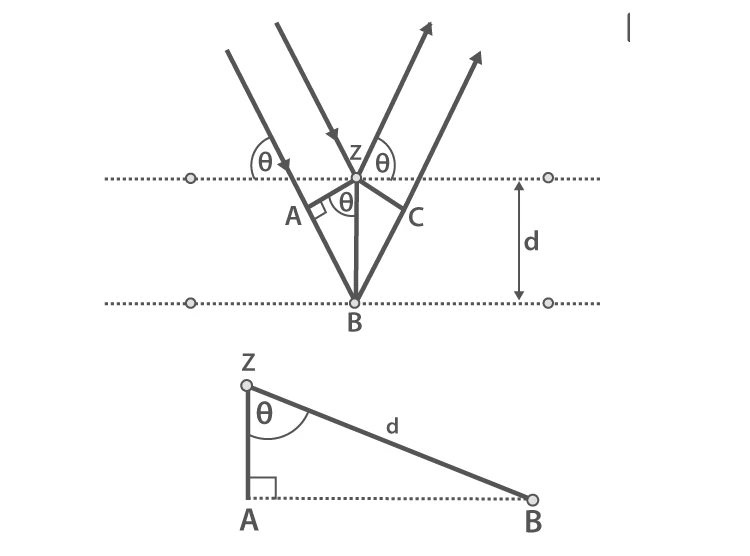
Geometric representation used in deriving Bragg’s Law
The extra distance traveled by the second beam is the sum of segments \(AB\) and \(BC\), which are equal:
\[ n \lambda = AB + BC = 2 AB \]
From the right triangle formed, \(AB = d \sin \theta\), where \(d\) is the interplanar spacing.
Substituting, we get:
\[ n \lambda = 2 d \sin \theta \]
This is the fundamental expression of Bragg’s Law.
Example: X-rays with wavelength 0.09 nm are incident on a crystal with interplanar spacing 0.20 nm. Calculate the smallest angle \(\theta\) for first-order diffraction (n=1).
Solution:
Using Bragg’s Law:
\[ 1 \times 0.09 = 2 \times 0.20 \times \sin \theta \]
\[ \sin \theta = \frac{0.09}{0.40} = 0.225 \]
\[ \theta = \sin^{-1}(0.225) \approx 13^\circ \]
Thus, the first-order diffraction occurs at approximately \(13^\circ\).
Practical Uses and Experimental Insights of Bragg’s Diffraction
Applications of Bragg’s Law in Scientific Research
Bragg’s Law is instrumental in various scientific fields, especially in material science and chemistry, for analyzing crystal structures. Some key applications include:
In X-ray fluorescence spectroscopy (XRF) and wavelength dispersive spectrometry (WDS), crystals with known interplanar spacings are used to analyze unknown samples.
X-ray diffraction (XRD) techniques utilize Bragg’s Law to determine the spacing between atomic planes, aiding in the identification and characterization of crystalline materials.
Understanding the arrangement of atoms in solids, which is essential for developing new materials and studying their properties.
Understanding Bragg’s Diffraction Phenomenon
Bragg’s diffraction occurs when waves such as X-rays or subatomic particles have wavelengths comparable to the spacing between atomic planes in a crystal. This leads to constructive interference at specific angles, producing a diffraction pattern that can be recorded and analyzed.
Example: An X-ray beam with wavelength 0.065 nm is diffracted by a crystal with lattice spacing 0.25 nm. Calculate the glancing angle for the second-order diffraction (n=2).
Solution:
Given:
\(\lambda = 0.065 \text{ nm}\)
\(d = 0.25 \text{ nm}\)
\(n = 2\)
Using Bragg’s Law:
\[ 2 \times 0.065 = 2 \times 0.25 \times \sin \theta \]
\[ \sin \theta = \frac{0.13}{0.5} = 0.26 \]
\[ \theta = \sin^{-1}(0.26) \approx 15^\circ \]
The glancing angle for second-order diffraction is approximately \(15^\circ\).
Summary Table for Quick Review
Parameter | Description |
|---|---|
Bragg’s Law | \( n \lambda = 2 d \sin \theta \) |
\(n\) | Order of diffraction (integer) |
\(\lambda\) | Wavelength of incident X-rays |
\(d\) | Distance between atomic planes in the crystal |
\(\theta\) | Angle of incidence/reflection of X-rays |
Constructive Interference | Occurs when path difference equals \(n \lambda\) |
X-ray Diffraction (XRD) | Technique to study crystal structures using Bragg’s Law |
Bragg Diffraction | Diffraction pattern formed due to constructive interference of scattered waves |
Applications | Material characterization, crystal structure analysis, spectroscopy |
Originators | William Henry Bragg and William Lawrence Bragg |
Glossary of Key Terms
Term | Definition |
|---|---|
Bragg’s Law | Relationship describing the condition for constructive interference of X-rays reflected from crystal planes. |
Diffraction | The bending and spreading of waves when they encounter obstacles or openings. |
Constructive Interference | When two or more waves combine to produce a wave of greater amplitude. |
Interplanar Spacing (d) | The distance between adjacent atomic planes in a crystal lattice. |
Wavelength (\(\lambda\)) | The distance between successive crests of a wave. |
Order of Diffraction (n) | An integer representing the number of wavelengths fitting into the path difference. |
X-ray Diffraction (XRD) | A technique to study crystal structures by analyzing diffraction patterns. |
Rayleigh Scattering | Scattering of light or other electromagnetic radiation by particles much smaller than the wavelength. |
Glancing Angle | The angle between the incident beam and the crystal plane. |
Crystal Lattice | A regular, repeating arrangement of atoms in a crystalline solid. |
Frequently Asked Questions (FAQs)
What is the significance of Bragg’s Law in crystallography?
Bragg’s Law provides the fundamental condition for X-ray diffraction, enabling scientists to determine the atomic structure of crystals by analyzing diffraction patterns.
How does the angle \(\theta\) relate to the diffraction pattern?
The angle \(\theta\) is the angle of incidence and reflection of X-rays on crystal planes; specific values of \(\theta\) satisfy Bragg’s Law and produce constructive interference, forming the diffraction peaks.
Why must the path difference be an integer multiple of the wavelength?
This condition ensures that the scattered waves are in phase, leading to constructive interference and a detectable diffraction signal.
Can Bragg’s Law be applied to particles other than X-rays?
Yes, Bragg’s Law applies to any wave-like particles such as neutrons or electrons, provided their wavelength is comparable to the crystal lattice spacing.
Who discovered Bragg’s Law and when?
Bragg’s Law was formulated by William Henry Bragg and his son William Lawrence Bragg in 1913, earning them the Nobel Prize for their work on crystal structures.