Understanding Biot-Savart Law and Its Applications
Fundamentals of Magnetic Fields from Electric Currents
Conceptual Overview of Biot-Savart Law
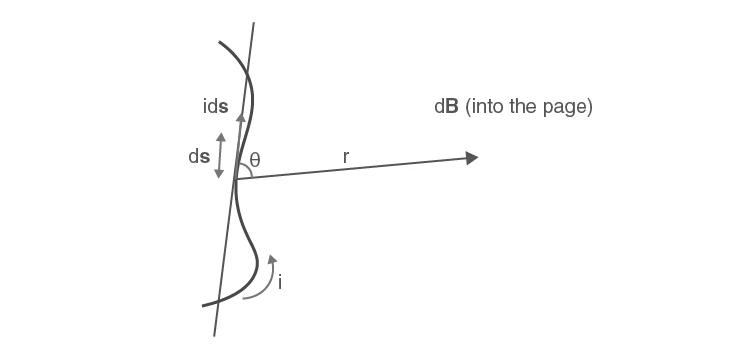
The Biot-Savart Law provides a mathematical description of the magnetic field generated by a small segment of current-carrying conductor. This current element is treated as a vector quantity, representing both magnitude and direction of the current segment. The law enables us to calculate the magnetic field at any point in space due to this element, forming the foundation for understanding magnetic effects of electric currents.
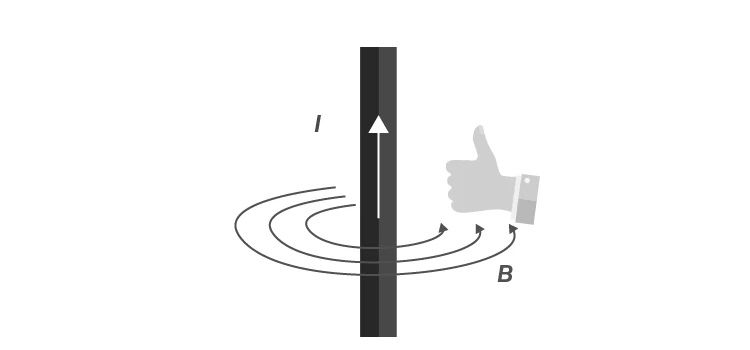
It is essential to recognize that the magnetic field produced is always perpendicular to the plane formed by the current element and the position vector pointing to the observation point. The direction of this magnetic field can be determined using the right-hand thumb rule: the thumb points along the current direction, while the curled fingers indicate the magnetic field lines.
Diagram illustrating the Biot-Savart Law and magnetic field direction
Example 1: Magnetic Field Direction from a Current Element
Consider a straight wire segment carrying current towards the north. Using the right-hand thumb rule, determine the direction of the magnetic field at a point located east of the wire.
Solution:
Point your right thumb in the direction of the current (north).
Your fingers curl around the wire; at the point east of the wire, the magnetic field points downward (into the page).
Thus, the magnetic field at the east point is directed into the plane of the page.
Mathematical Expression and Calculation of Magnetic Fields
Deriving the Biot-Savart Formula
To quantify the magnetic field generated by a small current element, consider a wire carrying current \( I \) with a differential length \( ds \). The current element vector is \( I \, ds \), aligned with the current's direction. The magnetic field \( d\mathbf{B} \) at a point located by position vector \( \mathbf{r} \) from the element is given by the Biot-Savart Law:
\[ d\mathbf{B} = \frac{\mu_0}{4\pi} \frac{I \, d\mathbf{s} \times \hat{\mathbf{r}}}{r^2} \]
Here, \( \mu_0 = 4\pi \times 10^{-7} \, \text{T}\cdot\text{m/A} \) is the permeability of free space, \( r \) is the distance from the current element to the point, and \( \hat{\mathbf{r}} \) is the unit vector pointing from the element to the point.
The cross product indicates that the magnetic field is perpendicular to both the current element and the position vector, consistent with the right-hand rule.
Vector representation of current element and magnetic field direction
Example 2: Magnetic Field at the Center of a Circular Loop
A circular loop of radius \( 0.03 \, \text{m} \) carries a current of \( 0.3 \, \text{A} \). Calculate the magnetic field at the center of the loop.
Solution:
The magnetic field at the center of a circular loop is given by:
\[ B = \frac{\mu_0 I}{2R} \]
Substituting the values:
\[ B = \frac{4\pi \times 10^{-7} \times 0.3}{2 \times 0.03} = 6.28 \times 10^{-6} \, \text{T} \]
Therefore, the magnetic field at the center is \( 6.28 \times 10^{-6} \, \text{T} \).
Practical Uses and Significance of the Biot-Savart Law
Applications in Science and Engineering
The Biot-Savart Law is instrumental in various fields, including:
Calculating magnetic fields at atomic and molecular scales, aiding in understanding magnetic properties of materials.
Analyzing aerodynamic flows by determining velocities induced by vortex lines in fluid dynamics.
Designing electromagnets, inductors, and other electrical devices where precise magnetic field calculations are necessary.
Its versatility extends to both theoretical and applied physics, making it a cornerstone in electromagnetism.
Why Biot-Savart Law is Essential
This law shares conceptual similarity with Coulomb’s law in electrostatics, providing a magnetic counterpart to electric field calculations. It is particularly useful for:
Determining magnetic fields from small or complex current distributions.
Handling symmetrical current configurations where direct integration is feasible.
Serving as a foundational principle for more advanced electromagnetic theories.
Example 3: Magnetic Field at the Center of a Semicircular Wire
A semicircular wire of radius \( 0.15 \, \text{m} \) carries a current of \( 120 \, \text{A} \). Find the magnetic field at the center of the semicircle.
Solution:
The magnetic field at the center of a semicircular wire is:
\[ B = \frac{\mu_0 I}{4 R} \]
Substituting the given values:
\[ B = \frac{4\pi \times 10^{-7} \times 120}{4 \times 0.15} = 2.51 \times 10^{-4} \, \text{T} \]
Hence, the magnetic field at the center is \( 2.51 \times 10^{-4} \, \text{T} \).
Summary Table for Quick Review
Concept | Formula | Key Points |
|---|---|---|
Biot-Savart Law (Differential form) | \( d\mathbf{B} = \frac{\mu_0}{4\pi} \frac{I \, d\mathbf{s} \times \hat{\mathbf{r}}}{r^2} \) | Magnetic field from a small current element; direction by right-hand rule |
Magnetic field at center of circular loop | \( B = \frac{\mu_0 I}{2R} \) | Uniform field at center; \( R \) is loop radius |
Magnetic field at center of semicircular wire | \( B = \frac{\mu_0 I}{4R} \) | Half the circular loop field; \( R \) is radius |
Permeability of free space | \( \mu_0 = 4\pi \times 10^{-7} \, \text{T}\cdot\text{m/A} \) | Constant in magnetic field calculations |
Glossary of Key Terms
Term | Definition |
|---|---|
Biot-Savart Law | Mathematical relation to find magnetic field from a current element. |
Current Element | A small segment of a conductor carrying current, treated as a vector. |
Magnetic Field (\( \mathbf{B} \)) | Vector field representing magnetic influence around currents and magnets. |
Permeability of Free Space (\( \mu_0 \)) | Physical constant defining magnetic permeability in vacuum. |
Right-Hand Thumb Rule | Mnemonic to determine magnetic field direction around current. |
Position Vector (\( \mathbf{r} \)) | Vector from current element to the point where magnetic field is calculated. |
Cross Product | Vector multiplication giving a vector perpendicular to two input vectors. |
Magnetic Flux Density | Measure of magnetic field strength per unit area, denoted by \( \mathbf{B} \). |
Current Loop | A closed conducting wire carrying current, producing a magnetic field. |
Semicircular Wire | A wire bent in half a circle, used in magnetic field calculations. |
Frequently Asked Questions
Which electrical law is Biot-Savart Law analogous to?
Biot-Savart Law in magnetism is analogous to Coulomb’s law in electrostatics, as both describe fields generated by sources (current elements or charges) inversely proportional to the square of the distance.
Can Biot-Savart Law be used to calculate electric field intensity?
No, Biot-Savart Law is specifically for magnetic field calculations. Electric field intensity is determined by Coulomb’s law and related electrostatic principles.
How do you find the magnetic field at the center of a circular conductor?
Use the formula \( B = \frac{\mu_0 I}{2R} \), where \( I \) is current and \( R \) is the radius of the conductor.
What happens to the magnetic field if the radius of the conductor is infinite?
If the radius \( R \) approaches infinity, the magnetic field at the center approaches zero, as the current loop effectively becomes a straight wire with negligible curvature.
Is the direction of the magnetic field always perpendicular to the current element?
Yes, according to Biot-Savart Law, the magnetic field direction is perpendicular to both the current element and the position vector, determined by the right-hand thumb rule.