Comprehensive Overview of Binding Energy and Its Types
Fundamentals of Binding Energy in Physical Systems
Understanding the Concept of Binding Energy
Binding energy refers to the minimum energy necessary to detach a particle from a system of particles, effectively separating the system into individual components. This concept is pivotal in fields such as atomic physics, chemistry, and condensed matter physics. In nuclear physics, binding energy is often synonymous with separation energy, describing the energy required to disassemble a nucleus into its constituent protons and neutrons, collectively called nucleons.
Since energy must be supplied to overcome the forces holding the nucleus together, nuclear binding energy is always a positive quantity. This principle also extends to atoms and ions held together within crystal lattices.
Example Problem
Calculate the energy needed to remove a neutron from a nucleus if the binding energy per nucleon is \(8.5 \text{ MeV}\) and the nucleus contains 20 nucleons.
Solution:
The total binding energy of the nucleus is:
\[ E_{\text{total}} = 8.5 \times 20 = 170 \text{ MeV} \]
Removing one neutron requires energy approximately equal to the binding energy per nucleon:
\[ E_{\text{remove neutron}} \approx 8.5 \text{ MeV} \]
Thus, about \(8.5 \text{ MeV}\) of energy is needed to separate one neutron from the nucleus.
Classification and Characteristics of Binding Energy Types
Electron Binding Energy and Ionization
Electron binding energy, commonly known as ionization energy, is the energy required to remove an electron from its atomic orbital. This energy arises primarily from electromagnetic interactions between the electron and the nucleus, as well as interactions with other electrons. Photons mediate these electromagnetic forces, making ionization energy a key concept in atomic and molecular physics.
Example Problem
An atom requires \(12.3 \text{ eV}\) to remove its outermost electron. What is the ionization energy in joules?
Solution:
Using the conversion \(1 \text{ eV} = 1.602 \times 10^{-19} \text{ J}\),
\[ E = 12.3 \times 1.602 \times 10^{-19} = 1.97 \times 10^{-18} \text{ J} \]
The ionization energy is \(1.97 \times 10^{-18} \text{ J}\).
Atomic Binding Energy Explained
Atomic binding energy is the total energy required to disassemble an atom into its nucleus and free electrons. It can be viewed as the sum of the ionization energies of all electrons in the atom. This energy results from electromagnetic forces between electrons and the nucleus, mediated by photons, and is fundamental to understanding atomic stability.
Example Problem
Calculate the approximate atomic binding energy of an atom with three electrons, given their ionization energies are \(5.1 \text{ eV}\), \(10.2 \text{ eV}\), and \(15.6 \text{ eV}\).
Solution:
Sum of ionization energies:
\[ E_{\text{atomic}} = 5.1 + 10.2 + 15.6 = 30.9 \text{ eV} \]
The atomic binding energy is approximately \(30.9 \text{ eV}\).
Nuclear Binding Energy and Mass Defect
Nuclear binding energy is the energy needed to break a nucleus into free protons and neutrons. It corresponds to the mass defect, which is the difference between the combined mass of individual nucleons and the actual mass of the nucleus. This energy arises from the residual strong nuclear force, mediated by mesons.
The relationship between energy and mass is given by Einstein’s equation:
\[ E = mc^{2} \]
where \(c\) is the speed of light. The mass defect \(M_d\) is calculated as:
\[ M_{d} = (m_n + m_p) - m_o \]
where \(m_n\) and \(m_p\) are the masses of neutrons and protons respectively, and \(m_o\) is the observed atomic mass.
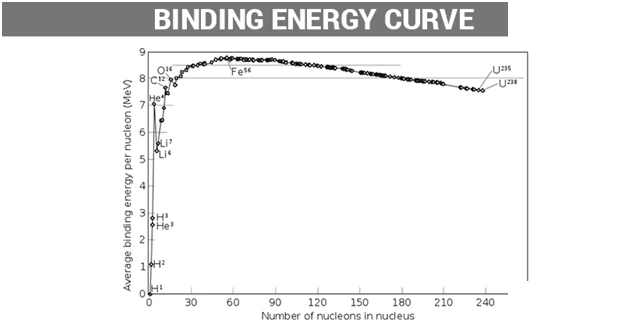
Graph depicting the nuclear binding energy curve
Example Problem
A nucleus has 8 protons and 8 neutrons. Given \(m_p = 1.00728 \text{ AMU}\), \(m_n = 1.00867 \text{ AMU}\), and the measured atomic mass \(m_o = 15.994 \text{ AMU}\), find the mass defect.
Solution:
Total mass of nucleons:
\[ (8 \times 1.00728) + (8 \times 1.00867) = 8.05824 + 8.06936 = 16.1276 \text{ AMU} \]
Mass defect:
\[ M_d = 16.1276 - 15.994 = 0.1336 \text{ AMU} \]
This mass defect corresponds to the binding energy released when the nucleus formed.
Bond Energy and Practical Implications of Binding Energy
Bond Energy in Chemical Systems
Bond energy, or bond-dissociation energy, quantifies the energy required to break a chemical bond between atoms in a molecule. This energy is released or absorbed during chemical reactions such as combustion or explosions, representing chemical energy transformations.
Example Problem
Calculate the energy needed to break two bonds in a molecule if each bond requires \(350 \text{ kJ/mol}\) to dissociate.
Solution:
Total energy required:
\[ E = 2 \times 350 = 700 \text{ kJ/mol} \]
Thus, \(700 \text{ kJ/mol}\) is needed to break both bonds.
Binding Energy in Nuclear Reactions: Fusion and Fission
Binding energy plays a crucial role in determining whether nuclear fusion or fission is energetically favorable. For nuclei lighter than iron-56, fusion releases energy as the binding energy per nucleon increases with mass. Conversely, heavier nuclei release energy through fission, as splitting them produces fragments with higher binding energy per nucleon. The nuclear binding energy curve peaks at iron-56, marking the most stable nucleus.
Illustration related to nuclear binding energy and stability
Exam Tip: Remember that the peak of the nuclear binding energy curve at mass number 56 indicates maximum nuclear stability, which is why iron-56 is often considered the most stable nucleus.
Quick Reference Summary
Type of Binding Energy | Description | Force Involved | Typical Energy Scale |
|---|---|---|---|
Electron Binding Energy (Ionization Energy) | Energy to remove an electron from an atom or molecule | Electromagnetic | eV (electron volts) |
Atomic Binding Energy | Total energy to separate an atom into nucleus and electrons | Electromagnetic | eV to keV |
Nuclear Binding Energy | Energy to split nucleus into protons and neutrons | Strong Nuclear Force | MeV (million electron volts) |
Bond Energy | Energy to break chemical bonds between atoms | Chemical (Electromagnetic) | kJ/mol |
Glossary of Key Terms
Term | Definition |
|---|---|
Binding Energy | Minimum energy required to separate particles in a system |
Nucleons | Protons and neutrons within an atomic nucleus |
Ionization Energy | Energy needed to remove an electron from an atom |
Mass Defect | Difference between combined mass of nucleons and actual nucleus mass |
Strong Nuclear Force | Force that holds protons and neutrons together in the nucleus |
Mesons | Particles mediating the strong nuclear force |
Bond-Dissociation Energy | Energy required to break a chemical bond |
Fusion | Process of combining light nuclei to form a heavier nucleus |
Fission | Splitting of a heavy nucleus into lighter nuclei |
Avogadro’s Number | Number of particles in one mole, approximately \(6.022 \times 10^{23}\) |
Frequently Asked Questions
What are nucleons?
Nucleons are the protons and neutrons that make up an atomic nucleus.
What types of binding energy exist?
Binding energy types include electron binding energy (ionization energy), atomic binding energy, and nuclear binding energy.
How is energy related to mass in nuclear physics?
Energy and mass are related by Einstein’s equation \(E = mc^{2}\), where mass can be converted into energy and vice versa.
What is another name for electron binding energy?
Electron binding energy is also called ionization energy, the energy needed to remove an electron from an atom.
Is binding energy positive or negative?
Binding energy is always a positive value because energy must be supplied to break the bonds holding particles together.