Comprehensive Guide to Trigonometric Functions
Fundamentals of Trigonometric Ratios
Understanding Primary Trigonometric Ratios
Trigonometric functions express the relationship between the angles and sides of a right-angled triangle. The three fundamental ratios are sine, cosine, and tangent, each defined as a ratio of specific sides relative to an angle.
Consider a right triangle with angle \( a \), where the sides opposite, adjacent, and hypotenuse are labeled accordingly. The primary functions are:
- Sine: Ratio of the length of the side opposite angle \( a \) to the hypotenuse.
- Cosine: Ratio of the length of the side adjacent to angle \( a \) to the hypotenuse.
- Tangent: Ratio of the length of the side opposite angle \( a \) to the adjacent side.
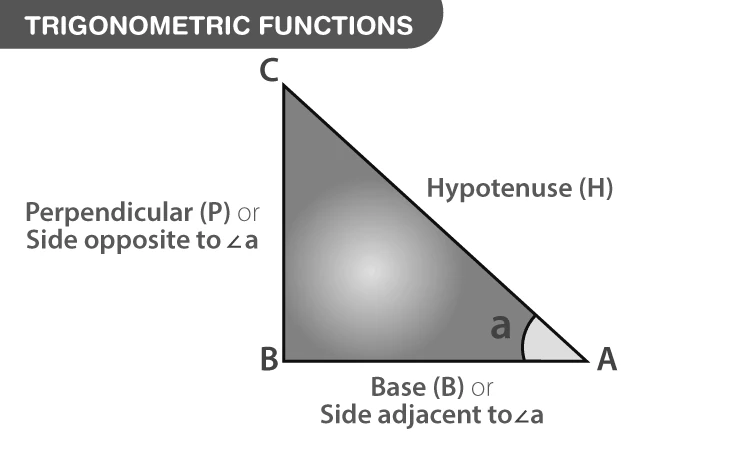
Example:
In a right triangle, if the hypotenuse measures 13 cm and the side opposite angle \( a \) is 5 cm, find \( \sin a \), \( \cos a \), and \( \tan a \) given the adjacent side is 12 cm.
Solution:
\[ \sin a = \frac{\text{Opposite}}{\text{Hypotenuse}} = \frac{5}{13} \]
\[ \cos a = \frac{\text{Adjacent}}{\text{Hypotenuse}} = \frac{12}{13} \]
\[ \tan a = \frac{\text{Opposite}}{\text{Adjacent}} = \frac{5}{12} \]
Derived Trigonometric Functions: Cotangent, Secant, and Cosecant
Besides the primary functions, three additional ratios are defined as reciprocals:
- Cosecant (csc): Reciprocal of sine, \( \csc a = \frac{1}{\sin a} \).
- Secant (sec): Reciprocal of cosine, \( \sec a = \frac{1}{\cos a} \).
- Cotangent (cot): Reciprocal of tangent, \( \cot a = \frac{1}{\tan a} \).
These functions are useful in various trigonometric calculations and can be expressed in terms of triangle sides as well.
Example:
Given \( \cos a = \frac{3}{5} \), calculate \( \sec a \) and \( \cot a \) if \( \tan a = \frac{4}{3} \).
Solution:
\[ \sec a = \frac{1}{\cos a} = \frac{1}{\frac{3}{5}} = \frac{5}{3} \]
\[ \cot a = \frac{1}{\tan a} = \frac{1}{\frac{4}{3}} = \frac{3}{4} \]
Essential Trigonometric Formulas and Identities
Key Trigonometric Formulas for Right Triangles
Trigonometric formulas provide relationships between the functions and are vital for solving problems involving angles and sides. The primary formulas for a right-angled triangle with angle \( x \) include:
- \( \sin x = \frac{\text{Opposite}}{\text{Hypotenuse}} \)
- \( \cos x = \frac{\text{Adjacent}}{\text{Hypotenuse}} \)
- \( \tan x = \frac{\text{Opposite}}{\text{Adjacent}} \)
- \( \sec x = \frac{1}{\cos x} \)
- \( \csc x = \frac{1}{\sin x} \)
- \( \cot x = \frac{1}{\tan x} \)
Fundamental Identities and Their Properties
Trigonometric identities simplify expressions and solve equations. Important properties include:
- Even and Odd Functions: Cosine and secant are even functions, meaning \( \cos(-x) = \cos x \) and \( \sec(-x) = \sec x \). The other functions are odd, for example, \( \sin(-x) = -\sin x \).
- Periodicity: Most trig functions repeat values over intervals. Sine, cosine, secant, and cosecant have period \( 2\pi \), while tangent and cotangent have period \( \pi \).
- Pythagorean Identities:
\[ \sin^2 x + \cos^2 x = 1 \]
\[ 1 + \tan^2 x = \sec^2 x \]
\[ \csc^2 x = 1 + \cot^2 x \]
Sum and Difference Formulas
These formulas allow calculation of trigonometric functions for sums or differences of angles:
\[ \sin(x \pm y) = \sin x \cos y \pm \cos x \sin y \]
\[ \cos(x \pm y) = \cos x \cos y \mp \sin x \sin y \]
\[ \tan(x \pm y) = \frac{\tan x \pm \tan y}{1 \mp \tan x \tan y} \]
Example:
Calculate \( \sin 75^\circ \) using sum formulas, knowing \( \sin 45^\circ = \frac{\sqrt{2}}{2} \) and \( \sin 30^\circ = \frac{1}{2} \).
Solution:
\[ \sin 75^\circ = \sin(45^\circ + 30^\circ) = \sin 45^\circ \cos 30^\circ + \cos 45^\circ \sin 30^\circ \]
Using \( \cos 30^\circ = \frac{\sqrt{3}}{2} \) and \( \cos 45^\circ = \frac{\sqrt{2}}{2} \),
\[ = \frac{\sqrt{2}}{2} \times \frac{\sqrt{3}}{2} + \frac{\sqrt{2}}{2} \times \frac{1}{2} = \frac{\sqrt{6}}{4} + \frac{\sqrt{2}}{4} = \frac{\sqrt{6} + \sqrt{2}}{4} \]
Graphical Behavior and Practical Applications of Trigonometric Functions
Visualizing Trigonometric Functions
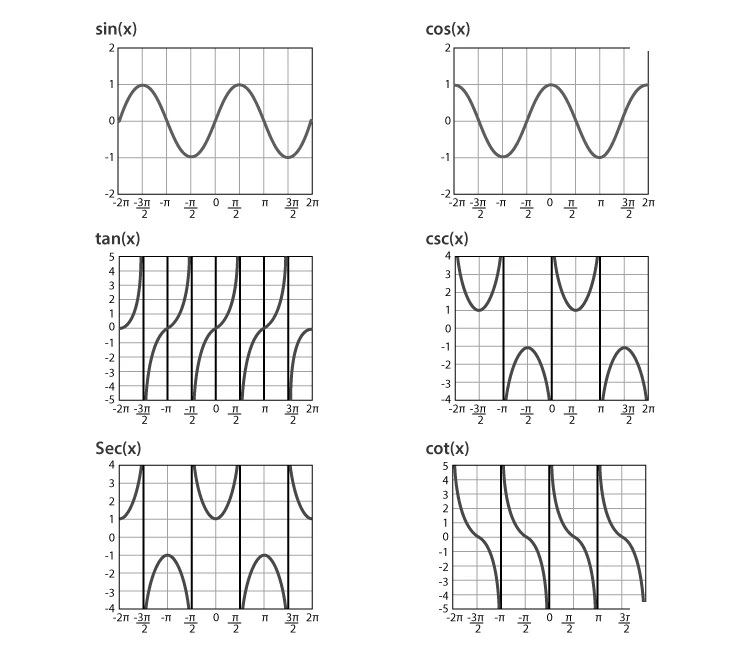
Graphs of sine, cosine, tangent, and their reciprocal functions illustrate how these ratios vary with angle. Each function has a specific domain and range, with periodic behavior:
- Sine and Cosine: Range between -1 and 1, period \( 2\pi \).
- Tangent and Cotangent: Range all real numbers, period \( \pi \).
- Secant and Cosecant: Range \( (-\infty, -1] \cup [1, \infty) \), period \( 2\pi \).
Stepwise Approach to Solving Trigonometric Problems
To solve trigonometric problems effectively:
- Identify the given angle and sides in the triangle.
- Choose the appropriate trigonometric ratio based on the sides involved.
- Apply relevant formulas or identities to find unknown values.
- Use reciprocal or sum/difference identities if needed.
- Verify answers with known values or graph behavior.
Example 1:
Find the values of \( \sin 30^\circ \), \( \cos 45^\circ \), and \( \tan 60^\circ \) using standard trigonometric values.
Solution:
\[ \sin 30^\circ = \frac{1}{2} \]
\[ \cos 45^\circ = \frac{\sqrt{2}}{2} \]
\[ \tan 60^\circ = \sqrt{3} \]
Example 2:
Calculate \( \sin 135^\circ \) using the sum formula.
Solution:
\[ \sin 135^\circ = \sin(90^\circ + 45^\circ) = \sin 90^\circ \cos 45^\circ + \cos 90^\circ \sin 45^\circ \]
Since \( \sin 90^\circ = 1 \) and \( \cos 90^\circ = 0 \),
\[ = 1 \times \frac{\sqrt{2}}{2} + 0 \times \frac{\sqrt{2}}{2} = \frac{\sqrt{2}}{2} \]
Example 3:
A person stands 15 meters from a tree and observes the top at an elevation angle of \( 25^\circ \). Calculate the height of the tree.
Solution:
Let the height be \( h \) meters. Using tangent,
\[ \tan 25^\circ = \frac{h}{15} \]
Using \( \tan 25^\circ \approx 0.466 \),
\[ h = 15 \times 0.466 = 6.99 \text{ meters} \]
The tree is approximately 7 meters tall.
Quick Reference: Trigonometric Ratios at Common Angles
| Angle (°) | \( \sin \theta \) | \( \cos \theta \) | \( \tan \theta \) | \( \csc \theta \) | \( \sec \theta \) | \( \cot \theta \) |
|---|---|---|---|---|---|---|
| 0 | 0 | 1 | 0 | — | 1 | — |
| 30 | \( \frac{1}{2} \) | \( \frac{\sqrt{3}}{2} \) | \( \frac{1}{\sqrt{3}} \) | 2 | \( \frac{2}{\sqrt{3}} \) | \( \sqrt{3} \) |
| 45 | \( \frac{\sqrt{2}}{2} \) | \( \frac{\sqrt{2}}{2} \) | 1 | \( \sqrt{2} \) | \( \sqrt{2} \) | 1 |
| 60 | \( \frac{\sqrt{3}}{2} \) | \( \frac{1}{2} \) | \( \sqrt{3} \) | \( \frac{2}{\sqrt{3}} \) | 2 | \( \frac{1}{\sqrt{3}} \) |
| 90 | 1 | 0 | — | 1 | — | 0 |
Glossary of Key Trigonometric Terms
| Term | Definition |
|---|---|
| Sine (sin) | Ratio of the opposite side to the hypotenuse in a right triangle. |
| Cosine (cos) | Ratio of the adjacent side to the hypotenuse in a right triangle. |
| Tangent (tan) | Ratio of the opposite side to the adjacent side in a right triangle. |
| Cosecant (csc) | Reciprocal of sine, \( \csc \theta = \frac{1}{\sin \theta} \). |
| Secant (sec) | Reciprocal of cosine, \( \sec \theta = \frac{1}{\cos \theta} \). |
| Cotangent (cot) | Reciprocal of tangent, \( \cot \theta = \frac{1}{\tan \theta} \). |
| Hypotenuse | The longest side of a right triangle, opposite the right angle. |
| Adjacent Side | The side next to the angle of interest in a triangle. |
| Opposite Side | The side opposite to the angle of interest in a triangle. |
| Periodicity | The property of a function to repeat its values at regular intervals. |
Frequently Asked Questions on Trigonometric Functions
What are the six fundamental trigonometric functions?
The six primary functions are sine, cosine, tangent, cosecant, secant, and cotangent, each relating angles to side ratios in a right triangle.
How are trigonometric functions applied in real life?
They are used in fields like engineering, physics, navigation, and architecture to calculate distances, angles, and periodic phenomena.
Which three trigonometric functions are considered basic?
Sine, cosine, and tangent are the basic functions from which the others are derived.
What is the Pythagorean identity in trigonometry?
The fundamental identity is \( \sin^2 x + \cos^2 x = 1 \), expressing the relationship between sine and cosine for any angle \( x \).
What are the ranges of sine, cosine, and tangent functions?
Sine and cosine values range between -1 and 1, while tangent can take any real value from negative to positive infinity.