Comprehensive Guide to Parabolas and Their Properties
Understanding the Nature and Definition of Parabolas
Fundamental Concept and Geometric Definition
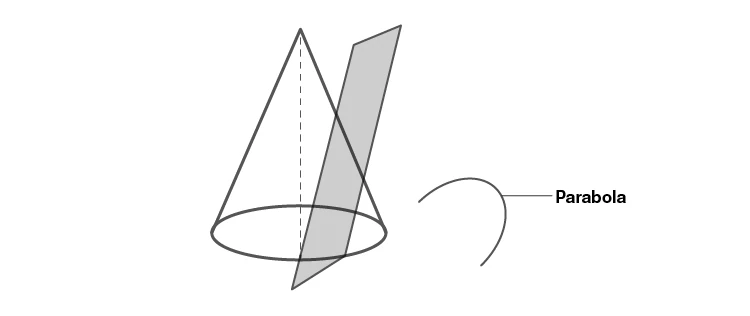
A parabola is a distinctive U-shaped curve formed as the set of all points equidistant from a fixed point called the focus and a fixed straight line known as the directrix. This curve emerges naturally as a conic section when a plane intersects a right circular cone parallel to one of its generators.
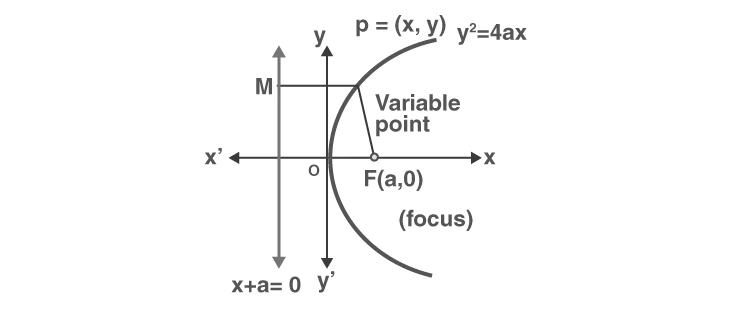
In essence, for any point \( P \) on the parabola, the distance to the focus \( F \) equals the perpendicular distance to the directrix line.
This property is mathematically expressed as:
\[ PF = PD \]
Example 1: Identifying Focus and Directrix
Given a parabola defined by the locus of points equidistant from the point \( (2, 3) \) and the line \( y = 1 \), determine the focus and directrix.
Solution:
- The fixed point \( (2, 3) \) is the focus.
- The fixed line \( y = 1 \) is the directrix.
- Any point \( P(x, y) \) on the parabola satisfies \( \sqrt{(x-2)^2 + (y-3)^2} = |y - 1| \).
Equations and Parametric Forms of Parabolas
Standard and General Equations
The standard form of a parabola depends on the orientation of its axis:
- For a parabola opening right or left (axis along x-axis), the equation is \( y^2 = 4ax \) or \( y^2 = -4ax \).
- For a parabola opening up or down (axis along y-axis), the equation is \( x^2 = 4ay \) or \( x^2 = -4ay \).
Here, \( a \) represents the distance from the vertex to the focus.
The general form of a parabola with vertex at \( (h, k) \) is:
\[ y = a(x - h)^2 + k \quad \text{or} \quad x = a(y - k)^2 + h \]
Parametric Representation
Parametric coordinates provide a convenient way to represent points on a parabola. For the parabola \( y^2 = 4ax \), the parametric form is:
\[ x = at^2, \quad y = 2at \]
Similarly, for \( x^2 = 4ay \), the parametric form is:
\[ x = 2at, \quad y = at^2 \]
Example 2: Parametric Coordinates Verification
Verify that the point \( (12, 8) \) lies on the parabola \( y^2 = 4ax \) with \( a = 4 \) using parametric equations.
Solution:
- From parametric form, \( x = at^2 = 4t^2 \), \( y = 2at = 8t \).
- Given \( y = 8 \), so \( 8 = 8t \Rightarrow t = 1 \).
- Then \( x = 4 \times 1^2 = 4 \), but given \( x = 12 \), so the point does not lie on the parabola with \( a=4 \).
- Hence, \( (12, 8) \) is not on the parabola \( y^2 = 16x \).
Key Properties: Tangents, Normals, and Focal Chords
Equations of Tangents and Normals
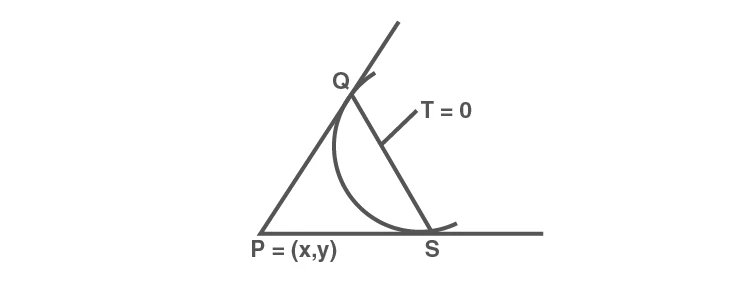
A tangent to a parabola touches it at exactly one point. For the parabola \( y^2 = 4ax \), the tangent at point \( (x_1, y_1) \) is given by:
\[ y y_1 = 2a (x + x_1) \]
In parametric form, the tangent at \( (at^2, 2at) \) is:
\[ t y = x + a t^2 \]
The slope form of the tangent with slope \( m \) is:
\[ y = m x + \frac{a}{m} \]
The normal is the line perpendicular to the tangent at the point of contact. For \( y^2 = 4ax \), the normal at \( (x_1, y_1) \) is:
\[ y - y_1 = -\frac{y_1}{2a} (x - x_1) \]
Parametric form of the normal at \( (at^2, 2at) \) is:
\[ y = -t x + 2 a t + a t^3 \]
Example 3: Tangent Equation from External Point
Find the equation of the tangent(s) to the parabola \( y^2 = 8x \) from the point \( (10, 6) \).
Solution:
- For parabola \( y^2 = 4ax \), here \( 4a = 8 \Rightarrow a = 2 \).
- Equation of tangents from \( (x_1, y_1) \) is given by \( S S_1 = T^2 \), where:
- \( S = y^2 - 4ax \), \( S_1 = y_1^2 - 4a x_1 = 6^2 - 8 \times 10 = 36 - 80 = -44 \).
- \( T = y y_1 - 2a (x + x_1) = y \times 6 - 4 (x + 10) = 6y - 4x - 40 \).
- Equation: \( (y^2 - 8x)(-44) = (6y - 4x - 40)^2 \).
- Expanding and simplifying yields the tangent equations.
Focal Chord Characteristics
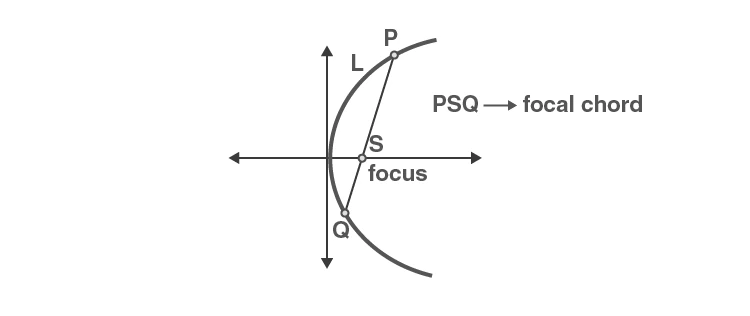
A focal chord is any chord passing through the focus of the parabola. For \( y^2 = 4ax \), if the chord joins points \( P = (a t_1^2, 2 a t_1) \) and \( Q = (a t_2^2, 2 a t_2) \), then:
- The product of parameters satisfies \( t_1 t_2 = -1 \).
- The length of the focal chord is \( a (t + \frac{1}{t})^2 \) if one endpoint corresponds to parameter \( t \).
- The semi-latus rectum is the harmonic mean of the segments of any focal chord.
Example 4: Length of a Focal Chord
Calculate the length of the focal chord of the parabola \( y^2 = 8x \) corresponding to parameter \( t = 2 \).
Solution:
- Here, \( a = 2 \) since \( 4a = 8 \).
- Length of focal chord is \( a \left(t + \frac{1}{t}\right)^2 = 2 \left(2 + \frac{1}{2}\right)^2 = 2 \times \left(\frac{5}{2}\right)^2 = 2 \times \frac{25}{4} = \frac{50}{4} = 12.5 \).
Analyzing Positions and Intersections Involving Parabolas
Determining Point Location Relative to a Parabola
For the parabola \( y^2 = 4ax \), the position of a point \( P(x_1, y_1) \) is determined by evaluating:
\[ S_1 = y_1^2 - 4a x_1 \]
- If \( S_1 > 0 \), \( P \) lies outside the parabola.
- If \( S_1 = 0 \), \( P \) lies on the parabola.
- If \( S_1 < 0 \), \( P \) lies inside the parabola.
Intersection of a Line with a Parabola
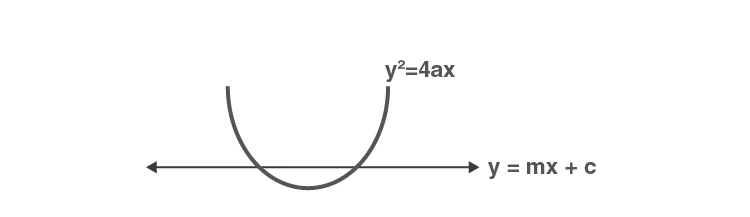
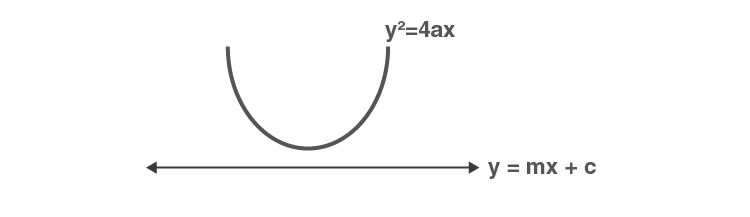
Consider the parabola \( y^2 = 4ax \) and a line \( y = mx + c \). Substituting into the parabola yields:
\[ (mx + c)^2 = 4ax \]
Rearranged as a quadratic in \( x \):
\[ m^2 x^2 + 2 m c x + c^2 - 4 a x = 0 \]
The discriminant \( D \) is:
\[ D = (2 m c - 4 a)^2 - 4 m^2 c^2 \]
- If \( D > 0 \), the line intersects the parabola at two distinct points.
- If \( D = 0 \), the line is tangent to the parabola.
- If \( D < 0 \), the line does not intersect the parabola.
Example 5: Tangency Condition
Find the value of \( c \) such that the line \( y = 2x + c \) is tangent to the parabola \( y^2 = 8x \).
Solution:
- Here, \( a = 2 \).
- Substitute \( y = 2x + c \) into \( y^2 = 8x \):
- For tangency, discriminant \( D = 0 \):
\[ (2x + c)^2 = 8x \Rightarrow 4x^2 + 4 c x + c^2 = 8x \]
Rearranged:
\[ 4x^2 + (4c - 8) x + c^2 = 0 \]
\[ (4c - 8)^2 - 16 c^2 = 0 \]
\[ 16 c^2 - 64 c + 64 - 16 c^2 = 0 \Rightarrow -64 c + 64 = 0 \]
\[ c = 1 \]
Illustrative Problems on Parabolas
Problem 1: Vertex and Directrix from General Equation
Given the parabola \( 2 y^2 + 3 y - 4 x - 3 = 0 \), find its vertex, axis, directrix, tangent at the vertex, and length of the latus rectum.
Solution:
Rewrite the equation:
\[ \left(y + \frac{3}{4}\right)^2 = 2 \left(x + \frac{33}{32}\right) \]
Comparing with \( Y^2 = 4 a X \), where \( Y = y + \frac{3}{4} \), \( X = x + \frac{33}{32} \), and \( 4a = 2 \), so \( a = \frac{1}{2} \).
- Vertex: \( \left(-\frac{33}{32}, -\frac{3}{4}\right) \).
- Axis: \( y = -\frac{3}{4} \).
- Directrix: \( x = -\frac{49}{32} \) (since directrix is \( X = -a \)).
- Tangent at vertex: \( x = -\frac{33}{32} \).
- Length of latus rectum: \( 4a = 2 \).
Problem 2: Equation of Parabola from Focus and Directrix
Find the equation of the parabola with focus at \( (3, -4) \) and directrix \( x - y + 5 = 0 \).
Solution:
For any point \( (x, y) \) on the parabola, distance to focus equals distance to directrix:
\[ \sqrt{(x - 3)^2 + (y + 4)^2} = \frac{|x - y + 5|}{\sqrt{1^2 + (-1)^2}} = \frac{|x - y + 5|}{\sqrt{2}} \]
Squaring both sides:
\[ (x - 3)^2 + (y + 4)^2 = \frac{(x - y + 5)^2}{2} \]
Expanding and simplifying leads to:
\[ x^2 + y^2 + 2xy - 22x + 26y + 25 = 0 \]
Or equivalently:
\[ (x + y)^2 = 22x - 26y - 25 \]
Problem 3: Intersection Angle of Two Parabolas
Find the angle \( \theta \) between the parabolas \( y^2 = 4x \) and \( x^2 = 32y \) at their intersection point \( (16, 8) \).
Solution:
Slope of tangent to \( y^2 = 4x \) at \( (16, 8) \):
\[ m_1 = \left.\frac{dy}{dx}\right|_{(16,8)} = \frac{2}{y} = \frac{2}{8} = \frac{1}{4} \]
Slope of tangent to \( x^2 = 32y \) at \( (16, 8) \):
\[ m_2 = \left.\frac{dy}{dx}\right|_{(16,8)} = \frac{2x}{32} = \frac{32}{32} = 1 \]
Angle between tangents:
\[ \tan \theta = \left|\frac{m_2 - m_1}{1 + m_1 m_2}\right| = \frac{1 - \frac{1}{4}}{1 + \frac{1}{4}} = \frac{\frac{3}{4}}{\frac{5}{4}} = \frac{3}{5} \]
\[ \theta = \tan^{-1} \left(\frac{3}{5}\right) \]
Summary Table: Essential Parabola Formulas and Properties
| Property | Formula / Description |
|---|---|
| Standard Equation (opens right) | \( y^2 = 4ax \) |
| Standard Equation (opens up) | \( x^2 = 4ay \) |
| Focus | \( (a, 0) \) for \( y^2=4ax \), \( (0, a) \) for \( x^2=4ay \) |
| Directrix | \( x = -a \) for \( y^2=4ax \), \( y = -a \) for \( x^2=4ay \) |
| Length of Latus Rectum | \( 4a \) |
| Parametric Coordinates | \( (at^2, 2at) \) for \( y^2=4ax \), \( (2at, at^2) \) for \( x^2=4ay \) |
| Tangent Equation (point form) | \( y y_1 = 2a (x + x_1) \) |
| Normal Equation (point form) | \( y - y_1 = -\frac{y_1}{2a} (x - x_1) \) |
| Focal Chord Condition | \( t_1 t_2 = -1 \) for points \( (a t_1^2, 2 a t_1) \) and \( (a t_2^2, 2 a t_2) \) |
| Position of Point \( P(x_1, y_1) \) | Evaluate \( S_1 = y_1^2 - 4a x_1 \): \( S_1 > 0 \) outside, \( S_1 = 0 \) on, \( S_1 < 0 \) inside parabola |
Glossary of Key Terms
| Term | Meaning |
|---|---|
| Parabola | A U-shaped curve defined as the locus of points equidistant from a focus and a directrix. |
| Focus | A fixed point used in the definition of a parabola. |
| Directrix | A fixed line used in the definition of a parabola. |
| Vertex | The point where the parabola changes direction; midpoint between focus and directrix. |
| Latus Rectum | A chord through the focus perpendicular to the axis of the parabola. |
| Parametric Coordinates | Coordinates expressed in terms of a parameter \( t \) that satisfy the parabola equation. |
| Tangent | A line that touches the parabola at exactly one point. |
| Normal | A line perpendicular to the tangent at the point of contact on the parabola. |
| Focal Chord | A chord passing through the focus of the parabola. |
| Eccentricity | A measure of the conic's deviation from circularity; for parabola, it is 1. |
Frequently Asked Questions
What is the eccentricity of a parabola?
The eccentricity of a parabola is always equal to 1, indicating its unique conic property.
How do you find the equation of the tangent to a parabola at a given point?
For \( y^2 = 4ax \), the tangent at \( (x_1, y_1) \) is \( y y_1 = 2a (x + x_1) \).
What is the length of the latus rectum of a parabola?
The length of the latus rectum is \( 4a \), where \( a \) is the distance from the vertex to the focus.
How can you determine if a point lies inside, on, or outside a parabola?
Calculate \( S_1 = y_1^2 - 4a x_1 \). If \( S_1 < 0 \), the point is inside; if \( S_1 = 0 \), on the parabola; if \( S_1 > 0 \), outside.
What are some practical applications of parabolas?
Parabolas are used in architectural arches and in designing parabolic reflectors for satellite dishes and telescopes.