Fundamentals and Formulas of Hyperbola
Understanding the Hyperbola and Its Equation
Introduction to Hyperbola and Its Geometric Features
A hyperbola is a type of conic section that resembles two mirrored curves opening away from each other, known as branches. It forms when a plane intersects both halves of a double right circular cone at an angle parallel to the cone's axis. Unlike a parabola, which has a single curve, a hyperbola consists of two distinct branches.
Key points defining a hyperbola include two foci and two vertices. The foci are fixed points located away from the center, and the vertices are the closest points on each branch to the center. These elements are essential in describing the hyperbola's shape and properties.
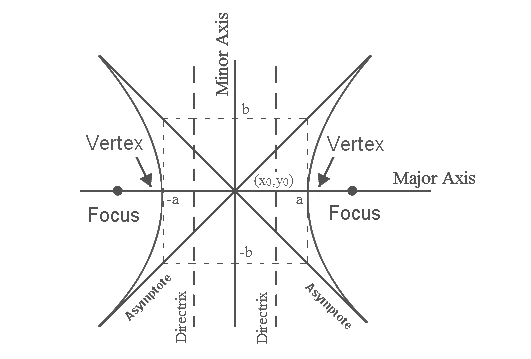
Illustration of a hyperbola showing center, foci, and vertices
The standard form of a hyperbola centered at \((x_0, y_0)\) with horizontal transverse axis is expressed as:
\[ \frac{(x - x_0)^2}{a^2} - \frac{(y - y_0)^2}{b^2} = 1 \]
Here, \(a\) represents the semi-major axis length, and \(b\) is the semi-minor axis length. The center \((x_0, y_0)\) is the midpoint between the vertices and foci.
Example: Consider a hyperbola centered at \((3, -1)\) with \(a = 5\) and \(b = 4\). Write its equation.
Solution: Substituting the values into the standard form:
\[ \frac{(x - 3)^2}{5^2} - \frac{(y + 1)^2}{4^2} = 1 \]
Or equivalently:
\[ \frac{(x - 3)^2}{25} - \frac{(y + 1)^2}{16} = 1 \]
Key Components and Characteristics of a Hyperbola
Axes and Their Equations
The major axis of a hyperbola is the line passing through its center, both foci, and vertices. Its length is twice the semi-major axis, i.e., \(2a\). For a hyperbola with a horizontal transverse axis, the major axis lies along the line:
\[ y = y_0 \]
The minor axis is perpendicular to the major axis and passes through the center. Its length is \(2b\), and its equation is:
\[ x = x_0 \]
Example: For a hyperbola centered at \((2, 3)\) with \(a = 6\) and \(b = 5\), find the equations of the major and minor axes.
Solution:
Major axis: \(y = 3\)
Minor axis: \(x = 2\)
Eccentricity and Its Significance
Eccentricity measures how much a conic section deviates from being a perfect circle. For hyperbolas, the eccentricity \(e\) is always greater than 1, indicating a more elongated shape. It is calculated by:
\[ e = \frac{\sqrt{a^2 + b^2}}{a} \]
For a standard hyperbola, eccentricity often approximates values like \(2\sqrt{2}\), but it varies depending on \(a\) and \(b\).
Example: Calculate the eccentricity of a hyperbola with \(a = 4\) and \(b = 3\).
Solution:
\[ e = \frac{\sqrt{4^2 + 3^2}}{4} = \frac{\sqrt{16 + 9}}{4} = \frac{\sqrt{25}}{4} = \frac{5}{4} = 1.25 \]
Asymptotes and Their Equations
Asymptotes are straight lines that the hyperbola approaches but never touches. They intersect at the hyperbola's center and guide the shape of the branches. The equations of the asymptotes for a hyperbola centered at \((x_0, y_0)\) are:
\[ y = y_0 + \frac{b}{a}(x - x_0) \]
\[ y = y_0 - \frac{b}{a}(x - x_0) \]
Example: Find the asymptotes of a hyperbola centered at \((1, 2)\) with \(a = 3\) and \(b = 4\).
Solution:
\[ y = 2 + \frac{4}{3}(x - 1) \]
\[ y = 2 - \frac{4}{3}(x - 1) \]
Vertices, Foci, and Directrix of a Hyperbola
Locating the Vertices
The vertices are the points on each branch closest to the center, marking the ends of the transverse axis. For a hyperbola centered at \((x_0, y_0)\), the vertices are located at:
\[ (x_0 + a, y_0) \quad \text{and} \quad (x_0 - a, y_0) \]
Example: Determine the vertices of a hyperbola centered at \((5, -2)\) with \(a = 7\).
Solution:
\[ (5 + 7, -2) = (12, -2) \quad \text{and} \quad (5 - 7, -2) = (-2, -2) \]
Identifying the Foci
The foci are fixed points that define the hyperbola such that the difference of distances from any point on the curve to the foci is constant. Their coordinates are:
\[ \left(x_0 + \sqrt{a^2 + b^2}, y_0\right) \quad \text{and} \quad \left(x_0 - \sqrt{a^2 + b^2}, y_0\right) \]
Example: Find the foci of a hyperbola centered at \((0, 0)\) with \(a = 5\) and \(b = 12\).
Solution:
\[ \sqrt{5^2 + 12^2} = \sqrt{25 + 144} = \sqrt{169} = 13 \]
Thus, the foci are at:
\[ (0 + 13, 0) = (13, 0) \quad \text{and} \quad (0 - 13, 0) = (-13, 0) \]
Directrix and Its Role
The directrix is a fixed line used in the geometric definition of a hyperbola. It is perpendicular to the axis of symmetry and lies at a distance related to \(a\) and \(b\) from the center. The directrix equations are:
\[ x = \pm \frac{a^2}{\sqrt{a^2 + b^2}} \]
Example: Calculate the directrix lines for a hyperbola with \(a = 6\) and \(b = 8\).
Solution:
\[ \sqrt{6^2 + 8^2} = \sqrt{36 + 64} = \sqrt{100} = 10 \]
\[ x = \pm \frac{6^2}{10} = \pm \frac{36}{10} = \pm 3.6 \]
Application: Analyzing a Specific Hyperbola Equation
Step-by-Step Problem Solving
Consider the hyperbola defined by the equation:
\[ \frac{(x - 5)^2}{8^2} - \frac{(y - 3)^2}{6^2} = 1 \]
Determine the vertices, asymptotes, major and minor axes, and directrix lines.
Solution:
Given:
Center: \((x_0, y_0) = (5, 3)\)
Semi-major axis: \(a = 8\)
Semi-minor axis: \(b = 6\)
Vertices:
\[ (5 + 8, 3) = (13, 3) \quad \text{and} \quad (5 - 8, 3) = (-3, 3) \]
Asymptotes:
\[ y = 3 + \frac{6}{8}(x - 5) = 3 + \frac{3}{4}(x - 5) \]
\[ y = 3 - \frac{3}{4}(x - 5) \]
Major Axis: Length is \(2a = 16\), equation:
\[ y = 3 \]
Minor Axis: Length is \(2b = 12\), equation:
\[ x = 5 \]
Directrix:
Calculate \(\sqrt{a^2 + b^2}\):
\[ \sqrt{8^2 + 6^2} = \sqrt{64 + 36} = \sqrt{100} = 10 \]
Directrix lines are:
\[ x = \pm \frac{8^2}{10} = \pm \frac{64}{10} = \pm 6.4 \]
Summary of Hyperbola Properties
Property | Definition | Formula / Equation |
|---|---|---|
Standard Equation | Defines hyperbola centered at \((x_0, y_0)\) | \(\displaystyle \frac{(x - x_0)^2}{a^2} - \frac{(y - y_0)^2}{b^2} = 1\) |
Major Axis | Line through center, foci, vertices | \(y = y_0\), length \(2a\) |
Minor Axis | Perpendicular to major axis through center | \(x = x_0\), length \(2b\) |
Eccentricity | Measures deviation from circle | \(\displaystyle e = \frac{\sqrt{a^2 + b^2}}{a}\) |
Asymptotes | Lines hyperbola approaches but never touches | \(\displaystyle y = y_0 \pm \frac{b}{a}(x - x_0)\) |
Vertices | Closest points on branches to center | \((x_0 \pm a, y_0)\) |
Foci | Fixed points defining hyperbola | \(\left(x_0 \pm \sqrt{a^2 + b^2}, y_0\right)\) |
Directrix | Line used in hyperbola construction | \(\displaystyle x = \pm \frac{a^2}{\sqrt{a^2 + b^2}}\) |
Glossary of Key Terms
Term | Meaning |
|---|---|
Hyperbola | A conic section with two branches formed by intersecting a plane with a double cone |
Foci (Focus) | Two fixed points used to define a hyperbola |
Vertices | Points on the hyperbola closest to the center on each branch |
Center | Midpoint between the vertices and foci of the hyperbola |
Semi-major Axis (a) | Half the length of the major axis |
Semi-minor Axis (b) | Half the length of the minor axis |
Major Axis | Line passing through center, foci, and vertices |
Minor Axis | Line perpendicular to major axis through the center |
Eccentricity (e) | Ratio indicating how stretched the hyperbola is; always greater than 1 |
Asymptotes | Lines that the hyperbola approaches but never intersects |
Directrix | Fixed line used in the geometric definition of the hyperbola |
Frequently Asked Questions
What distinguishes a hyperbola from a parabola?
A hyperbola consists of two separate branches formed by intersecting a plane with both halves of a double cone, while a parabola has a single curve formed by a plane parallel to the cone's side.
How do you find the vertices of a hyperbola?
Vertices are located at a distance \(a\) from the center along the major axis, at points \((x_0 \pm a, y_0)\) for a horizontal hyperbola.
What is the significance of eccentricity in a hyperbola?
Eccentricity measures how elongated the hyperbola is; for hyperbolas, it is always greater than 1, indicating deviation from a circle.
How are the asymptotes of a hyperbola determined?
Asymptotes are straight lines passing through the center with slopes \(\pm \frac{b}{a}\), given by \(y = y_0 \pm \frac{b}{a}(x - x_0)\).
What role does the directrix play in a hyperbola?
The directrix is a fixed line perpendicular to the axis of symmetry, used in the geometric definition of the hyperbola and helps in locating points on the curve.