Comprehensive Guide to Ellipses: Properties, Equations, and Applications
Fundamentals of Ellipses and Their Defining Characteristics
Understanding the Ellipse as a Geometric Locus
An ellipse is defined as the set of all points on a plane where the combined distance from two fixed points, called foci, remains constant. These foci are enclosed within the curve of the ellipse. The fixed reference line associated with an ellipse is known as the directrix, and the ratio of the distance from any point on the ellipse to a focus, compared to its distance to the directrix, is called the eccentricity, denoted by \( e \).
Eccentricity quantifies how stretched or elongated the ellipse is, with values ranging between 0 and 1. A value of 0 corresponds to a perfect circle, while values closer to 1 indicate a more elongated shape.
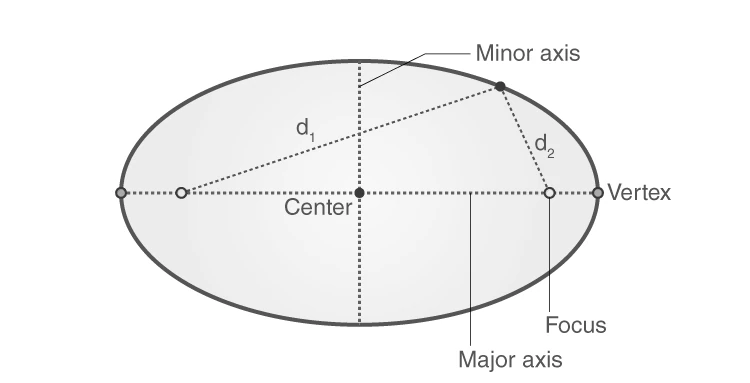
Diagram showing the ellipse with its foci and directrix
The ellipse resembles an oval and is characterized by two principal axes: the major axis and the minor axis. The area enclosed by the ellipse depends on the lengths of these axes, specifically the semi-major axis \( a \) and the semi-minor axis \( b \). The formula for the area is:
\[ \text{Area} = \pi a b \]
Unlike other conic sections such as parabolas and hyperbolas, which are open and unbounded, the ellipse is a closed and bounded curve.
Example: Consider an ellipse with foci located at points \( F_1 \) and \( F_2 \). If the sum of distances from any point \( P \) on the ellipse to these foci is 20 units, and the distance between the foci is 12 units, determine the length of the major axis.
Solution: The sum of distances from any point on the ellipse to the foci is equal to the length of the major axis, which is \( 2a \). Given:
\[ 2a = 20 \implies a = 10 \text{ units} \] The distance between the foci is \( 2c = 12 \implies c = 6 \) units.
Therefore, the major axis length is:
\[ 2a = 20 \text{ units} \] This confirms the major axis length is 20 units.
Axes and Key Properties of Ellipses
Exploring the Major and Minor Axes
An ellipse is defined by two perpendicular diameters: the major axis and the minor axis. The major axis is the longest diameter passing through the center and both foci, while the minor axis is the shortest diameter perpendicular to the major axis at the center.
The semi-major axis, denoted by \( a \), is half the length of the major axis, and the semi-minor axis, denoted by \( b \), is half the length of the minor axis.
Key properties of ellipses include:
Two fixed points called foci (singular: focus).
A directrix line associated with each focus.
Eccentricity \( e \) lies between 0 and 1, where \( 0 \leq e < 1 \).
The sum of distances from any point on the ellipse to the two foci is constant.
The ellipse has a unique center, one major axis, and one minor axis.
Calculating Eccentricity and Its Significance
The eccentricity \( e \) of an ellipse is the ratio of the distance from the center to a focus \( c \) over the semi-major axis \( a \):
\[ e = \frac{c}{a} \]
Since \( c \leq a \), the eccentricity is always less than 1. Using the relationship between \( a \), \( b \), and \( c \):
\[ c^2 = a^2 - b^2 \]
we can express eccentricity as:
\[ e = \sqrt{1 - \frac{b^2}{a^2}} \]
Example: An ellipse has a semi-major axis of 9 cm and a semi-minor axis of 6 cm. Calculate its eccentricity.
Solution: Given \( a = 9 \text{ cm} \), \( b = 6 \text{ cm} \),
\[ e = \sqrt{1 - \frac{b^2}{a^2}} = \sqrt{1 - \frac{6^2}{9^2}} = \sqrt{1 - \frac{36}{81}} = \sqrt{\frac{45}{81}} = \sqrt{\frac{5}{9}} = \frac{\sqrt{5}}{3} \approx 0.745 \] Thus, the eccentricity is approximately 0.745.
Deriving and Applying the Standard Equation of an Ellipse
Formulating the Ellipse Equation with Center at Origin
When the ellipse is centered at the origin \((0,0)\) and its foci lie along the x-axis, the standard equation is derived from the definition that the sum of distances from any point \( P(x,y) \) on the ellipse to the foci \( F_1(-c,0) \) and \( F_2(c,0) \) is constant and equal to \( 2a \):
\[ PF_1 + PF_2 = 2a \]
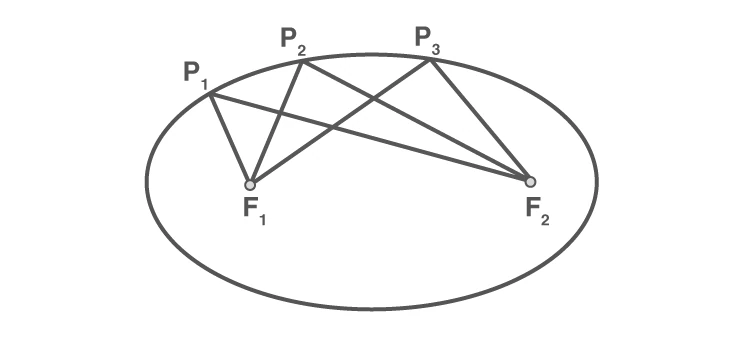
Ellipse illustrating points and foci
Using the distance formula, the distances are:
\[ PF_1 = \sqrt{(x + c)^2 + y^2}, \quad PF_2 = \sqrt{(x - c)^2 + y^2} \]
Squaring and simplifying leads to the standard form:
\[ \frac{x^2}{a^2} + \frac{y^2}{b^2} = 1 \]
where \( b^2 = a^2 - c^2 \), and the domain for \( x \) is \( -a \leq x \leq a \).
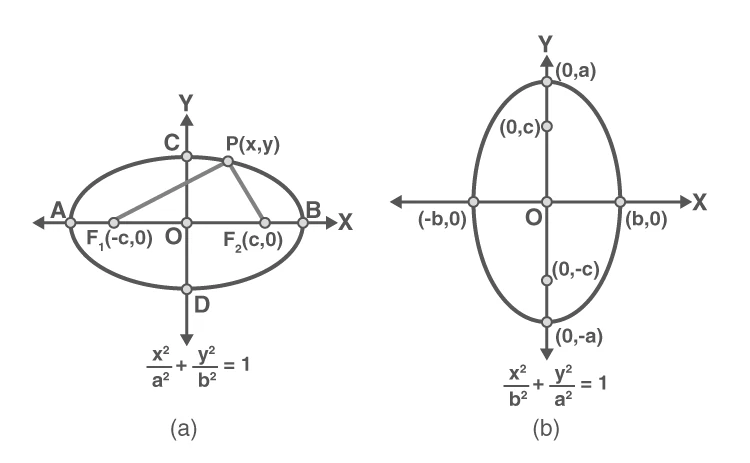
Ellipse centered at origin with foci on x-axis
Equation for Ellipse with Major Axis Along Y-Axis
If the major axis lies along the y-axis, the equation modifies to:
\[ \frac{x^2}{b^2} + \frac{y^2}{a^2} = 1 \]
with \( -b \leq x \leq b \) and \( a > b \).
Example: Derive the equation of an ellipse centered at the origin with foci at \( (0, \pm 5) \) and a major axis length of 12 units.
Solution: The major axis length is \( 2a = 12 \implies a = 6 \). The foci are at \( (0, \pm c) \) with \( c = 5 \).
Using \( c^2 = a^2 - b^2 \), we find:
\[ b^2 = a^2 - c^2 = 6^2 - 5^2 = 36 - 25 = 11 \] The equation of the ellipse is:
\[ \frac{x^2}{11} + \frac{y^2}{36} = 1 \]
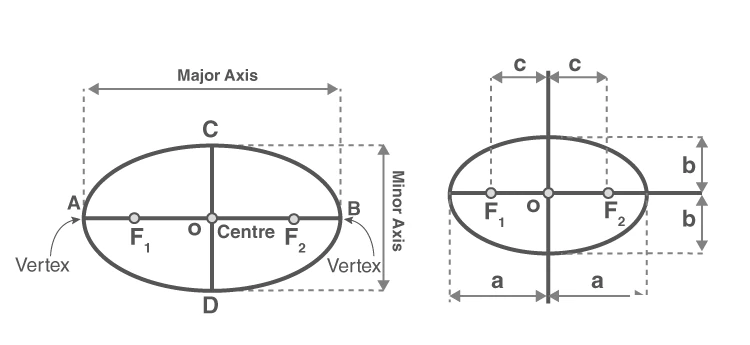
Ellipse showing vertices, foci, and axes
Formulas for Area, Perimeter, and Latus Rectum of an Ellipse
Calculating the Area of an Ellipse
The area enclosed by an ellipse depends on its semi-major axis \( a \) and semi-minor axis \( b \). Unlike a circle, which uses radius squared, the ellipse area formula is:
\[ \text{Area} = \pi a b \]
Example: Find the area of an ellipse with semi-major axis 8 cm and semi-minor axis 3 cm.
Solution: Using the formula:
\[ \text{Area} = \pi \times 8 \times 3 = 24\pi \approx 75.4 \text{ cm}^2 \]
Approximating the Perimeter of an Ellipse
Unlike circles, the perimeter (circumference) of an ellipse does not have a simple exact formula. An approximation is given by:
\[ p \approx 2 \pi \sqrt{\frac{a^2 + b^2}{2}} \]
where \( a \) and \( b \) are the semi-major and semi-minor axes respectively.
Understanding the Latus Rectum of an Ellipse
The latus rectum is a line segment perpendicular to the major axis passing through a focus, with endpoints on the ellipse. Its length is given by:
\[ L = \frac{2b^2}{a} \]
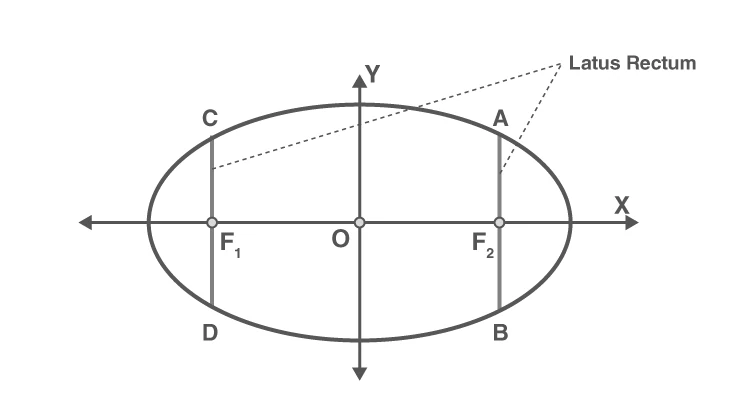
Illustration of latus rectum in an ellipse
Summary of Key Ellipse Concepts and Formulas
Concept | Formula / Description |
|---|---|
Ellipse Definition | Set of points where sum of distances to two foci is constant |
Major Axis Length | \( 2a \) |
Minor Axis Length | \( 2b \) |
Eccentricity | \( e = \frac{c}{a} = \sqrt{1 - \frac{b^2}{a^2}} \), \( 0 \leq e < 1 \) |
Relationship between axes and foci | \( c^2 = a^2 - b^2 \) |
Standard Equation (major axis on x-axis) | \( \frac{x^2}{a^2} + \frac{y^2}{b^2} = 1 \) |
Standard Equation (major axis on y-axis) | \( \frac{x^2}{b^2} + \frac{y^2}{a^2} = 1 \) |
Area | \( \pi a b \) |
Perimeter (approx.) | \( 2 \pi \sqrt{\frac{a^2 + b^2}{2}} \) |
Latus Rectum Length | \( \frac{2b^2}{a} \) |
Glossary of Important Terms Related to Ellipses
Term | Definition |
|---|---|
Ellipse | A closed curve where the sum of distances from two fixed points (foci) is constant |
Foci (Focus) | Two fixed points inside the ellipse used to define it |
Major Axis | The longest diameter passing through the center and foci |
Minor Axis | The shortest diameter perpendicular to the major axis at the center |
Semi-Major Axis | Half the length of the major axis, denoted by \( a \) |
Semi-Minor Axis | Half the length of the minor axis, denoted by \( b \) |
Eccentricity | Ratio \( e = \frac{c}{a} \) indicating ellipse elongation |
Directrix | A fixed line used in the geometric definition of the ellipse |
Latus Rectum | Line segment perpendicular to major axis through a focus with endpoints on ellipse |
Center | Midpoint of the line segment joining the foci |
Frequently Asked Questions on Ellipses
What defines an ellipse in geometry?
An ellipse is the set of all points in a plane where the sum of distances to two fixed points (foci) is constant.
How are the major and minor axes of an ellipse characterized?
The major axis is the longest diameter passing through the center and foci, while the minor axis is the shortest diameter perpendicular to the major axis at the center.
What is the significance of eccentricity in an ellipse?
Eccentricity measures how much the ellipse deviates from being circular, with values between 0 (circle) and 1 (highly elongated ellipse).
How do you calculate the area of an ellipse?
The area is calculated using the formula \( \pi a b \), where \( a \) and \( b \) are the semi-major and semi-minor axes respectively.
What is the standard equation of an ellipse centered at the origin?
For an ellipse with major axis along the x-axis, the equation is \( \frac{x^2}{a^2} + \frac{y^2}{b^2} = 1 \). If the major axis is along the y-axis, it is \( \frac{x^2}{b^2} + \frac{y^2}{a^2} = 1 \).