Calculating Distances Between Lines and Points in Coordinate Geometry
Determining the Perpendicular Distance from a Point to a Line
Understanding the Concept and Deriving the Formula
In coordinate geometry, the shortest distance from a point to a line is the length of the perpendicular segment drawn from the point to the line. Consider a line represented by the general equation \( Ax + By + C = 0 \) and a point \( P(x_1, y_1) \) not lying on the line. The perpendicular distance \( d \) from the point to the line is the length of the segment \( PM \), where \( M \) is the foot of the perpendicular from \( P \) to the line.
To derive the formula for this distance, we use the area of triangle \( PQR \), where \( Q \) and \( R \) are the intercepts of the line on the x-axis and y-axis respectively. The coordinates of these points are \( Q\left(-\frac{C}{A}, 0\right) \) and \( R\left(0, -\frac{C}{B}\right) \).
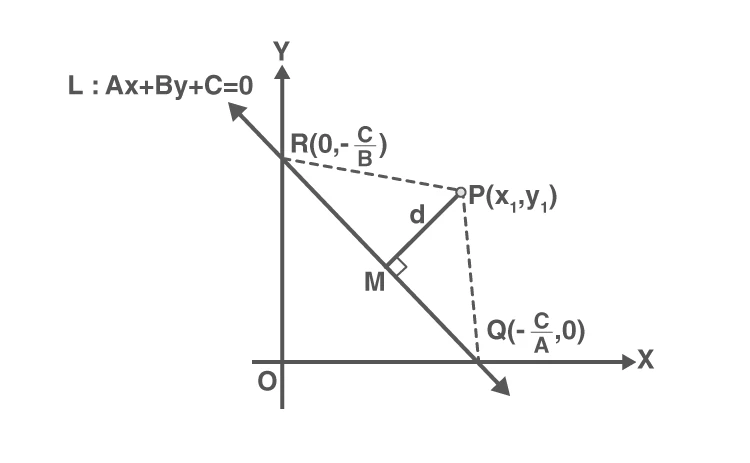
The area of triangle \( PQR \) can be expressed as:
\[ \text{Area} = \frac{1}{2} \times \text{Base} \times \text{Height} = \frac{1}{2} \times PM \times QR \]
Rearranging for \( PM \), the perpendicular distance:
\[ PM = \frac{2 \times \text{Area of } \triangle PQR}{QR} \]
The area of a triangle with vertices \( (x_1, y_1), (x_2, y_2), (x_3, y_3) \) is given by:
\[ \Delta = \frac{1}{2} \left| x_1(y_2 - y_3) + x_2(y_3 - y_1) + x_3(y_1 - y_2) \right| \]
Substituting \( P(x_1, y_1), Q\left(-\frac{C}{A}, 0\right), R\left(0, -\frac{C}{B}\right) \) into the formula, we get:
\[ \text{Area} = \frac{1}{2} \left| x_1 \left(0 + \frac{C}{B}\right) + \left(-\frac{C}{A}\right) \left(-\frac{C}{B} - y_1\right) + 0 \times (y_1 - 0) \right| \]
Simplifying:
\[ \text{Area} = \frac{1}{2} \left| \frac{C}{B} x_1 + \frac{C^2}{AB} + \frac{C}{A} y_1 \right| \]
Multiplying both sides by 2:
\[ 2 \times \text{Area} = \left| \frac{C}{AB} \right| \times \left| A x_1 + B y_1 + C \right| \]
The length \( QR \) is calculated using the distance formula:
\[ QR = \sqrt{\left(0 + \frac{C}{A}\right)^2 + \left(\frac{C}{B} - 0\right)^2} = \left| \frac{C}{AB} \right| \sqrt{A^2 + B^2} \]
Substituting these into the expression for \( PM \):
\[ PM = \frac{\left| \frac{C}{AB} \right| \times \left| A x_1 + B y_1 + C \right|}{\left| \frac{C}{AB} \right| \sqrt{A^2 + B^2}} = \frac{\left| A x_1 + B y_1 + C \right|}{\sqrt{A^2 + B^2}} \]
Thus, the perpendicular distance from the point \( (x_1, y_1) \) to the line \( Ax + By + C = 0 \) is:
\[ d = \frac{\left| A x_1 + B y_1 + C \right|}{\sqrt{A^2 + B^2}} \]
Example 1: Calculating Distance from a Point to a Line
Find the perpendicular distance from the point \( (4, -2) \) to the line \( 2x - 3y + 6 = 0 \).
Solution:
Given: \( A = 2, B = -3, C = 6, x_1 = 4, y_1 = -2 \).
Using the distance formula:
\[ d = \frac{|2 \times 4 + (-3) \times (-2) + 6|}{\sqrt{2^2 + (-3)^2}} = \frac{|8 + 6 + 6|}{\sqrt{4 + 9}} = \frac{20}{\sqrt{13}} \]
Therefore, the distance is \( \frac{20}{\sqrt{13}} \approx 5.55 \text{ units} \).
Measuring the Distance Between Two Parallel Lines
Formula Derivation and Application
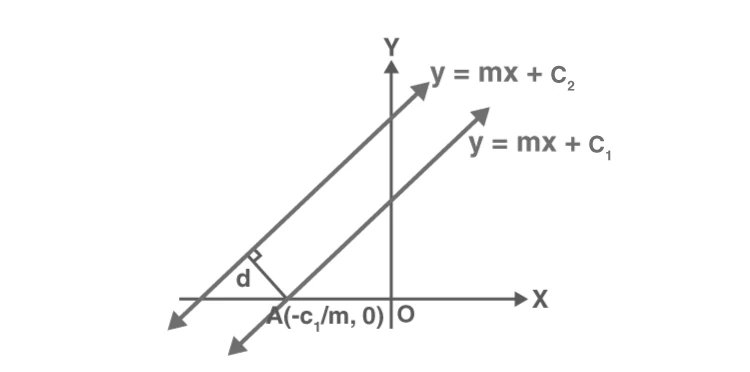
Two lines are parallel if they have the same slope. The equations of two parallel lines can be expressed as:
\[ y = m x + c_1 \quad \text{and} \quad y = m x + c_2 \]
The shortest distance between these lines is the length of the perpendicular segment connecting them. This distance can be found by calculating the perpendicular distance from any point on one line to the other line.
Using the point-to-line distance formula, the distance \( d \) between the two lines is:
\[ d = \frac{|c_1 - c_2|}{\sqrt{1 + m^2}} \]
Alternatively, if the lines are given in the general form:
\[ L_1: A x + B y + C_1 = 0 \quad \text{and} \quad L_2: A x + B y + C_2 = 0 \]
then the distance between them is:
\[ d = \frac{|C_1 - C_2|}{\sqrt{A^2 + B^2}} \]
Example 2: Finding Distance Between Parallel Lines
Calculate the distance between the lines \( 4x - 3y + 7 = 0 \) and \( 4x - 3y - 5 = 0 \).
Solution:
Here, \( A = 4, B = -3, C_1 = 7, C_2 = -5 \).
Using the formula:
\[ d = \frac{|7 - (-5)|}{\sqrt{4^2 + (-3)^2}} = \frac{12}{\sqrt{16 + 9}} = \frac{12}{5} = 2.4 \text{ units} \]
Hence, the distance between the two lines is 2.4 units.
Shortest Distance Between Two Parallel Lines
Conceptual Understanding and Practical Computation
The shortest distance between two parallel lines is always the length of the perpendicular segment connecting them. This distance remains constant regardless of which points on the lines are chosen, as long as the segment is perpendicular to both lines.
Using the general form of the lines:
\[ L_1: A x + B y + C_1 = 0, \quad L_2: A x + B y + C_2 = 0 \]
The shortest distance \( d \) is given by:
\[ d = \frac{|C_1 - C_2|}{\sqrt{A^2 + B^2}} \]
Example 3: Determining a Parameter Using Distance Between Lines
The distance between the parallel lines \( 7x + 24y + 3 = 0 \) and \( 7x + 24y + k = 0 \) is \( \frac{7}{25} \) units. Find the value of \( k \).
Solution:
Given: \( A = 7, B = 24, C_1 = 3, d = \frac{7}{25} \).
Using the distance formula:
\[ \frac{7}{25} = \frac{|3 - k|}{\sqrt{7^2 + 24^2}} = \frac{|3 - k|}{25} \]
Multiplying both sides by 25:
\[ 7 = |3 - k| \]
So, \( 3 - k = \pm 7 \).
Case 1: \( 3 - k = 7 \Rightarrow k = -4 \)
Case 2: \( 3 - k = -7 \Rightarrow k = 10 \)
Therefore, \( k \) can be either \(-4\) or \(10\).
Quick Reference: Key Formulas for Distances in Coordinate Geometry
| Concept | Formula | Explanation |
|---|---|---|
| Distance from Point \( (x_1, y_1) \) to Line \( Ax + By + C = 0 \) | \( d = \frac{|A x_1 + B y_1 + C|}{\sqrt{A^2 + B^2}} \) | Length of perpendicular from point to line |
| Distance Between Parallel Lines \( y = m x + c_1 \) and \( y = m x + c_2 \) | \( d = \frac{|c_1 - c_2|}{\sqrt{1 + m^2}} \) | Shortest distance between two lines with same slope |
| Distance Between Parallel Lines \( L_1: A x + B y + C_1 = 0 \) and \( L_2: A x + B y + C_2 = 0 \) | \( d = \frac{|C_1 - C_2|}{\sqrt{A^2 + B^2}} \) | Perpendicular distance between two lines in general form |
Glossary of Important Terms
| Term | Definition |
|---|---|
| Perpendicular Distance | The shortest distance from a point to a line, measured along a perpendicular segment. |
| Parallel Lines | Two lines in the same plane that never intersect and have equal slopes. |
| Slope | The measure of the steepness of a line, calculated as the ratio of vertical change to horizontal change. |
| Intercept | The point where a line crosses the x-axis or y-axis. |
| General Form of Line | An equation of a line expressed as \( Ax + By + C = 0 \). |
| Distance Formula | A formula to calculate the distance between two points in coordinate geometry. |
| Triangle Area Formula | Formula to find the area of a triangle using coordinates of its vertices. |
| Foot of Perpendicular | The point on a line where a perpendicular from another point meets the line. |
| Coordinate Geometry | A branch of geometry using coordinates and algebraic equations to study geometric figures. |
| Perpendicular Segment | A line segment that forms a right angle with another line. |
Frequently Asked Questions
How do you find the distance from a point to a line?
Use the formula \( d = \frac{|A x_1 + B y_1 + C|}{\sqrt{A^2 + B^2}} \) where \( (x_1, y_1) \) is the point and \( Ax + By + C = 0 \) is the line.
What condition must two lines satisfy to be parallel?
Two lines are parallel if their slopes are equal, meaning they never intersect.
Can the distance between two parallel lines be zero?
No, if the distance is zero, the lines coincide and are not distinct parallel lines.
Is the perpendicular distance between two parallel lines always the same?
Yes, the shortest distance between two parallel lines is constant everywhere along the lines.
How to find the distance between two lines given in slope-intercept form?
Use the formula \( d = \frac{|c_1 - c_2|}{\sqrt{1 + m^2}} \) where \( m \) is the common slope and \( c_1, c_2 \) are the y-intercepts.